
Recent Reviews
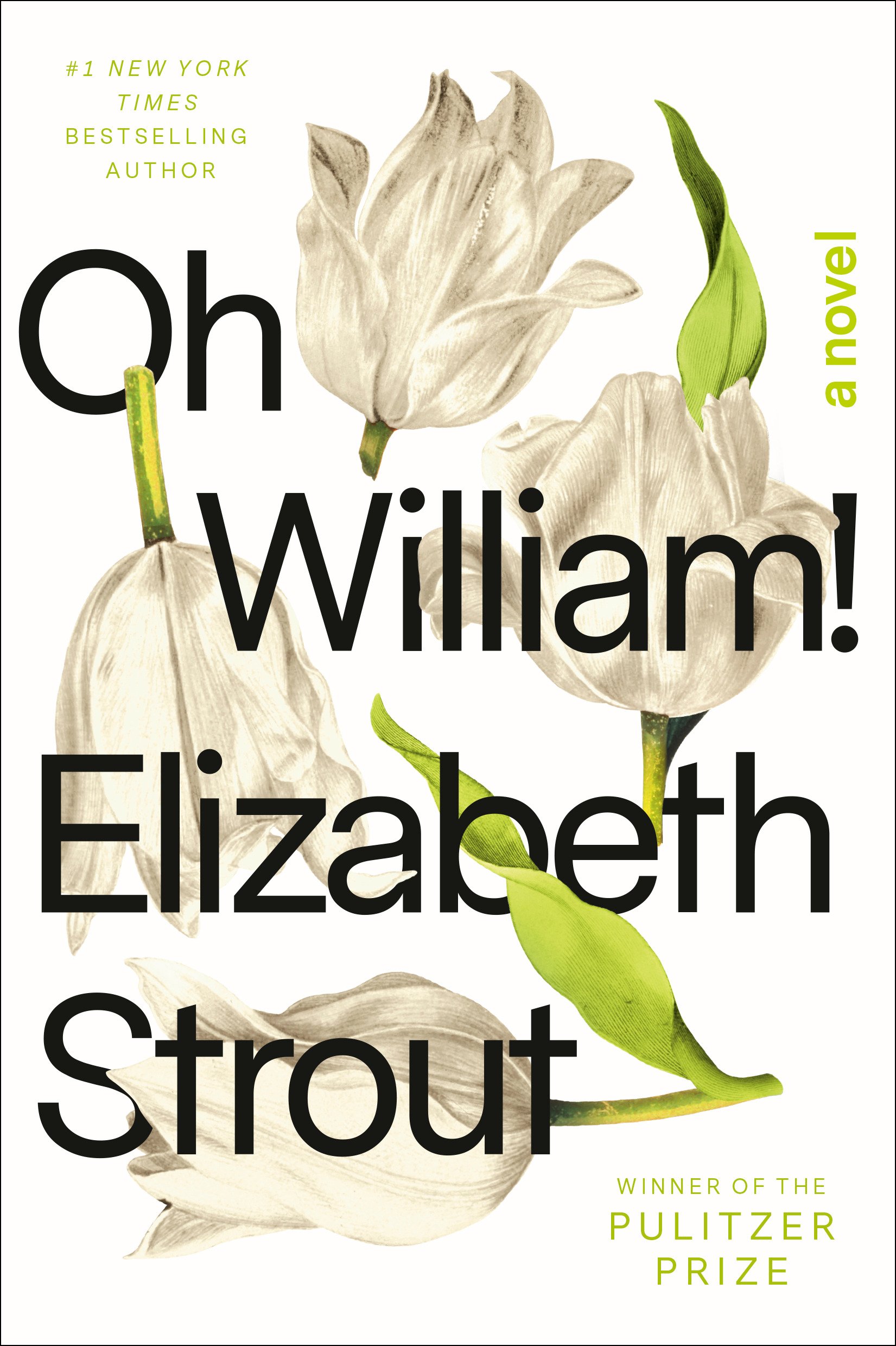
Oh William! by Elizabeth Strout
Elizabeth Strout is one of my favorite authors. No doubt, this Pulitzer Prize winner is a talented writer. But what I admire most is her persistent probing into the human psyche. What does it mean to be a person? Can we know ourselves? Can we really know the people we love? Strout’s books quietly invite readers to reflect on the nuances of family relationships. If you haven't read ‘Olive Kittredge’ and ‘The Burgess Boys’, I highly recommend them.
With “Oh William!” Strout explores the dynamics of a marriage. She revisits Lucy Barton, the protagonist of her last two novels. Lucy’s beloved second husband, David, has died, and Lucy has been pondering her life while grieving. Her ex-husband William, the father of her grown daughters, asks Lucy to join him on a road trip to Maine. His second wife has left him, and he wants to investigate a recently uncovered family secret. Romance is not the motivation; William needs Lucy’s company. Throughout their short adventure, Lucy thinks more specifically about her relationship with William and her initial attraction to him. With the passing of time and the help of a therapist, she is aware of just how little she knew about herself and William. Though her marriage lasted twenty years, she thinks, “William had always been a mystery to me. I am only saying: I wondered who William was.” Of course, she knew intimately William’s likes, dislikes, preferences and needs. But Lucy is wondering about something more profound, more complicated about their relationship.
Though Lucy is a successful 63-year-old writer living in New York City, she is still naïve and trapped within her youthful feelings of invisibility. Her voice is passive and distant. She has not psychologically moved beyond her impoverished childhood filled with neglect and disregard. Grateful for her writing career and kindhearted daughters, Lucy still doesn’t believe she deserves happiness. She tolerated William’s bad behavior in their marriage while making poor judgments herself. She reflects, “Who ever really knows the experience of another?”
Driving with William for hours in a car creates an opportunity for Lucy to understand more. Lucy and William query each other about different moments in their marriage and share their perspectives. The discovery of William’s family secret enriches their conversation.
When they return to their separate lives in New York City, Lucy comprehends a bit more about herself and her life with William. Without angst, she states on the final page, “Everybody in this whole wide world, we do not know anybody, not even ourselves! Except a little tiny, tiny bit we do. But we are all mythologies, mysterious. We are all mysteries.”
This short novel is packed with thought-provoking insights about marriage and the complexities of human relationships. Another gem by Elizabeth Strout. 4/5

Olive, Again by Elizabeth Strout
Elizabeth Strout is a wise and talented writer. This truth is reinforced in Olive, Again, her seventh novel. In these thirteen interconnected stories, Strout reveals a keen insight into the human condition. These stories are a meditation about people who are unclear about who they are and why they made the choices they did.
This book is a sequel to Strout’s 2008 Pulitzer-Prize winning novel Olive Kittredge. In that novel, Olive was stubborn, bossy and not the least bit reflective. Like a kaleidoscope, the book showed readers Olive’s many selves. We saw Olive’s shifting emotions and actions in her role as mother, wife, teacher and neighbor. And though we didn’t always like what we saw, Strout highlighted the many selves that dwell in a person. Twenty years later, Olive is still cantankerous, opinionated, and self-involved, but she has softened. Her narcissism has given way to humility as she begins to question what it might feel like - to be another person. In her eighth decade, Olive’s revelation is poignant because she knows her time on earth is coming to an end.
Olive still resides in the small town of Crosby, Maine. After her husband Henry died, she married Jack Kennison, a former Harvard professor who also harbors regret about several of his decisions. Olive and Jack wrestle with their diminishing physical capabilities and imminent decline. They struggle to make sense of the relationships in their lives. Olive wonders why she was mean to her first husband Henry and why she feels such distance from her son Christopher. Jack wonders why he had an affair when he loved his wife, Betsy. He, too, is estranged from his only child, Cassie, who lives in San Francisco.
When Olive’s son Christopher, his wife Ann and their four children visit Olive, their time together is not easy. There is misunderstandings and miscommunication. Belatedly, Olive has begun to contemplate the small choices and big decisions that shaped her life. She realizes her frayed relationships might derive from her actions and not solely the deficiencies in Christopher and Ann. “She could not understand what it was about her, but it was about her that had caused this to happen. And it had to have been there for years, maybe all of her life, how would she know. As she sat across from Jack -stunned – she felt as though she had lived her life as though blind.”
One night, Jack and Olive are at a restaurant and the woman with whom Jack had an affair walks by their table. They speak and Jack is shaken. “What frightened him was how much of his life he had lived without knowing who he was or what he was doing. … He senses that he had lived his life in a way that he had not known. This meant there had been a large blindspot directly in front of his eyes. It meant that he did not understand, not really at all, how others had perceived him. And it meant that he did not know how to perceive himself.”
Olive and Jack seem to lack an understanding of their current selves or the factors that shaped their personalities. Olive does know that her father’s suicide affected her, but that tragedy was never processed. Now as they reach the end of their lives, Olive and Jack feel distressed about what their lives meant and how they chose to live. Could they have changed themselves in a significant way? Maybe. Maybe not. But awareness might have led to them to more intentional lives.
Melancholy hovers around the characters. Loneliness haunts every story Some readers might say the novel is dark. It is hard to read about regret and remorse. But I believe Elizabeth Strout’s beautiful book is a gift, a wake-up call to us all. She is warning readers that even though self-awareness is hard, we don’t have to live with so little understanding of ourselves. We can reflect on how our behavior affects not just those who we love, but everyone we encounter.
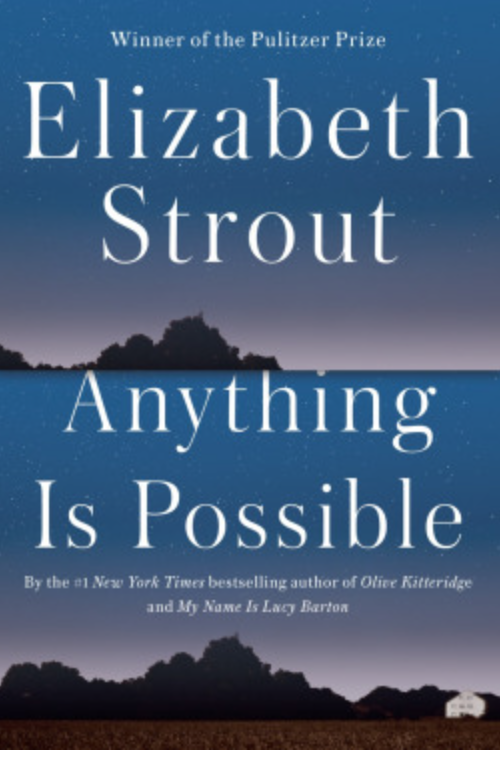
Anything is Possible by Elizabeth Strout
I enthusiastically recommend Elizabeth Strout’s stunning book Anything is Possible. In the nine interconnected stories about people from the fictitious town of Amgash, Illinois, Strout identifies the defining experience that shaped each character. She avoids linguistic ornamentation or exaggeration and simply writes raw, clear and honest prose. Just as I was feeling judgmental or frustrated about a character’s choice, Strout zeros in on the dramatic moment or life experience that shaped that character and my feeling changed to empathy and compassion. Strout isn’t heavy-handed, maudlin or didactic. These stories feel authentic and astute.
Lucy Barton, the protagonist from Strout’s previous book My Name is Lucy Barton, is mentioned in most the stories. Lucy manages to escape Amgash and becomes a famous novelist. In one story Lucy returns to Amgash to visit with brother Pete and sister Vicky. Sitting in the living room of the home where they were raised and where Pete still lives, the three siblings descend into their childhood dynamic. With both petty and wise recollections, the siblings discuss the pain, shame, and embarrassment of their youth. Being poor and abused by their parents and ostracized by their classmates made their early lives almost unbearable. Still stuck in their small lives in Amgash, Pete and Vicky resent Lucy’s abandonment and feel pride in her success. As they talk, Lucy feels catapulted back in time and has a panic attack. Her two siblings jump into action and drive Lucy back to Chicago. Through all their suffering and bitterness toward life and each other, it is clear that these siblings love one another, if only as survivors of the same upbringing.
Strout explores how the aftermath of specific events continues to reside within people and results in emotional paralysis. The poignant shame of poverty seeps into these stories even for those who are now well off. Part of Strout’s insight derives from viewing her characters lives over decades. Like a detective, she shows how the trajectory of a person’s life can be traced to a few key factors. There is a lot of unmet need and unfair judgments in these stories. Strout understands the complexity of motivation, fear, and desire and eloquently captures the ways people can demean with cruelty or soar with grace. Anything Is Possible inspires us to be empathetic and understanding because with empathy and understanding anything is possible.
