Favorite books about the Psyche and the Soul
I have listed books that I have read since I started my blog in 2015. Not every entry has a review yet. I know there are many more books to consider. Email me your suggestions!
Woman Authors

Ann Patchett’s moving new novel Whistler is a tender meditation on connection, memory, and healing. Though divorce, grief, and trauma run through the story, the novel is uplifting, not bleak. Patchett writes with characteristic insight about childhood experiences, both remembered and buried, that quietly shape the adults we become. As in Commonwealth (2016) and The Dutch House (2019), the aftermath of divorce occupies the emotional center of the novel, and is also depicted with insight, humor, and grace.
A chance encounter at the Metropolitan Museum of Art in New York City reunites 53-year-old Daphne Fuller with her former stepfather, Eddie Triplett. Eddie was married only briefly to Daphne’s mother, and 40 years have passed since he and Daphne last saw one another. Still, his brief presence in her childhood left an indelible mark. Their interests aligned, their banter came easily, and Eddie’s warmth offered comfort to nine-year-old Daphne. She loved him. Together, they had survived a traumatic car accident that deepened their bond: it was Eddie’s kindness and courage in that dire moment that helped keep them alive as they waited to be rescued. Soon after the accident, Daphne’s mother divorced Eddie and contact between them ceased.
When Daphne and Eddie meet again in the novel’s opening chapter, the past returns with startling force. Daphne is overcome with emotion. Daphne says, “And with that I bowed my head and covered my face. I hadn’t known there was something in me to break, but there it was and break it did. I stepped into an open crack in time and fell backwards.”
Later, she realizes, “…somewhere deep inside myself, in a place inaccessible to me since I was nine, I had missed him every day of my life.”
As adults, Daphne and Eddie are given the rare chance to recover what time seemed to have taken from them. They spend long hours together retracing the paths their lives took in the decades apart and eventually speaking openly about the night of the accident. Through Daphne and Eddie, Patchett beautifully shows how certain people remain lodged in the heart and how love can endure beneath the surface of ordinary life. Whistler is a wistful novel illuminating that healing, even if delayed, is possible. 5/5
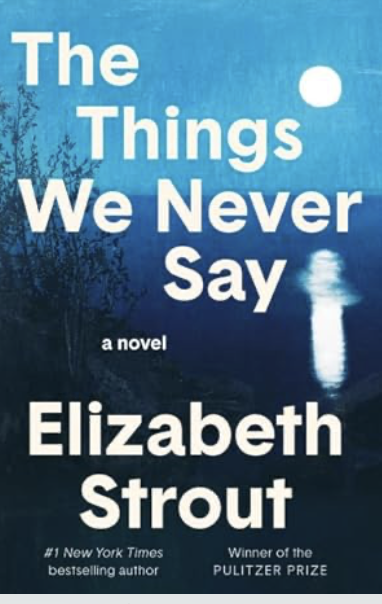
Elizabeth Strout has written another gem. She has a remarkable ability to deeply probe the psyches of her characters while delivering a perceptive and absorbing read. In this novel, her 11th, she dives even deeper into that well.
Artie Dam, a beloved high school history teacher, is depressed. He feels alone and isolated—not because he lacks people to talk to or spend time with; he doesn’t. He is surrounded by people who love him: his wife of 30 years, his grown son, his fellow teachers, his students, and his friends. Rather, it is an internal angst that plagues him, leaving him with the sense that most thoughts are meant to remain solitary, not shared. The divisive divisions in this country don’t help.
When Artie learns a profound secret about his life, he must decide how to proceed with this knowledge. The revelation forces him to recognize that we don’t truly know ourselves—and sometimes not even the people closest to us. Toward the book’s ending, he thinks he might know why people never say the thoughts closest to their hearts. “Because to say anything real was to say things nobody wanted to know, or if they wanted to know, they would not care in the right way. Or even understand. It’s a private thing to be alive.”
Strout continues to explore the human condition with persistence and curiosity. Though the book is psychologically astute, its ethos is heavy and existential. Author Elizabeth Day’s blurb on the back sums up this novel beautifully: “Strout is a brilliant chronicler of the ambiguity and delicacy of the human condition.” Highly recommend. 5/5

Virginia Evans’s novel The Correspondent radiates warmth, wisdom, insight, and humor. Structured as a collection of letters and emails, the narrative beautifully explores the inner world of a woman’s life while offering her unique perspective on the human experience. The book also celebrates the value and magic of the written word making this novel my favorite of 2025.
Each morning, 73-year-old Sybil Van Antwerp sits down to write letters, a daily ritual she has maintained for much of her life. Her correspondence includes neighbors, colleagues, authors, her brother, her children, her best friend, and one person to whom she writes without ever sending the letters. Expressing her thoughts and emotions through correspondence s becomes her way of connecting with others, while also maintaining distance. Sybil is divorced, a mother of two living children and a retired lawyer. Her personality is marked by stubbornness, sarcasm, and sassiness, yet she also possesses a strong sense of manners and decorum.
Self-sufficiency has long been her pride, but she is gradually losing her sight. Uncomfortable as it is, she finds herself needing help from other people. Ironically, as her vision narrows, her world broadens. This vulnerability seems to make her correspondence more revealing. She seems to be gaining deeper insights about herself and the people in her life. She writes to her daughter, “I know you think of me as your mother only, but please remember, inside, I am also just a girl.”
This period of change leads Sybil to seek forgiveness and to forgive those who have wronged her. She writes with increasing humility and grace. As the narrative unfolds, readers become acquainted with her family and associates, witnessing her steady personal growth. The novel ultimately celebrates the power of writing as a tool for self-discovery.
The Correspondent is an uplifting and perceptive book, offering readers a heartfelt celebration of emotional evolution and the enduring significance of the written word. Highly recommend. 5/5.

Heather Clark’s novel, The Scrapbook, is a haunting, sensual, and melancholy narrative that offers a fascinating and unique perspective on the enduring impact of World War II. Through exquisite prose and multi-layered psychological insight, Clark crafts a story deeply rooted in how the complexities of history influence the present.
At the heart of the novel is Anna, an American senior at Harvard in 1996, whose life is shaped by a scrapbook left to her by her grandfather. This cherished artifact contains photographs from his time as a young soldier in World War II, including powerful images from his participation in the liberation of Dachau and the seizure of the Eagle’s Nest which Hitler used for social functions. The scrapbook becomes a touchstone for Anna, guiding her thoughts and actions as she begins her own adult life.
Anna’s fascination with the past deepens when she meets Christoph, a visiting German student. Their connection quickly turns into infatuation, leading Anna to follow Christoph to Germany. Like Anna, Christoph is obsessed with World War II, though he holds complicated feelings about his grandfathers’ roles in Hitler’s army. He is simultaneously judgmental and defensive of them, ultimately weighed down by a sense of inherited guilt. For example, he quotes German philosopher Theodor Adorno’s observation to Thomas Mann from the late 1940s: “It was as if the Germans truly believed they had never been Nazis. They had completely repressed their obedience to Hitler.”
As Anna’s first romantic relationship unfolds, she is swept up by Christoph’s intensity. Together, they visit sites featured in her grandfather’s scrapbook, engaging in intellectual discussions about the war, German architecture, art and literature. Despite the passage of fifty years since the end of the war, their love is haunted by unresolved historical trauma. Anna grapples with difficult questions: Does Christoph’s grandfather’s complicity mean Christoph himself is capable of similar actions? Should he be held accountable for the misdeeds of his ancestors?
While the backdrop of their relationship is WWII, their difficulties are not solely the result of their families’ histories. Instead, their eventually dysfunctional relationship is shaped by their youth and Anna’s naivety. In highlighting the uncertainties of young love, some aspects of their interactions did not feel entirely convincing. Their personality traits and relationship also hint at the dynamics between their countries during the war.
Heather Clark’s outstanding novel wrestles with profound themes of inherited guilt, obsessive love, and the trauma that echoes through generations. The Scrapbook is a serious and thought-provoking exploration of how, despite the decades, WWII continues to shape identity and relationships. 4.5/5
(Thanks to my friend Karen for giving me this book!)

The Bright Years, Sarah Damoff’s debut novel, is my favorite book (thus far) in 2025. The narrative focuses on a multi-generational family navigating the complexities of alcoholism, concealed truths, and personal tragedy. While challenging subjects, the book avoids becoming overly somber, instead presenting a narrative infused with dignity and hope. Damoff’s beautiful prose and insightful observations contribute to the novel’s poignancy and tenderness.
The story follows Lillian and Ryan Bright, who meet in a Fort Worth public library in 1979, fall in love, and eventually marry. Significant aspects of their histories remain undisclosed: Ryan conceals his father’s alcoholism, while Lillian does not reveal that she gave up a child for adoption. Their lives are initially marked by happiness and the birth of their daughter, Georgette. Yet, the convergence of hidden pasts gradually complicates their relationship. As Ryan succumbs to alcohol dependence, the family’s once-bright years begin to darken. Damoff offers nuanced insight into the origins of Ryan’s addiction and skillfully examines its psychological impact on his family.
Despite these adversities, the motif of healing and connection permeates the novel. Lillian Bright’s reflection that “time can wash dirt off a memory until it is revealed as something else entirely” encapsulates the book’s exploration of forgiveness and hope. Through her vivid depiction of complex characters, Damoff emphasizes optimism and compassion amid hardship. The Bright Years shows that healing is possible. 5/5

With great insight, Elizabeth Strout’s newest novel probes the complexity of human relationships. How well can we know another person? How well can we know ourselves? She concludes not well: “We are all such mysteries.” But her novel offers an antidote to this isolation. Listening to other people’s stories connects us to them and causes us to empathize with their plight. Exchanging stories is a gift we can give to ourselves and others.
This character-driven novel takes place in the fictional town of Crosby, Maine. We have met the protagonists in Strout’s prior books: Bob Burgess, Lucy Barton, and Olive Kittridge. The plot revolves around their deepening friendships, the stories they share, and the murder of an elderly woman on the outskirts of town.
Strout’s characters are defined by the traumas (often unknown to others) that shaped their journey. Her characters’ ordeals occurred in their childhoods and have been the engine (consciously or unconsciously) driving their lives. Olive Kittredge says, ‘If you don’t think everyone is broken in some way, you’re wrong.” The novel’s characters have endured sexual abuse, suicide, alcoholism, disease, divorce, poverty, and the guilt of accidentally killing a parent.
The novel has a wistful tone as the characters wrestle with themselves and those they encounter. They share their fears and worries, their joys and pleasures, and the stories they hear about other people in town. Just when you are about to judge a character’s cruel action or poor choice, the character’s background is revealed, and you feel compassion instead.
The book can sometimes feel like a quirky collection of short stories. Still, Strout weaves them into an existential narrative about how people overcome their hardships and connect with others. Lucy Barton states, “People just live their lives with no real knowledge of anybody.”
In this world filled with so much suffering, Strout suggests that listening to others without judgment is a gift of love and the only antidote to the existential loneliness of our minds. This novel is poignant, provocative and packed with insights. I highly recommend Tell Me Everything. 5/5

There is heart and soul in this beautiful novel by Laura Spence-Ash. Her writing is layered with astute reflections about familial love, conflicting loyalties, time passing, and the long road to understanding and forgiveness. The writing is warm and intimate, and there is no violence or treachery. As of April 2024, this is my favorite book of the year.
In 1940, when the German bombing of London became acute, Reg and Millie Thompson sent their only child, Beatrix, to America to keep her safe. After a two-week boat ride to Boston, an angry and frightened 11-year-old Beatrix meets Ethan and Nancy Gregory and their two sons, William and Gerald. She is warmly welcomed, assigned her own room and spends five formative summers with her new family on their private island in Maine. Nancy Gregory bathed her gently when she arrived. Ethan Gregory taught her to swim. William and Gerald seamlessly included her in their adventures. Her initial fear and loneliness gave way to feelings of comfort and inclusion. The Gregory’s come to love Beatrix, whom they now call Bea, and she comes to love them. Her life is changed forever, as is theirs.
Bea's parents hoped their daughter would be safe and happy and far from the danger in London. "They sent her away so she could have a childhood. They hadn't realized, though, that their decision meant that her childhood would, instead, be taken away from them." When the war ends, Bea is back on a boat to London. She doesn't want to return and would rather stay in this happy home with people who pay close attention to her needs. After five years away from London, Bea’s American family's warmth and emotional habits comfort her.
But to her London home, Bea returns.
Each of the Gregory family members feels Beatrix's absence. They leave her bedroom intact. After the war, the Gregory family members send Bea letters, and William visits Bea in London. As they move through their twenties and thirties, both sons miss Bea and struggle to find peace in their adult relationships. Meanwhile, Bea is angry with her mother and strives to establish her life in London as an adult. The war years were a formative and life-changing experience for Beatrix, her parents and the Gregory family. Each of these eight characters shares the narration, a testament to Spence-Ash's writing skills.
Gentle and warm, Spence-Ash combines descriptions of daily activities with an emotional log. The story is told over decades and illuminates the evolving bond between Bea and the Gregory’s, (especially the two sons) and the expanding distance between Bea and her parents. The past persistently hovers in each character's thoughts as they wrestle with their complicated and conflicted feelings. The novel reads like the journals of these eight characters as they each sort out their feelings about that monumental and influential time in their lives. This quiet novel is filled with grace. 5/5

I recently reread Roxana Robinson’s 2008 novel Cost. If you haven’t read this book, you are in for a treat. Not because the story is happy—it is not—but because Robinson is a gifted connoisseur of deconstructing family dynamics. Her elegant prose penetrates the emotional interiority of her characters with precision and empathy.
On one level, the story is about a 22-year-old man named Jack Lambert, who is a heroin addict. On another level, the story is about how a destructive family dynamic is passed from generation to generation, resulting in one family member unconsciously being assigned to carry the burden of the damage.
Jack’s parents, Julia and Wendell, are divorced. When Jack’s older brother Steven tells his parents that Jack’s drug use has become dangerous, they each choose denial, but soon an intervention is arranged. Jack’s parents, brother, grandparents, and aunt gather at Julia’s summer home in Maine. When the addiction counselor asks them to write about what they love about Jack, they all bristle. “Love is not a word their family used.” Though the family members have pleasant public personas, their past anger, hurt and distrust lurks when they are together.
Robinson writes about Jack’s heroin addiction with intimacy and captures the obsessive thoughts of an addict looking for his next fix. She also depicts the emotional cost to Jack’s family as his stealing and lying intrude on their lives. Their feelings alternate between grief and guilt to fury and rage. This theme propels much of the plot.
(Spoiler Alert) However, the more compelling theme is the family dynamic that has pathologized Jack since childhood. “He was always a wild center of the storm.” Jack carried the burden of his parents’ and even his grandparents’ choices. The ambiguity of Jack’s paternity was never discussed. It was unconsciously known. Jack’s father Wendell says at the intervention, “I think I was too hard on Jack.” And then later, “It’s like hearing that he is Chinese or that he’s not my son.” Wendell knows and doesn’t know, and Julia is not sure.
This powerful novel about the scourge of heroin addiction and the scourge of toxic family dynamics long ignored is heartbreaking. Robinson’s ability to illuminate each family member’s past and present interiority is extraordinary. Jack pays a painful price for his addiction as does his family. Eventually, there can be a cost of not dealing with the past. 5/5

I have read dozens of books about the Holocaust and WWII. Meticulously researched and deeply profound, ‘The Postcard’ is among the best. Anne Berest has written an autobiographical novel that details the emotional wounds and persistent pain of Holocaust survivors and their progeny. The story describes how France’s Vichy government, in collaboration with the Nazis, sent tens of thousands of French Jews to die in concentration camps, including the author’s great-grandparents. The book also explores religious identity, family secrets, persistent silence, intergenerational trauma, and the healing power of stories.
In 2003, the narrator’s mother, Léila, receives a postcard in her Paris home. On the front is a photo of the Opéra Garnier. Four names are written on the back: Ephraïm, Emma, Noémie and Jacques. These are the names of Léila’s grandparents and two of their three children. They all died in the crematoriums of Auschwitz in 1942. The sole survivor was Noémie and Jacques’ older sister, Myriam. Myriam is now deceased and shared almost nothing with her daughter Léila about her wartime torment.
When this faded postcard arrived in 2003, Anne Berest was in her twenties and not interested in determining the postcard’s sender. Fifteen years later and now a mother, Anne and her mother Léila decide to investigate. Who sent this postcard? And why now, 58 years after WWII’s end? Due to their forensic level of research and professional help, Anne and her mother, Léila, discover letters, forms, applications, diaries, names, addresses, and logs from government entities, allowing them to learn the story of their family’s deportation from France to Auschwitz. Meanwhile, their search for the sender of the postcard continues.
This novel explores intergenerational trauma. Myriam did not speak of her murdered parents and siblings. This does not appear to have been a conscious decision but rather a survival mechanism. Anne says of her grandmother, “I think she kept silent out of guilt for being alive.” And though Myriam did not share any details, Anne and her mother, Léila, discover the dates, places and people involved in Myriam’s escape from the unfathomable terror of that time.
As a child, Anne Berest was conscious of not tripping on the invisible barbed wire when people spoke of the war. So much about her family’s prior lives was unspoken. And yet, despite missing the mayhem and murder, Léila and Anne experienced their own fear and anxiety for all that was unspoken and unknown. Research now shows that trauma can be transmitted cellularly in the womb. Berest quotes Alejandro Jodorowsky: “There are, in the genealogical tree, traumatized, unprocessed places that are eternally seeking relief. From these places, arrows are launched toward future generations. Anything that has not been resolved must be repeated and will affect someone else, a target located one or more generations in the future.”
Anne Berest’s superb storytelling makes the book compelling. She writes with passion, love and curiosity about her family. Not only is the mystery of the postcard solved, but she also uncovers in granular detail what happened to her great-grandparents, aunt, uncle and grandmother during the war. Knowledge of her family’s past makes her present life and the lives of her mother and grandmother more understandable. Berest’s references to intergenerational trauma are intriguing and thought-provoking. ‘The Postcard’ shows us how a seemingly civilized society allowed the murder of their fellow citizens. Antisemitism is still rampant. And books like ‘The Postcard’ show us what can happen if bigotry is not contained. I highly recommend this book. 5/5

In 1992, Jane Smiley won the Pulitzer Prize for her astonishing novel ‘A Thousand Acres.’ Rereading this novel heightened my admiration for this literary gem. Smiley’s ability to inhabit her characters is deep and nuanced. The book is tragic, but Smiley’s psychological acumen is remarkable. The story’s themes touch on aging, power, repression, competition, and control, but mostly the emotional cost of silence within a family and community.
Shakespeare’s King Lear provides the plot’s scaffolding. Larry Cook is an aging widowed patriarch of a respected farming family in Cabot, Iowa. Rather impulsively, he divides his land between his three grown daughters, Rose, Ginny, and Caroline. But when the youngest daughter Caroline questions his decision, he deletes her from the deal. Larry’s decision is rash and may indicate his emerging dementia. His choice catalyzes the dramatic eruption in the Cook family dynamic. Tragedy ensues.
Narrated by the middle daughter Ginny, the story shows the strain of farming the land and raising livestock. Decisions have life-and-death implications that empower and entangle families. Ginny, Rose, and their husbands struggle to maintain the Cook Family’s 1000-acre farm. Rose and Ginny glorify the family’s long history and traditions while feeling trapped in their roles and duties required to keep the farm going. They revere and resent their way of life and the small town where everyone knows each other’s business.
Ginny and Rose also continue to take care of their cantankerous and cruel father, who expects everyone he encounters to defer to him. Unlike the other characters, the origins of Larry Cook’s behavior are unclear. Smiley might say that thousands of years of patriarchy would best describe his callous conduct. He manipulates and denigrates his friends and family because he can; it is as if he is the king of Cabot, Iowa. Meanwhile, the youngest Cook sister, Caroline, has left the farm and is an attorney in Des Moines. Caroline harbors resentment toward her older sisters and blames them for her exclusion from the transaction. She knows nothing of what Rose and Ginny endured to protect her from their father.
Ginny says, “The wisdom of the plains. Pretend nothing happened.” But old wounds appear as Rose, Ginny, and their husbands make decisions about the farm. Repressed emotions begin to leak, and eventually, the characters will give voice to their feelings. The results of years of silence are like a tornado ripping the Cook family members from their foundations. By the novel’s end, the full tragedy of these repressed lives becomes clear.
And though ‘A Thousand Acres’ might sound depressing, it is not. Smiley’s ability to create complex characters and write precisely about their family dynamics is inspiring. Readers can gain insight into the human condition. Isn’t that the purpose of a well-written novel? 5/5

I do love a book set in San Francisco. Hometown pride, I suppose.
Written by Stacia Pelletier and published in 2017, ‘The Half Wives’ is gripping and even hypnotic. Pelletier’s evocative descriptions of turn-of-the-century San Francisco are so immersive that the City feels like another character. It does take a couple of chapters to acclimate to the second-person narrator. But as the complex emotion of the characters emerge, the story crescendo toward a sad but satisfying conclusion.
The entire novel takes place on May 22, 1897. It was on May 22, sixteen years ago on that day that Henry and Marilyn Plageman’s 2-year-old son Jack died. Marilyn and Henry commemorate their son’s death yearly with a ritual at the San Francisco cemetery on Lone Pine Hill. But this year threatens to be different. The City of San Francisco intends to move the graves to Colma, a new cemetery south of the City. Because of the sweeping ocean views, the City believes the current cemetery could be used for homes and businesses. Jack knows that Marilyn can’t bear the thought of moving Jack to a new plot of land. So, Henry does what he can to stop the move. (Read the author’s note at the end of the book first. She explains how most San Francisco cemeteries were moved to Colma.)
After Jack’s death, each privately mourned Jack. Marilyn focused on charity work for an orphanage. And Henry started a relationship with a woman named Lucy, with whom he has a ten-year-old named Blue. He stays with them once a week.
Jack and Marilyn love one another. But like the San Francisco fog, Jack’s death hovers over them. His death is like an invisible string that connects them and restrains them from processing the reason Jack died. ‘The Half Wives’ is a unique and engaging read.
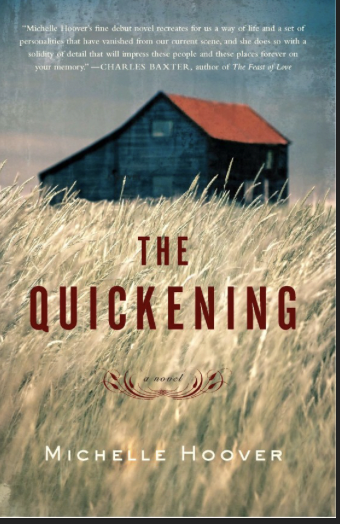
‘The Quickening’ was hard to put down. Michelle Hoover’s lyrical writing, compelling characters, and dramatic setting create a palpable tension. It is a story about two families struggling to survive on the isolated Midwest plains. As the families begin to rely on one another, mutual resentments accumulate. Using language as sparse as the plains, Hoover’s emotionally charged novel transports us to a time, place, and dialect that no longer exists.
In 1913 Mary Morrow walked the mile to meet her new neighbor. She longed for a friend. She had been raised in a city. It was where she met her abusive husband, Jack. On this vast prairie, only one friendship option exists. Her name is Edinan Current. Edina and Mary’s temperaments couldn’t be different. Edinan is content farming alone or with her gentle husband, Frank. Except for a church that plays a part in the story, these folks could be living on the moon. The book explores Edwina and Mary’s internal worlds and reveals their different fortitudes, attitudes, and character. Life proceeds over the years, and they help one another through miscarriages, hurt children, sick animals, failed crops, the Great Depression, a fire, encroaching poverty, and more isolation. Edinia and Mary have secrets; some are known to the other but never acknowledged. These families are intertwined not out of mutual admiration but by circumstance. Eventually, betrayal rears its ugly head. These two women make decisions that affect their families and the next generation.
The book is an homage to the families that farmed in isolation their 180 acres thanks to the Homestead Act. Feelings are not shared. People are tight-lipped and private. Hoover’s use of metaphors, simile, and allegories are breathtaking. Words are not wasted, and meaning exists in the words not written. This powerful story is about the emotional toll of hard work and heartache on two farmwives and their families as they toil on the Midwest plains. 4.5/5

I read Kate Southwood’s ‘Falling To Earth’ over a year ago, and this novel's power has stayed with me. I am in awe of Southwood’s beautiful writing and the cadence of this mesmerizing story. This dramatic story is like reading a tragedy from Shakespeare. Heartbreak awaits you, but you keep reading because Shakespeare’s writing and observations will penetrate your being.
The tragedy Southwood writes about in ‘Falling to Earth’ is twofold. On March 18, 1925, an actual tornado whipped through Illinois, Indiana and Missouri. It was one of the worst tornados in our country’s history and is now called the Tri-State Tornado. This day is the starting point from where Southwood begins her fiction, in a small town called Marah, Illinois. The tornado destroys buildings and people, including a schoolhouse full of children. With so much destruction and loss, the townspeople are overwrought and bereft.
Paul Graves and his wife Mae live in March with their three children and Paul’s mother Lavinia. By some miracle, the Graves family escapes the tornado’s devastation. Their house is untouched, and their children are unharmed. They have done nothing wrong but survive. The story's second tragedy is the community’s reaction to Paul and Mae’s good fortune. Though Paul and Mae work hard to help their neighbors clean up and rebuild, the townspeople with whom they have been friendly, slowly turn against them. A collective but uncoordinated desire for Paul Graves's family to suffer takes hold. This small, tormented town of 1925 becomes snarled in superstitions and small-mindedness. With silent shunning and petty cruelties, they blame the Graves family for escaping the catastrophe. At some level, these former neighbors and friends come to believe that if the Graves family suffers, their grief will be soothed.
This book is a wise meditation on grief. Southwood’s depiction of this dreadful dynamic is well depicted. The novel’s pacing is slow, which makes the action more suspenseful. The story encompasses the rawness of human emotions.
Southwood’s writing is precise with poetic flourishes that pack an emotional punch. More importantly, Southwood’s psychological insight into human emotions and behavior is subtly and superbly delivered. ‘Falling to Earth’ teaches how grief can ricochet, even striking undeserving victims. 5/5

Dani Shapiro’s newest book ‘Signal Fires’ has burrowed deep inside of me. The novel is thoughtful, spiritual, ethereal, psychological and even transcendent. Its power is not in the specific story line, but the existential questions Shapiro explores. She tackles the circular nature of time, the many selves inside each of us, the psychological impact of not processing trauma, the magic of serendipity and the enduring presence of all people (dead or alive) in our universe. Like time itself, this novel moves from the present to the past with hints of the future, providing richness and depth to the story.
The book begins in 1985. Teenage siblings Sarah and Theo Wilf are driving their friend Misty Zimmerman home. They have been drinking. When the car crashes near the Wilf house, their father, Ben Wilf, who is a doctor, runs outside. His children are uninjured, but Misty is dead. That night, an unspoken agreement is made between Ben, his wife Mimi and their two teens. They will never speak about what happened or how they feel, a pact that persists for decades. “Sarah sometimes wonders whether talking would have been better. Silence didn’t make it go away but instead drove the events of that night more deeply into each of them.”
Shapiro allows us to enter the emotional lives of these characters in the aftermath of their trauma. And though the characters reflect privately on the horror of that night, they mostly move forward weighted down by their guilt. Consciously and unconsciously they make decisions that alter the trajectories of their lives. “There is no straight line. Memory, history - things that happened fifteen years ago or fifty are as alive now as if they had just happened or are about to happen.”
After Sarah and Theo are grown and moved away, a young couple moves across the street. One evening, Ben hears the husband calling out. His wife is in labor and the ambulance has not arrived. Ben races to the house and delivers the infant who the couple names Waldo. Over time, Ben and Waldo become close. The novel shows how random connections can affect our lives in profound ways. Waldo becomes an astrophysicist and shares commentary about the stars and space, adding another dimension to the story. But the novel’s primary focus is on the repercussions of trauma. Every person responds differently to tragedy . But holding onto painful secrets can have dire consequences. “Unexpressed, they will wind their way through and around each of them like vines choking a strand of untended trees.”
The story is a meditation of love and loss, grief and trauma and eventually about healing and hope. I applaud Shapiro’s ambitious exploration of these themes. Though the story is heavy, its intensity is offset by moments of illumination and insight. ‘Signal Fires’ is a novel is infused with humanity and spirituality. I highly recommend. 5/5

‘Migrations’ was one of my favorite novels of 2022. Charlotte McConaghy published this exquisite story in 2019. Suspenseful, gripping and atmospheric, the novel stunned me with its ability to immerse the reader in a different world. Characterized as a CLI-FI (climate fiction) McConaughy certainly comprehends the implications of climate change, but she is also an insightful interpreter of the human soul.
The protagonist of the novel, Franny Stone is a thirty-year-old Irish woman with a troubled past. The details of that past slowly reveal themselves in each chapter, like puzzle pieces that create a full picture by the end of the story.
The novel take place in the not-too-distant future where most wild animals are extinct. No food for one species means no food for the animals up the food chain. So now animals are bred in farms for food, but the natural world as we know it has ceased to exist.
Though not formally educated, Franny’s knowledge about birds is voluminous. Scientists in the story believed that the Arctic Wren a species of bird was still alive and making their long migration from the Artic to Antarctica. Franny wants to follow the Wren to their destination. She talks her way onto a fishing vessel where the crew hopes to take in one last big catch. At some level, she thinks that if she saves the birds, maybe she can save herself.
As we learn about Franny’s life, we can see she is running toward the natural world and away from her traumatic past. Like her mother, she is restless soul who wanders during the day and sleepwalks at night. She says, “It isn't fair to be the kind of creature who is able to love but unable to stay.” It feels like she is punishing herself for some unnamed transgressions which we lean in a slow cadence of revelation. Franny’s painful experience of her younger days has nestled into her soul and she feels that she cannot change and must be punished,
‘Migrations’ is heavy and heartbreaking, raw and wrenching. It is a character driven story about a woman wrestling with her past while living in an eerie world without the sound or sight of animals. No fish, no birds, no mammals. This story aches with the fallibility and majesty of human choices both individually and globally. McConaghay is not didactic, just factual. if we don’t make changes The world we know will no longer exist. 4/5

Despite its tranquil tone, Claire Keegan’s ‘Small Things Like These’ packs a provocative punch. In 114 pages, she delves into the heart and mind of a man questioning the purpose of his life. After witnessing a disturbing event, his past comes rushing into the present. Short-listed for this year’s Booker Prize, this small novel inspires,
Christmas is fast approaching in the small Irish town where Bill Furlong was born, raised and still lives. The year is 1985 and an economic downturn has enveloped the town. But Bill, a coal merchant, feels fortunate he can still support his wife and five daughters.
One day delivering coal to the Catholic convent for unwed mothers, Bill finds a young woman locked in the coal shed. It shakes him deeply and unearths thoughts about his own unwed mother. When Bill’s mother had become pregnant at 16, her family disowned her. Because the Protestant woman for whom Bill’s mother worked invited Bill’s mother to move in and raise her child, Bill’s mother was spared the convent for unwed mothers. A blessing for Bill and his mother.
What Bill saw at the convent begins to plague him. His wife says, “If you want to get on in life, there are things you have to ignore, so you can keep on.” But the image of that young, scared girl upsets the compassionate Bill Furlong. His relationship with the nuns is cordial, but still, his conscience won’t rest. “Why were the things that were closet so often the hardest to see?” Feelings about his deceased mother and his unknown father stir inside him. Bill begins to reevaluate his obligations to himself, his family and his community. He wonders, “Was there any point in being alive without helping one another?”
Claire Keegan’s sparse prose grabs her readers and places them in Bill Furlong’s heart and mind. In these turbulent times, she provokes her readers to contemplate their responsibilities to others. If each of us does one small compassionate act, our world would undoubtedly be a better place. 4/5
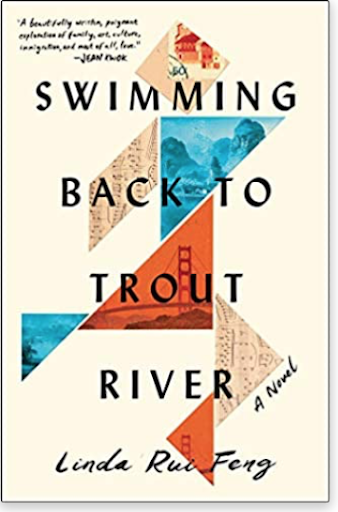
This review was published in the San Francisco Examiner on July 29, 2021
Linda Rui Feng’s debut novel “Swimming Back to Trout River” is an exquisite meditation on love and loss in the wake of China’s ruinous Cultural Revolution from 1966 to 1976. The book brings to life how repressive regimes create lasting emotional scars on individuals touched by their cruelties. The protagonists are vulnerable but resilient as they leave China to start anew in America. Their hopeful moments are few and fleeting as the wounds of the old world shape their choices in the new.
Feng, a former San Francisco resident and professor in East Asian studies at the University of Toronto, has written a book that’s not primarily about China’s politics. Instead, it is an evocative exploration of the inner life of specific immigrants and the burdens they carry with them.
The story begins in China in 1981 as Cassia, a young mother, abandons her 5-year-old daughter Junie at the home of her in-laws. The story of why Cassia leaves Junie unfolds slowly. Junie’s grandparents live in a small village, near a river, where they dote on Junie. Born without legs below her knees, Junie is not deterred by her disability. She is bright, inquisitive and loves her grandparents.
As Junie’s 12th birthday approaches, Junie’s father Momo, who is in the United States pursuing a graduate degree, writes that he will bring her to America to join him and Cassia. What Junie and her grandparents do not know is that when Cassia arrived in San Francisco, she did not proceed with her plan to meet Momo. She works as a nanny for a little boy, while Momo, many miles away, still hopes to reunite with Cassia and Junie.
Cassia and Momo met while working in a factory town in remote China. Both were traumatized by horrifying events during the Cultural Revolution; each witnessed terrifying acts of physical violence and emotional cruelty. Memories of the period remained too raw for them to share, and their emotional distance compounded over time. The birth of their disabled daughter exacerbated their separateness. Each reacted differently to her arrival. A subsequent and tragic life-changing event fueled their growing isolation.
As the story develops, it becomes apparent that although they left China, Momo and Cassia did not leave their personal demons behind. Their interior lives remain bound up in the anguish of their younger selves. By the end of the novel, we learn the secrets that haunt their lives. The narration artfully moves between past and present while the characters’ emotional complexity deepens.
A separate stream in the narrative revolves around Dawn, whom Momo met at university before knowing Cassia. A gifted musician, Dawn makes a mark in Momo’s life, inspiring his lifelong passion for music. Dawn, too, endured tragedy during the Cultural Revolution. While in San Francisco as part of a musical delegation from China, Dawn made the difficult decision to defect. Music’s ability to motivate, nurture and touch human souls is a prominent theme in the story.
Another powerful theme focuses on the Chinese word yuanfen, for which there is no English translation. The concept refers to the idea that invisible threads, which can be identified but not completely understood, connect people and events. Numerous examples of yuanfen create drama and tension as the novel crescendos toward its surprising conclusion.
I might have preferred a different ending, but this quibble doesn’t detract from the book’s extraordinary virtues. Feng, a gifted writer and storyteller, astutely and unusually conveys the role of emotions in determining life choices. “Swimming Back to Trout River” celebrates the power of hope, the interconnectedness of people, the constancy of grief and the complexity of love: together, a microcosm of the human condition.

This review was published in the San Francisco Examiner on October 13, 2019
https://www.sfexaminer.com/entertainment/dutch-house-a-powerful-drama-about-family-and-memory/
Ann Patchett’s remarkable new novel ‘The Dutch House’ dives deep into family dynamics, the amorphous nature of memory and the power of the past to shape the present. Patchett continues the theme of her superb book, ‘Commonwealth’: adult children sorting through the detritus of parents’ troubled lives. Patchett’s graceful prose is rich with references to fairy tales and parables. The result is a novel dense with human drama and layers of meaning.
After WWII, Cyril Conroy is a poor man. Due to one successful investment, he becomes wealthy and purchases an iconic house in a suburb of Philadelphia. “Be careful what you wish for” could be the novel’s subtitle; this acquisition is the beginning of the end of Cyril’s happy family and sizable fortune. The mansion, once owned by a Dutch family, is ornate, opulent and architecturally significant. Cyril is confident his new bride, Elna, will fall in love with its lavish beauty. He couldn’t have been more mistaken. Elna, who had considered becoming a nun, hates the ostentatious house. One day, she permanently leaves the Dutch House and her family, choosing instead to help the poor.
This abandonment creates trauma for her three-year-old son, Danny and most especially for her ten-year-old daughter, Maeve. Eventually, their father remarries. His new wife, Andrea, and her two daughters move into the Dutch house, dislodging Danny from his childhood and displacing Maeve from her bedroom. When Cyril Conroy dies unexpectedly four years later, the stepmother, Andrea, cruelly throws Maeve and Danny out of the Dutch house that she now owns. Maeve becomes Danny’s guardian and protector.
Narrated from Danny’s point of view, the novel follows Maeve and Danny as they attempt to make sense of the events that led to their eviction. Though they obtain college degrees, secure jobs, and in Danny’s case, marry and have kids, Maeve and Danny are bonded to one another and trapped in the past. For decades they keep returning to the Dutch House as if a magnetic force is pulling them toward it. While parked across the street, they sit in Maeve’s car and gaze at their old home. With anger, sadness and humor, they examine their past. Maeve shares memories of their mother with Danny. Together, they analyze their enigmatic father and resent their mean stepmother. Danny’s wife says, “It’s like you’re Hansel and Gretel. You just keep walking through the dark woods holding hands no matter how old you get. Do you ever get tired of reminiscing?”
Their mother’s painful abandonment, their father’s careless choices and their stepmother’s petty vindictiveness alter the trajectories of their lives. As the single remnant of their childhoods, the Dutch House becomes a kind of museum of their memories. Then one morning, when Maeve is forty-nine and Danny forty-two, an unexpected event occurs and they decide to stop parking across the street. Twenty-seven years have passed since their expulsion. They realize, “We had made a fetish out of our misfortune, fallen in love with it.”
Yet the story is far from over. The Dutch House’s grip on their lives lessens but does not vanish. They must once again broaden their perspective of their past and open themselves to an unforeseen present.
Ann Patchett is like an archeologist excavating an emotional ruin. Her two main characters ask questions, analyze facts and arrive at hypotheses that morph with time and greater understanding. Danny and Maeve acknowledge that their memories might be unreliable and shaped to align with the narrative they created. But isn’t that the nature of recollection?
The surprise ending is moving without being maudlin. Acceptance, forgiveness and healing occur in unexpected ways. Ann Patchett’s talents as a writer are evident on every page. As one character says, “Sometimes you’ve got to put the past in the past.” With empathy, Ann Patchett shows us why that is easier said than done.

Alert: This review has spoilers.
In this transcendent novel, Mary Beth Keane’s talent for describing people’s inner lives appears on every page. Nuanced and insightful, the characters in Ask Again, Yes feel authentic and alive. The novel explores the emotional fallout of a tragedy that involves two families. Is forgiveness possible? What do we owe our families amid a calamity?
The year is 1973. Both Frankie Gleeson and Brian Stanhope are New York City rookie cops. When they each begin to start the families, they each move to the suburbs and coincidently land next door to each other. Francis and Lena soon have three daughters: the youngest named Kate. Anne and Brian Stanhope have one son whose name is Peter. The adults don’t interact with each other. Francis tells his daughter Kate to stay away from Peter’s mother, “Something’s not right.” When Peter and Kate enter school, they become close friends. Then a mental illness induced tragedy strikes when Kate and Peter are fourteen. Peter’s mother shoots Kate’s father. The repercussions from this shocking event will entangle the Gleasons and the Sandhopes in perpetuity.
Keane’s keen knowledge of the human condition allows the characters’ inner thoughts to propel the plot rather than external events. Yes, life moves on after the shooting. Everyone lives, though in a state of emotional and physical pain. There are graduations and job promotions, weddings and funerals, but Keane’s focus is on these characters’ internal reflections. Like a kaleidoscope, she shifts the narration, so readers learn the thoughts of Kate and Peter, Francis and Lena and Brian and Anne.
Kate and Peter’s love story dominates. The book’s cover made this plot seem sensational: the enigmatic title certainly added to that impression. Yet in Keane’s skilled hands, the notion that Kate and Peter would want to be with each other seems entirely believable. People who experience trauma together often gravitate toward one another. The fall out from the shooting dominates Kate and Peter’s inner lives. How could it not? They each experience grief, guilt and anguish for their parents and themselves. In the uproar and upheaval that follows, Peter moves to another town to live with an uncle. Kate’s father lingers in the hospital. As they move through their teens and into their twenties, Peter and Kate can think of nothing but each other. All four parents are living with pain and exhort Kate and Peter not to find each other. But they do - and all the family members must now navigate the complex maze of emotional dynamics and begin to understand the heartbreak of mental illness. As a psychiatrist tells Peter’s mother, “You repeat what you do not repair.”
Ask Again, Yes is a thoughtful rumination on how people navigate complicated feelings. She explores the passing of time, the randomness of life’s big choices, the need for understanding, the persistent ignorance around mental health issues, and the importance of forgiveness. The ending moved me in its simplicity and beauty. There is healing and mercy, compassion and empathy. Ask Again, Yes, is one of the most satisfying novels I have read this year. Thanks to the DJKKS Book Club.

Rachel Kadish’s The Weight of Ink is possibly my favorite book of 2018. In every page, I could feel Kadish’s passionate commitment to her characters and to the historical period she describes. Her appreciation of the written word is evident as she captures both the smallest details and largest historical themes. At one level the novel is a mystery to be solved. Yet due to Kadish’s skills as a writer and thinker, we are exposed to other levels of inquiry and thought: philosophy, the nature of love, religious viewpoints, moral obligations, the existence of God, gender roles and the power of the past to affect the present. No lightweight list of ideas to contemplate.
The novel opens in 2000. Helen Watt is a Professor of History at a University in London. When a former student asks her to examine a cache of old letters discovered in a 350 year-old-home he recently inherited, Helen is astounded by what she finds. She knows immediately these letters, written in Hebrew and Portuguese from the 1660s, are historically significant.
The novel then shifts to London in 1657. We meet Ester Valasquez, a young woman in her late teens who was adopted by Rabbi HaCoen Mendes after her parents died. Rabbi Mendes and Ester have left Amsterdam and traveled to London where the Rabbi will lead a small Jewish community. Because he was tortured for not renouncing his faith during the Inquisition, Rabbi Mendes is now blind. Though the rabbi does not support women reading or writing, Ester is a skilled scribe and secretly assists with his correspondence.
Though 400 years separate Helen and Ester, both women seek to utilize their intellectual gifts. Their identities are intrinsically connected to their ability to think and express themselves by writing down their thoughts. Ester says, “.... the unpooling of ink has brought me much comfort always, and often have I written what I would not speak.” However, the religious, social and political customs of that time period do not allow women that option. Esters complains, “A woman’s body was a prison in which her mind must wither.” Nonetheless, Ester develops a way to communicate her own thoughts even as she continues to scribe for the Rabbi. This bold decision contributes to the mystery of these letters three centuries later. In 2000, women participate fully in academia. However, Helen Watt still faces sexism and isolation by the male colleagues in her department. Yet because of brave women like Ester Valequez, Helen Watt publishes her thoughts under her own name.
Kadish’s novel also illuminates the unfair and precarious plight of the Jews. Though fortunate to be in London and not Spain, the Jewish community of London in the late 17th century is at the mercy of the clerical and political leaders of London. An acquaintance of Ester says, “… to be a Jew in this world, I understand is a danger. If a Jew speaks the truth of his faith in the wrong moment, though that faith harms none, he brings down untold wrath.” Kadish depicts the texture of oppression the Jewish community faced during this time.
Rotating between two time structures can be difficult. Often readers connect to the characters in one time period but not characters in the other. In The Weight of Ink I felt immersed in the characters’ struggles from both time periods. At 560 pages, The Weight of Ink is not a short read, but it is an emotionally, intellectually and worthwhile one.

Goldie Cohen is missing from her family’s home in Buffalo, New York. We learn this fact in the first few pages of Nancy Reisman’s absorbing and compelling novel, The First Desire. The year is 1929 and Goldie’s disappearance has thrown the Cohen family into turmoil. In her late twenties and the oldest of five adult children, Goldie directs the household after the recent death of their mother Rebecca. Has Goldie been kidnapped, has she fallen victim to a tragic accident or has she simply left?
Sister Sadie posts signs and notifies the police. After just a couple of weeks and deaf to the pleas of his grown children, Goldie’s father, Abe Cohen, decides that the family will sit Shiva. With this public pronouncement that “Goldie is dead to him", we learn that Goldie’s father believes Goldie has left the family. Abe Cohen’s patriarchal decision-making process gives us our first glance at his stubbornness, inflexibility and the emotional impact on his family.
Abe and Rebecca Cohen were born and raised in Poland where family traditions were rigid and choices few. The reliable routines of the Cohen’s family life in Buffalo provide both an oasis and a prison for the family. Except for Sadie, who lives with her husband Bill and their two daughters across town, the other four siblings live and work with their widowed father in the family jewelry store. Though the Cohen family members’ lives are intertwined, they each live on their own emotional island. They need each other and they resent each other. Their freedom is constrained by money, societal norms, and the customs of their Jewish faith.
However living in Buffalo, not Poland, has allowed these five adult siblings to consider their own needs. So though they remain diligent and dutiful to the family, they feel stifled and suffocated. By our modern sensibilities, they should enjoy the family camaraderie. Instead, the siblings feel oppressed by their roles and responsibilities. They experience the sweetness of being known by their family while seeking anonymity. The freedom to reinvent oneself or seek a new direction seems impossible. These adult siblings feel frozen in time; their maturation stunted. In addition, as the years pass, the shadow of anti-Semitism in the United States and the horrors in Europe hover in the Buffalo air.
Reisman’s novel explores the family interactions to offer an explanation of WHY Goldie did what she did. By probing into each of the character’s perspective (including Goldie), Reisman strengthens our understanding of their needs and longings. Their desires seem to center around autonomy and sexual fulfillment. Reisman describes her character’s daily thoughts and deeper aspirations with empathy and compassion.
I loved the aching humanity of this novel. I wish Reisman had delved into the details of these siblings’ early years, as it would have given readers a greater understanding of the dynamics between the family members in their adulthood. Yet, Nancy Reisman’s The First Desire beautifully illustrates how family love can both comfort and smother.

Full Disclosure: Karen Day is a dear friend and I read several versions of this novel before publication.
Karen Day‘s compelling and psychologically nuanced novel explores the complex dynamic of two college friends Lee Sumner and Clare Michaels. Clare and Lee, along with their sorority sisters Sara and Ducky, travel from Indiana University to Florida for their spring break. Due to adolescent groupthink and poor decision-making, they change their plans to include a stay in Daytona Beach. They arrive in the middle of the night at the dingy, dilapidated rented home of one of Sara’s childhood friends where a party is in progress. With no room to sleep, Lee and Clare stay a few blocks away with a friend of the friend and a horrific event happens. Lee sacrifices herself to let Clare escape.
Set in the 1980’s, this novel takes place decades before the #MeToo Movement and the crime goes unreported. The girls head back to their sorority and each deal differently with the aftermath of the experience. Lee’s state of shock diminishes her drive to become a documentary filmmaker and she sputters through a series of menial jobs and ramshackle rentals. Clare’s guilt about her split-second decision to jump out the window and escape at Lee’s direction undermines her self-identity as a reliable caretaker. Exacerbating Clare’s guilt is her decision not to tell anyone that Lee had said, “Let her go, I’ll Stay.” Clare feels ashamed. “But how could they forgive me when they didn’t even know what I had done.”
Clare and Lee had met during the first exciting year of college. While Lee is intellectually gifted, her family offers Lee few emotional or financial resources. Lee is thrilled to meet Clare whose empathy and care comforts her. Clare is entranced by Lee’s enthusiasm and curiosity and feels rewarded for being a good listener. However, over the course of college, Clare feels weighted down by the drama of Lee’s dysfunctional family and Lee’s related need for Clare’s reassurance and support. Clare says, “….I felt her intensity sucking in the life out of everything.” But in fact, Clare’s resentment derives more from a lifetime of taking care of her mother - the famous author of the bestseller, Listen, Before You Go. Clare feels confused about whether or not Phoebe, the protagonist in her mother’s novel, is based on her or not. Had Clare’s mother prescribed who she should be and how should act? No wonder Clare sometimes feels hollow.
Simultaneously, Lee has transferred her fear of emotional abandonment onto Clare. After the Florida trip, college graduation and marriage to her college boyfriend, Clare, too, feels stuck in her own life. Her guilt about leaving Lee at that dreary house in Florida compels her to routinely visit Lee in New York City and call her every day.
One of the indicators of a successful novel is if the reader witnesses change, growth and connection to the characters. Karen Day’s I’ll Stay achieves this goal. Though the opening chapters are gripping and set the novel’s tone, the later chapters equally captivated me. That is where Day unravels the family dynamics and psychological interiors of both Clare and Lee and their transference and countertransference with one another. Day shows her readers the powerful unconscious forces inside Lee and Clare that shaped the choices they made before and after the Florida trip. She captures the ways in which people seek to replace and replicate unhealthy and healthy family dynamics in friendships and relationships especially in early adulthood. With a light touch, Day shows the benefits of working with a therapist to unpack and understand feelings and experiences especially if trauma is involved.
At the novel’s end, Clare and Lee are ten years out of college and have begun to examine not only what happened on that fateful night in Florida but also the factors that had been propelling them in their pre-college lives. It seems that Clare and Lee will be able to move on with their lives with greater understanding, insight, and hope for their futures. Though they will each carry this trauma with them, it will not define who they are.

Yaa Gyasi’s powerful and painful novel begins in Ghana in the late 1700’s where we meet two half-sisters, Effia and Esi. James Collins, the British governor of the western African “Gold Coast,” marries Effia. Effia moves into the large white castle with Collins and he treats her well. However, Collins reigns over the castle’s dungeon where unbeknownst to Effia, her half-sister Esi waits to be sold into American slavery. The novel’s harrowing narrative rotates between the travails of Effia’s descendants in Africa and Esi’s descendants in America. Both Effia and Esi’s children must contend with new versions of subjugation.
Each generation finds themselves captive to some trauma at the hand of white men. Over time, Esi’s progeny experience captivity in the dungeon, the horror of the ship ride to America, the barbarity of rape and slavery, freed slaves sent back to plantations, indentured servitude, Jim Crow laws of the South, and the drug trade and prejudice in the North. Effia’s progeny in Africa experience fierce battles between the Ashanti and Fanti tribes as they fight for the right to align with European countries to profit from the slave trade. There are tribal wars, sexual violence, machete battles, Colonialism, fires, madness, banishment, and isolation. On both continents, old oppressions end and new ones take their place.
Like a richly textured painting, Homegoing is layered with generations of pain and suffering. It is as if the layers of tragedy are seemingly transferred consciously and unconsciously from one generation to the next. It becomes clear that the dominant survival task of each generation is to navigate the oppression they experience while hoping for a better life for their children. Overcoming racism and/or oppressive tribal customs is a daily task of the characters we meet.
The novel’s structure is as effective as it is impressive. Gyasi does not follow each person from birth to death but instead allows each son or daughter to pick up the narrative from his or her perspective as they connect their own decisions to the hard choices made by their parents. Each individual must navigate oppressive institutional racism along the way.
In beautiful language, Gyasi conveys how, even centuries later, Effia’s seventh great-granddaughter living in the present carries the burden of all the suffering that came before. Marjorie says, “She feared that the nightmares would come for her too, that she too would be chosen by the ancestors to hear their family stories.” In spite of all the horror, the characters exhibit a deep spirituality and psychological awareness about their plight. Even with incremental improvements in the lives of each generation, Gyasi says, “No one forgets that they were once captive, even if they are now free.”
In the final pages of "Homegoing", Esi’s seventh great-grandson Marcus Clifton, a Ph. D. candidate at Stanford University, wonders, “How could he explain it to (his girlfriend) Marjorie that what he wanted to capture with his project was the feeling of time, of having been a part of something that stretched so far back, was so impossibly large, that it was easy to forget that she, and he, and everyone else, existed in it - not apart from it, but inside of it.” I believe that this desire is what Gyasi sought to achieve in her novel. She has achieved her goal and so much more.

Elizabeth Graver’s 1977 novel, Unravelling, is intense, raw, sensual, and psychologically astute. Set in the 1820’s in rural New Hampshire, this book is one of the best coming-of-age stories I have read. Graver penetrates the complex inner lives of her characters and imbues them with words and deeds that impart insight and inspire empathy.
Aimee Slater, an older woman, narrates the novel. She tells a mesmerizing tale of how she came to live in a hunting shack on the edge of her parents’ property with limited family contact and minimal social interaction.
As a young girl Aimee lives and works on her family’s farm. Though her family experiences many hardships, Aimee’s relationship with her parents and siblings is positive. Aimee is perceptive, precocious, intuitive, and intelligent. But when she moves into adolescence and begins to have her own opinions, Aimee’s mother withholds her love and her father harshens his tone. Aimee begins to observe the various ways people navigate their feelings. She wonder about her mother’s relationship with her father, “What did she know of the man she lived with? Was he a gentle man with sudden, rare spinnings into rage, or an angry man who mostly held himself in check?”
Aimee and her brother Jeremiah are close in age and spend a lot of time together. As they begin adolescence, the siblings have a sexual encounter in the hayloft of their family’s barn. It is consensual, childlike, brief, and singular. Shame and embarrassment infiltrate their lives and they are never quite the same. In a different era, they might have gone to therapy or talked with a religious figure, but confusion corrodes their relationship. For relief, Aimee decides to leave the farm to work in the mills of Massachusetts. Without understanding Aimee’s motivations, her parents feel rejected and emotionally turn away.
Many tragedies befall Aimee and at age 17 she copes as best she can. She works hard in the mills and lives in a boarding house in Lowell. When she becomes pregnant, Aimee has no one but her family. Instead of sending love and support, her mother sends her a letter filled with judgment and wrath. The letter ends, “Do Not Come Home.” Rather than provide unconditional love, Aimee’s mother’s provincialism and religious superstitions determine her actions. After giving birth, Aimee returns to New Hampshire and does not lie or apologize. And like Hester Pryne in Hawthorne’s The Scarlet Letter, Aimee is shunned. Yet, as the decades pass, she creates her own little family with a disabled man from the town and a traumatized girl named Plumey. Reading about the unraveling of Aimee’s life haunts me. Yet Aimee’s accumulated insight and compassion over the years allow her to understand herself and attempt to reconcile with her elderly mother. As Aimee says of Plumey, “It is the deepest mystery what goes on inside anybody’s head.” Elizabeth Graver succeeds in delving into her characters’ heads and writing a novel filled with emotional and psychological nuance and poignancy.

Published in 2002, The Dive From Clausen’s Pier by Ann Packer is a rich exploration of the emotional dynamics of a young couple, their families, and their group of childhood friends after a traumatic accident. Packer creates characters for which I feel great empathy as they attempt to deal with a tragic situation. Her book reminds us that impulsive actions can change a person’s life.
Mike Mayer and Carrie Bell have lived in Madison their entire lives. They met at 15 and have been dating through high school and then four years at the university. Both are kind and conscientious. Their relationship has been one of thoughtfulness and tenderness. Now engaged, Carrie deflects and delays each time Mike asks about selecting a date. Not without inner conflict, she says, “I was hating myself because none of it felt right anymore. For so long I had thought of him as necessary ballast that would keep me safe. Now that ballast was holding me down, holding me back. I wanted lightness, freedom.” She also explains the stifling feeling she carries about their life in Madison, “We might work at banks and libraries and car dealerships but somehow the trappings of adulthood were merely that for us, merely trappings: the truth about us seemed to lie in the fact that we were still closest to the people we’d known since childhood." Feeling constrained by the confines of her hometown, Carrie imagines a wider world filled with stimulation and unpredictability. She has been emotionally distancing herself from the people she loves.
Mike feels Carrie’s love ebbing. On a picnic with their friends, Mike attempts to get Carrie’s attention by making an uncharacteristically spontaneous dive into a familiar lake. The water level is low and tragedy strikes. Mike becomes paralyzed.
The novel explores how people respond to their responsibilities in a time of crisis and chaos. As Mike deals with his physical paralysis, Carries becomes emotionally paralyzed. Everyone in her life tells her to be strong for Mike. A few months after the accident and burdened by constant hospital visits, Carrie feels the weight of Mike’s accident crushing her and she impulsively leaves Madison for New York. Though young, impetuous, and vulnerable to the vicissitudes of her heart, she needs to get away from the shrinking world of Madison to sort her feelings. Carrie loves Mike and she wants to support him. Yet, should she be disloyal to her own desires and simply marry him? Except for her mom, few people in her tight circle knew of her diminished feelings toward Mike. They think she simply left Mike in his time of need.
Carrie doesn’t offer the insights of an older, wiser woman. Yet, I admire that she seeks to understand herself and reflect on the choices she made and why she thinks she made them. She struggles to imagine if it would be harder to stay with her quadriplegic fiancé or harder to abandon him when he needs her most. And she berates herself for even thinking about leaving him. She wonders how, prior to the accident, Mike could have felt so content with the predictability of their planned lives. She reviews her own father’s abandonment of her mother when Carrie was three.
Carrie has experienced a different kind of trauma. She is only 23 years old. But rather than shrink from pain and conflict, she attempts to search her soul and determine what she should do next. Packer doesn’t offer us a simple happy ending. But like the rest of the book, it is satisfying to watch Carrie wrestle with the complexity of her commitments, her conflicts, and her emerging consciousness.

Alice Munro, the winner of the Nobel Prize in 2013 for her book Dear Life, is among the greatest of short story writers. In her scores of stories, she offers microscopic observations that reveal larger truths about her characters. While her writing is precise and observant, the motivations of her characters are imprecise and opaque. I recently reread one of my favorite Munro stories, The Bear Came Over the Mountain, which was made into a movie in 2007 titled Away From Her.
This heartbreaking story captures the slow painful effects of dementia on a long and complicated marriage. Fiona and Grant have been married for almost 50 years and Fiona, now at 70, is losing her memory. Munro’s narrator lays out the facts of Fiona’s decline without sentiment, “Over a year ago Grant had started noticing so many little yellow notes stuck up all over the house.” After Fiona wonders off at the supermarket, she says to Grant, “You know what you’re going to have to do with me, don’t you? You’re going to have to put me in that place. Shallowlake?” And Grant says, “Meadowlake. We’re not at that stage yet.”
But a paragraph later, on a cold January afternoon, Grant moves Fiona into Meadowlake. The transition is painful, as the rules prohibit Grant from visiting for a month to ease Fiona’s adjustment. Grant suffers. When he starts visiting Fiona, who acts as if she doesn’t know who he is or why he keeps coming to see her, Grant is perplexed. He asks the nurse if Fiona is “putting on an act.” During that month of acclimation, Fiona has become the constant companion to a man named Aubrey who is living at Meadowlake temporarily. The reader wonders if Fiona is retaliating for Grant’s past infidelities, or if Fiona is protecting Grant from her eventual demise.
When Aubrey returns to his home, Fiona is devastated. So Grant visits Aubrey’s wife, Marion, to ask her to let Aubrey visit Meadowlake for the sake of Fiona who has descended into depression. Grant’s primary motivation seems noble. He wants to ease his wife’s pain. That Grant loves Fiona is never in doubt. Grant has exhibited a version of loyalty in their long marriage, but he has not been loyal. So is he also atoning for his guilt? Is he proposing a relationship with Marion in exchange for Aubrey’s return to Meadowlake? When Marion calls Grant to ask him to attend a dance, is he acting on his pattern of infidelity or is he sacrificing himself for his wife? Munro describes their encounter but divulges nothing. Grant probably doesn’t entirely understand his motivations. And - spoiler alert - the reader simply learns that Grant has arranged for Aubrey to visit Fiona.
Munro’s captures the complexity of human emotion with her linguistic agility. Her writing is precise as a pinprick. She never becomes maudlin, nor does she pass judgment on her characters, even though this reader did!
Munro’s genius is that she writes engrossing stories and understands multiple motivations. With plenty of puzzle pieces provided, her readers can put the puzzle together in whatever way they choose. Each conclusion is plausible because there are so many complicated emotions percolating inside her characters. As Fiona says to Grant on the last page, “You could have driven away. Just driven away without a care in the world and forsook me, Forsooken me. Forsaken.” Is she speaking of Grant's past betrayals or her present living situation at Meadowlake? Probably both.
This is a tragic story about the effects of dementia on a marriage characterized by steadfast love and constant betrayal. Maybe Munro is saying love, in all its possible permutations, is still love. And due to her exquisite restraint, she leaves her readers reaching for their own conclusions.

Some divorces feel like a tsunami. The resulting tidal wave hits the whole coastline, but some communities get hit harder than others. Ann Patchett’s impressive new novel, Commonwealth, explores the effects of divorce on two families. Spanning decades, this novel is like a longitudinal study of the psychological effects of divorce on the six children whose lives were altered by the dismantling of their families.
Set in Los Angeles, the novel opens when thirty-year-old Bert Cousins kisses Beverly Keating at a christening party. A drunken mistake? End of story? No, because within a couple of years Beverly divorces her husband Fix, marries Bert, and moves across the country with her two little girls to live near Bert’s family in Virginia. Fix Keating is left alone in Los Angles. Bert Cousins leaves his wife Theresa and their four small children in Los Angeles. Though I wished that Patchett had explored Bert and Beverly's decisions to abandon their two young families, it seems that Patchett is more focused on the fallout for the kids.
Every summer, the Keating kids visit their dad in L.A. and the Cousins kids visit their dad in Virginia. And there are several weeks when all six kids become a version of the “Brady Bunch” sharing two bedrooms and a bathroom at Bert and Beverly’s house in Virginia. Beverly’s daughters welcome the visit of the four Cousin children. Patchett writes “Here was the most remarkable thing about the Keating children and the Cousins children: They did not hate one another, nor did they possess one shred of tribal loyalty. The six children held in common one overarching principle that cast their potential dislike for one another down to the bottom of the minor leagues: they disliked the parents. They hated them.”
And for good reason: these adults create havoc in their children’s’ lives. Bert and Beverly are self-involved and not present even during these summer visits. Taking care of six young kids is exhausting and so Bert and Beverly abdicate their responsibilities and the older kids fill the void. On a family road trip, Bert and Beverly leave a note under the kids’ motel room door; “Have breakfast in the coffee shop. You can charge it. We’re sleeping late.” The narrator offers, “One more document in the ever-growing mountain of evidence that they were on their own.” When the kids sneak down to the lake with a bottle of gin and a gun they find in Bert Cousins’ car, it becomes clear just how ignored they are.
During one of the summers, Cal, the oldest son of Bert and Theresa, dies. No clear picture emerges of the minute-by-minute specifics of what occurred that day. Caroline, now the oldest, instructs the other kids on what to say to the parents. The adults think that Cal died alone. But the other five kids were there and bear some responsibility for his death. In their guilt and youth, the stepkids adhere to the agreed-upon story. Even thirty years later, it is unclear it the parents know what transpired that summer afternoon.
Patchett keeps the emotion on an even keel in describing Cal’s death – almost too even. There must have been crying and chaos, grief and guilt. Moving deftly in time between the stepkids and parents, Patchett allows the characters to share their perceptions of what happened that summer day. Their adult recollections have been shaped and altered by the passing of time. The surviving five kids are haunted by guilt about Cal’s death. They struggle with relationships, employment, and addiction. The most capable of the clan ends up in a meditation center in Switzerland, breathing in and out the troubling memories of her childhood. In adulthood, each of the Keating/Cousins children flees to their own psychic corner. None of the grown kids live in the same town as each other or any of the four parents. Yet they are still a collection of citizens belonging to the commonwealth of their blended family.
One of the stepkids, Franny Keating, shares the story of her childhood with her boyfriend who is an author. The resulting book is a catalyst for the blended family to move their PTSD to the forefront. Patchett’s engaging writing lets the reader witness the complicated dynamics of the blended and extended family members. Only a writer with Patchett’s skill could capture the feelings and development of so many characters over such a long period of time.
For the Keating/Cousins kids, the complicated trajectory of their future lives was set in motion the day Bert Cousins kissed Beverly Keating. I won’t spoil the ending, but Patchett finds some redemption in the connection of the children to each other amidst the detritus of the parents’ poor decisions.

In this powerful story about a young girl growing up on a rundown horse ranch in Colorado, Aryn Kyle takes us on a ride that is both heartbreaking and hopeful. Alice Winston is 12-years old and lives with her father, Joe, her mother, Marion, and, until recently, her 17-year old sister Nona who eloped with her boyfriend. Alice’s father is struggling to keep the ranch afloat and her mother never leaves the house. Alice feels isolated and confused as she attempts to put the puzzle pieces of her life together. Alice is living her life, but she does not understand it.
The book exquisitely depicts life on a horse ranch and Alice’s internal musings about the people in her life. Alice also learns about human traits such as tenderness, cruelty and indifference by observing the interactions between her horses. She tries to comprehend why her father does what he does, why her mother does not come downstairs, why her sister abandons them, and why her lab partner Polly Cain drowns. The adults that provide the scaffolding of her life are doing the best they can, but they are limited. There is no one on the ranch capable of taking care of Alice’s most basic needs. She wears her sister’s hand-me-downs that are either too big or too small.
Kyle captures the rich complexity of Alice’s interior life as she encounters her immediate family, her grandparents, her classmates, and eventually the rich women who board their horses at the ranch. Alice names this collection of women "the Catfish" and one of the daughters becomes her first friend. Issues of class, adultery, and alienation seep into the interactions at the barn. Though the Catfish provide money to the Winston family, the residue of these womens' dysfunctional lives affect Alice and she feels more confused than ever. Enter Alice’s English teacher, Mr. Delmar. Alice confides in Mr. Delmar and through their conversations, Alice starts to make sense of the world and gain self-confidence.
One night, Alice’s mother Marion asks Alice about her father’s affection for Patty Jo, one of the Catfish. Alice is surprised that her mother knew her father's feelings, She says, “All these years, I had thought we were protecting her, shielding her from the ugly world outside. But now I wondered how I could have ever believed that I was protecting anyone from anything. The world was what it was. There were no secrets. There were only things that went unsaid.”
Kyle’s lyrical writing is both quiet and startling. She offers psychological insights and deep development of Alice's character. There are wonderful quotes that made me reach for my highlighter. When Alice learns from her sister the reason for their mother's retreat to her room, Alice says, “This information, I didn’t have to accept it. Stories get twisted over time. Memories changed shape. It didn’t have to be truth if I didn’t want it to be. The event flashed through my mind and I saw it happen. Real or not, it would stay in my mind, a scar on something that had moments before been flawless. It would be there forever.”
Kyle writes, “Childhood is never over, not really. But the places we come from don’t leave us as easily as we leave them.” No doubt Alice’s growing up will leave her with scars. It is hard to imagine recommending such a bleak book. Yet by the end of the novel, Alice has something she does not have at the beginning: a sense of empowerment. She better understands the choices and behaviors of the people in her life. The puzzle pieces are beginning to come together.

Vanessa Diffenbaugh’s The Language of Flowers is a beautiful book about the redemptive power of love, wisdom, grace and healing. By illuminating the Victorian era practice of communicating feelings through flower selection, Diffenbaugh softens the otherwise painful story of a young women trapped in the foster care system. We first meet 18 year-old Victoria Jones on her “emancipation day.” Victoria's social worker is driving her to a transition home in the Sunset District of San Francisco. Victoria feels unwanted, unloved, and unworthy. Abandoned at three weeks, Victoria has lived in dozens of foster homes. Though she is bright, her anti-social behavior and attachment disorder cause her to hide within herself. Victoria has pushed away anyone that begins to care about her. The pain of familiar isolation is better than the pain of rejection and abandonment. Miraculously, she endures the foster care system for 18 years. After running away from her “transition” home, she is homeless and living in a public park. She eventually works for a florist named Renata and rents a tiny room from Renata’s sister. After she meets Grant at the flower market, he hands her a clipping of mistletoe, which Victoria knows to symbolize - I surmount all obstacles. Victoria then gives Grant snapdragon which symbolizes-presumption. Victoria’s feels fear and something new: a glimmer of hope as she realizes they both know the language of flowers.
The story alternates between Victoria’s post-emancipation life and her recollection of the most formative year of her life when, at age 10, Victoria is placed in a foster home north of San Francisco. Her new foster mother, Elizabeth, is single and lives in a house on a vineyard. After experiencing abuse and neglect, Victoria seems incapable of receiving love. Yet, the lush landscape of grapes, flowers, and endless sky offer possibility. Her new foster mother sets clear boundaries for Victoria. She cooks her delicious meals, pays attention to her, and treats her with compassion and respect. Victoria’s hardened heart begins to yield. She is finally being treated with respect, not like an unworthy foster kid.
Initially, it is difficult for Elizabeth and Victoria. Yet, Elizabeth knows the shame of rejection and abandonment. She too was neglected and received little love from her distant father and mentally ill mother. She perseveres due to the love of her older sister, Catherine, who now lives next door. This experience provides Elizabeth with empathy and understanding. She tells Victoria, “Nothing you could do would make me send you away. Nothing. So you can go on testing me, hurling my mother's silver around the kitchen, if that is what you have to do - but know that my response will always be the same: I will love you and I will keep you.”
Elizabeth teaches Victoria the turn-of-the-century practice of conveying emotion through flowers. This cryptic communication resonates with Victoria and she begins to share her emotions through flowers. Victoria asks Elizabeth the name of the flower for hate. Elizabeth retorts, “The flower you are looking for is clearly the common thistle, which symbolizes "misanthropy." Misanthropy means hatred or mistrust of humankind. Victoria responds, “No one had ever described my feelings in a single word.” Victoria quickly absorbs this new language and uses it to communicate her feelings to Elizabeth. Victoria settles into Elizabeth’s world and experiences the feeling of being loved. “I didn't want to go back. I liked Elizabeth I liked her flowers, her grapes, and her concentrated attention. Finally, I realized, I had found a place I wanted to stay.”
Yet trouble is brewing. The sisters have not spoken in 15 years. The silence emanating from Catherine’s house next door has wrapped itself like a vine around Elizabeth’s heart. She begs her sister to talk with her, but is met with silence. Her grief and despair take their toll on Elizabeth's relationship with Victoria. When the day comes for Elizabeth to adopt Victoria, Elizabeth panics. She does not get out of bed. She fears she cannot provide Victoria with the love and nurturing she never received. Emotional chaos ensues and Victoria does something shocking. The foster care system cannot make sense of what transpired. There is miscommunication and misunderstanding and the fragile possibility of a loving home evaporates. Victoria is sent back into the foster care system for eight more years. Her grief is overwhelming as Victoria knows Elizabeth loves her and yet, in her guilt and confusion, Victoria believes she deserves her fate.
I don’t want to spoil the many subplots. But during the year that Victoria lives with Elizabeth, the seeds of love and acceptance were planted in Victoria. They are not revealed for 10 more years and Victoria’s painful path is hard to observe. Yet, Victoria does change and learns to integrate a bit of the love and trust she learned from Elizabeth into her present life. When Victoria sees Elizabeth again after 10 years, she bring Elizabeth a huge bouquet of flowers. The flowers in the bouquet are: Flax – I feel your kindness; forget me not – forget me not; hazel - reconciliation; white rose - grace; pink rose - a heart acquainted with love; helenium - tears; periwinkle - tender recollections; primrose - childhood; and bellflower - gratitude. Victoria has grown and changed. She not only understands the language of flowers; she can now experience the feelings they symbolize.
Men Authors

Four Letters of Love is a story about the mystical, often inexplicable ways people find their beloved. It’s hard to describe the beauty and grace of Niall Williams’ writing. His touch is light, his insights powerful, and each sentence overflows with lyricism. His reverence for the lush landscape of western Ireland and the people who dwell there can be felt in every line.
The book’s back cover states that Isabel Gore and Nicholas Coughlan are destined to be together. And though it’s frustrating that they don’t meet until the last third of the book, Williams seems intent on setting the stage first. In the early chapters, he reveals Isabel and Nicholas’ complicated backstories and the emotional forces that shaped them. These stories include childhood wounds, guilt and the complicated dynamics of each set of parents. Williams dissects and untangles those emotional strands with care and wisdom, adding context to their eventual meeting.
When Nicholas visits the island across the sea from Galway to seek a painting his father made, he falls hard for Isabel, and eventually she for him. Given their prior paths, the probability of their encounter is low, and their eventual meeting seems unlikely. To complicate matters, Isabel is already married. Yet out of the chaos and unpredictability of the world, Niall Williams suggests that sometimes blessings appear. Love’s path is not always straightforward, and Nicholas and Isabel’s connection takes time to take hold. The depth of their bond reveals itself most fully through Nicholas’ love letters.
Here is the short chapter in which he describes meeting Isabel for the first time.
“Some things do not bear telling. I think my father knew this. I think he knew how words can sometimes flatten the deepest emotions or pin them like wild butterflies stunned out of magnificent flight, flimsiest souvenirs of what moved and coloured air like silk. Better to image it. Imagine music playing, imagine light falling through the clouds into the morning street and the scent of the island following us as we walked to find the shop. Imagine there was nothing unlovely in the world, and that we walked as proof of miracles, our feet barely touching the path and smiles playing on our faces as the thousand birds sang in the sky. Imagine goodness floated from us into the city air and cars slowed to unwind windows and breathe the thick perfume that smelled like white candles and fresh linen. Imagine all the aches of the world had secretly mended, and music heralded the news, rising along allegro with notes like joy and laughter pealing as we opened the door. This is how I came to see Isabel Gore for the first time.”
Four Letter of Love is a gorgeous novel. Niall Williams pierces his characters’ hearts, reaches into their souls, and conveys their thoughts and feelings in beautiful, poetic prose. Highly recommend. 5/5

I picked up Bernhard Schlink’s The Reader without knowing what it was about and quickly became engrossed. The novel explores the Holocaust’s impact on postwar Germans through the relationship of Hanna Schmitz a 36-year-old woman, and Michael Berg, a 15-year-old boy. The story is provocative andphilosophical while packed with startling plot twists.
Instead of detailing the horrors of the Holocaust, the story delves into profound questions of guilt, morality, secrets and cowardice as experienced by the protagonists. It thoughtfully explores how the younger generation of Germans—the so-called “second generation” wrestles with the appalling actions of their elders who were involved with the Nazi regime. The book incites readers to reflect on how people can resist conformity, especially when prevailing cultural norms become unjust or cruel. The novel raises important issues of shame, complicity, and the struggle to act with integrity in the face of wrongdoing.
Beautifully written, suspenseful, and intellectually engaging, The Reader is clearly deserving of its many literary awards. I highly recommend this book. 5/5

Quiet and wise, Andrew Porter’s novel The Imagined Life is a literary and psychological gem. His elegant prose is intimate, layered, and lovely. Porter’s profound exploration of thought-provoking themes, such as the impossibility of understanding one’s parents’ inner lives and the delayed effects of childhood events on adults, draws readers into an intricate web of family dynamics.
Until recently, Steven Mills resided with his wife and son in Berkeley, California. Facing challenges in his marriage and career, he embarks on a quest to make sense of his father’s disappearance. His father had been a distinguished English professor at a Southern California college. In 1984, when Steven was 12 years old, his father disappeared after being denied tenure. The narrative alternates between Steven’s vivid memories of the year preceding his father’s abandonment and his present emotional journey to uncover the truth about his father’s desertion.
Many years had passed without Steven and his mother searching for his father. Their rage and relief seemed to immobilize them. Now, decades later, Steven travels throughout California, meeting with his father’s former friends and colleagues, gathering their perspectives and asking if and where his father might be living. When Steven realizes how deep his father’s abandonment had rooted itself inside him, something shakes free.
Andrew Porter’s nuanced novel delves into loss of innocence, family dynamics, mental health, and secrets. In addition to his beautiful writing, Porter deftly depicts the complexity and contradictions inherent in every person. While the novel’s tone may be melancholy, the ending offers hope that healing is possible. 5/5

In his newest novel, Colm Tóibín delves deep into the inner lives of his characters, revealing their thoughts and emotions. His emphasis is not on what his characters do but on how they think about their deeds. Combining a keen sense of Irish cultural norms with psychology, this book tackles the complexity of human communication and connection.
In Tóibín’s previous novel Brooklyn, a young woman named Eilis Lacey immigrated from Enniscorthy, Ireland, to Brooklyn, New York, and eventually married Tony Fiorello. When her older sister unexpectedly died, Eilis returned to Ireland and began a summer romance with local Jim Farrell. Neglecting to mention her marriage to anyone in Enniscorthy, Eilis found herself torn between her husband in Brooklyn and her feelings for Jim Farrell in Ireland. In the end, she returned to Brooklyn.
When Long Island begins in the 1970s, it has been twenty years since Eilis’ abrupt departure. Eilis and her husband have moved to Long Island and have two teenagers. Tony’s parents and brothers and their families live in the same cul-de-sac are intimately involved in Eilis’s family. And they constantly remind her that she is not Italian. When a man knocks on her door and tells Eilas that Tony has fathered a child with his wife, Eilis is shocked. The man states that after the baby is born, he or she will be brought to Eilis and Tony’s home. Eilis leaves Long Island and returns to Enniscorthy. She has no plan, but a determination that she will not raise the child. In Enniscorthy, she sees the still unmarried Jim Farrell. The story digs into the dynamic between Eilis, Jim, and Elias’ childhood friend, Nancy Sheridan, who has been dating Jim Farrell. Love and loyalty, betrayal and misunderstanding make their interactions complex and poignant.
Tóibín ability to mine his characters’ interiors makes the book riveting. He captures the contrast between the characters’ convivial public banter and their private angst and stresses. Even with those to whom they are closest, these characters rarely share their thoughts and feelings. Instead, they withhold, obfuscate or refrain from speaking. Living in Enniscorthy makes a person feel both supported and suffocated.
Though readers see the characters become assertive as they better understand their needs, I wish Tóibín had included more about their upbringings to shed light on why they make the choices they do. Nonetheless, there is no murder or mayhem, just good people with flaws and virtues navigating their lives as best they can. 4.5/5

Percival Everett’s most recent novel, James, is brilliant. The premise is provocative and perfect. Everett has reimagined Jim, the enslaved character from Mark Twain’s The Adventures of Huckleberry Finn and renamed him James. James’ intelligence and compassion burst from the pages. He has secretly read many of the books from his owner’s library. His reading and writing has made him more insightful than the white people with whom he must interact.
James speaks with perfect grammar and erudition as do many of his fellow slaves. His knowledge of writers and philosophers is extensive. Yet to protect themselves, he and his friends revert to “slave talk” when white people approach. James says,“My change in diction alerted the rest to the white boy’s presence.”
As in Twain’s novel, Huck is running away from his violent father while James is fleeing because he fears he will be sold. He hopes to escape to a “free state” and earn enough money to buy his wife and daughter’s freedom. And thus, Huck and James embark on a dangerous and revealing raft ride on the Mississippi River.
The story illuminates the revolting behavior and attitudes of white people who often project their own inferiority onto the slaves they own. James should be read in conjunction with Huckleberry Finn or maybe instead of Huckleberry Finn. Highly recommend 5/5.

Recently, a friend recommended Henry James’ short story, ‘The Altar of the Dead.’ Once I began, I was riveted. James knows his way around the tunnels and labyrinths of the human psyche. And his skill at translating these insights into the written word is stunning. In under 50 pages, he illuminates the raw and complicated emotions dwelling inside his characters.
Written in 1895, the story opens in London. The mood is melancholy, the setting dark and the protagonist’s character pensive. George Stransom’s wife-to-be Mary had died many Decembers past. Their wedding day never happened. George is haunted by her loss and the fervent desire to keep her alive in his memory. In a moment of inspiration, George conceives of an altar lighted with perpetual candles for Mary and his other friends who have passed. As a balm for his soul, he assigns an altar candle to each friend who had died. “He had perhaps not had more losses than most men, but he had counted his losses more; he hadn’t seen death more closely but had in a manner felt it more deeply. This suited his inclination, it satisfied his spirit, it gave employment to his piety.”
One day, he notices the presence of a woman at his altar who appears to be in mourning. They eventually speak and their intricate story unfolds. The story’s suspense derives more from the internal turmoil experienced by George and this woman more than any external event.
Though this book is about the rituals of remembering the dead, this story reveals how people navigate the steep hills of forgiveness and redemption among the living. “The Altar of the Dead’ is writing at its best. 5/5

‘Our Souls at Night’ by Kent Haruf is a tender and touching novel. I love the book’s title and the implied double meaning. Like Haruf’s other five first-rate novels, this story occurs in the small fictitious town of Holt, Colorado. It is a beautiful meditation on the emotional isolation of aging. Haruf’s writing is intimate while reserved and simple, while nuanced.
The book’s plot is straightforward. Widow Addie Moore knocks on the door of her widower neighbor Louis Waters. Addie says to Louis, “I wonder if you would consider coming to my house sometimes to sleep with me. I mean we’re both alone. We’ve been by ourselves for too long. For years, I’m lonely. I think you might be too.” Addie’s bold proposal is not about sex, but rather a hope for companionship. Addie and Lucas are in their 70s and keenly aware that they have fewer years ahead of them than behind. Loneliness has been a constant companion since their spouses died and their children moved away.
The next day Louis calls Addie, “I’d like to come over tonight if that is still alright.”
And the story of Addie and Lucas’ adventure begins.
Night after night, they lay next to one another sharing the stories of their lives. The joys and delights, the mistakes and regrets. They discuss their deceased spouses, careers, grown children, and Addie’s grandson. They are not interested in what their lives have meant in a larger existential way. Rather the dynamic between Lucas and Addie initially feels like a therapist and a patient or a clergy member and a parishioner. Addie and Lucas don’t apologize or analyze their pasts. They do not express their regrets in teary confessions of self-flagellation, but rather they state the truths of their lives. And the sharing of their souls becomes healing because there is no judgment. Lucas and Addie respond to each other’s stories with empathy.
It is not all smooth sailing. Unresolved dynamics with adult children emerge and petty small-town gossip grows. Nonetheless, Addie and Lucas grow fond of one another and even come to love one another. Their connection is both ordinary and sacred.
This book is about grace, tenderness, vulnerability, and maybe even forgiveness. Most important, their companionship makes them happy. I wish the ending were different, but it is probably realistic. Kent Haruf died in Nov. 2014. His writing about the human condition will be missed. Though I appreciated all his books, the love, and grace in ‘Our Souls at Night’ makes this novel my favorite.

‘The Sweetness of Water’ by Nathan Harris is an erudite depiction of a small Georgian town turned upside down after the Civil War. In the fictitious town of Old Ox, the white community viciously resists slavery’s end. Without dismantling oppressive social structures, the freedom of former slaves was limited; the seeds of Jim Crow were planted. The dialogue between the characters is filled with palpable tension and glimpses of hope. ‘The Sweetness of Water’ was on the 2021 Booker Prize Long List, President Obama’s 2021 Favorite Book List as well as Oprah’s Book Club selection for June 2021. A gifted writer, Nathan Harris was only 29 years old when this book was published!
George Walker is the primary protagonist. Born in the North, he never embraced the culture of the South. He and his wife Isabelle live on a farm on the outskirts of a fictitious town called Old Ox. The Civil War has ended, and they believe their son Caleb, who fought for the confederacy, is dead. They are bereft. One day, George encounters two former slaves named Landry and Prentiss. The brothers have fled the cruel plantation adjacent to the Walker farm and begun walking toward a new life. What that life will look like, they are not sure. When asked about their plans, Prentiss says, “It’s just nice. To be left alone for a time.” He also states that they want to find their mother, who had been sold. When George offers to pay the brothers a fair wage to help him farm his land, they accept. They will need money for their upcoming journey.
Miraculously, George and Isabelle’s son Caleb is alive and returns home. He joins his father, Landry, and Prentiss, in farming the land. When the townspeople hear that two black men and two white men are working side by side, they are enraged. They feel the Walkers have betrayed the existing social order. Though initially, the townspeople show perfunctory politeness toward the Walkers, there is smoldering resentment.
Like our current times, the people of Old Ox cling to the social hierarchy that puts white men at the top and treats Blacks, gays, women, and other minorities cruelly and unjustly. When a crime is committed that involves the Walkers, the white community doubles down on their racist rhetoric and actions. They believe a price should be paid for white folks who treat Blacks as equals.
Other themes pulse through the story: Caleb’s homosexual relationship with his best friend, the intimacies and distance in the Walker marriage, and the dignity of the freed brothers who have endured so much suffering. Though fewer characters would have made the story a bit crisper, Harris’ writing is quiet, and effective.
The horrid injustices experienced by Black Americans persist 150 years after the Civil War. And though progress has been made, calls for an official apology have been met with hostility. A movement exists to erase the mention of slavery and racism from our history. As Harris states, “The present thunders on while the past is a wound untended, unstitched, felt but never healed.” His book can inspire us to acknowledge the past in order to move toward a better future. 4/5

This is Happiness by Niall Williams is a magnificent novel and a perfect book to read during this pandemic. Williams’s narrative transports us to a simpler and more tranquil time. He tenderly captures the lives of people living in the small village of Faha in western Ireland. The story takes place in the 1950s, just as the parish is going to receive electricity. William’s book is one of the most meaningful I’ve read this year. You can feel yourself on the western coast of Ireland looking up at the stars. “Faha was where, when darkness fell, it fell absolutely, and when you went outside the wind sometimes drew apart the clouds and you stood in the revelation of so many stars you could not credit the wonder and felt smaller in body as your soul felt enormous.”
The book is narrated by Noel (Noe) Crowe, an older man, as he recalls the year he lived with his grandparents in Faha. Noe was seventeen then, and he recollects the dramatic months when workers erected poles that would carry electricity to the village. One electric worker named Christy McMahon had lived with Noe and his grandparents while working on the electrification. Christy specifically sought this assignment in Faha. Five decades ago, he had left his bride, Annie Mooney, at the altar on the day they were to be married. Christy felt haunted by his abandonment and hoped Annie would forgive him. He told Noe that he had loved her, but he became afraid his love “would swallow me up.” So at sixty years old, Christy had returned to Faha time to right the mistake he made.
The time Christy and Noe spent had a profound effect on Noe’s understanding of people’s complexity. Christy had told the young Noe, “Some of the things you do when you’re young are unforgivable to you when you’re old.” And Noe concluded from watching Christy wrestle with his choice of fifty years ago that “an older person must accommodate the younger one inside them.”
In lyrical language, Williams describes the presence of music, the ubiquity of rain, and the various religious perspectives of the Faha villagers. He illuminates the power of storytelling to pass the time and dissolve the darkness, especially in the days before electricity. Quirky and earnest characters grace the pages. On one level, the book might be perceived as a tale with sparse action, and yet it is an intricate exploration of universal emotional themes. The book is nostalgic without being maudlin, insightful without being moralistic. This is Happiness is compassionate and profound. It is an ode to the miracle and mystery of being alive. The village of pre-electricity Faha no longer exists, but thanks to William’s beautiful prose and enchanting storytelling skills, this time and place and live on. 5/5

Whenever I am about to embark on a trip, I thoroughly enjoy searching for stories set in the city of my destination. Earlier this month, my husband and I traveled to Lisbon, Portugal. In our luggage, we packed Lisbon books that we relished reading in the city’s cafés.
My favorite novel was Pascal Mercier’s Night Train to Lisbon written in 2004. The book follows the midlife journey of Raimund Gregorius a 57-year-old divorced classics professor living in Bern, Switzerland. After years in the same routine, he is open to change. He knows his life is half over and feels envy toward his students, “How much life they still have before them; how open their future still is; how much can still happen to them; how much they can still experience.”
While walking to his school one morning in the pouring rain, he notices a woman leaning over the edge of a bridge reading a letter. It appears that she might jump, but doesn’t. They speak briefly and Gregorius learns one fact about her: she is Portuguese. The encounter shakes him. Rather than teach his class, he walks to a nearby hotel and has a cup of tea. He has taken the first step to change his life.
Then at his local bookstore, Gregorius coincidently discovers a book by a Portuguese man named Amadeu Inácio de Almeida Prado. The book is titled A Goldsmith of Words. The introduction strikes a chord with Gregorius. Prado writes of wanting to become the ‘archeologist of his soul’ to understand the choices of his life. “Given that we can live only a small part of what there is in us –what happens with the rest?” These two Portuguese connected events inspire him. Within a couple of days, he makes an uncharacteristic decision and boards a train to Lisbon. He hopes to learn more about Amadeu Prado.
The novel follows Gregorius as he wanders through the streets of Lisbon learning about the complex life of Amadeus Prado and the book Prado wrote thirty years ago. When Prado and his friends were young, they had been part of the resistance against the right wing dictator António Salazar who ruled Portugal for 36 years. Like a John Le Carré or Dan Brown novel, the story follows Gregorius as he slowly pieces together what happened to Prado and his fellow fighters leading up to the Portuguese revolution of 1974. The book is not about the politics of Portugal. Rather the novel focuses on the now middle age resistance members who Gregorius meets. They each look back at the group’s complicated dynamics and the life and death choices they made during that terrifying time. Gregorius has empathy for each person’s plight and feels invigorated as he grasps each person’s perspective. The novel contains Prado’s plaintive philosophical and psychological musings about parents, love, religion and the meaning of life.
This novel was engaging, enjoyable and stimulating. Even if you are not in Lisbon, Night Train to Lisbon is a wonderful ride.
Review published in the San Francisco Examiner on July 22, 2018
http://www.sfexaminer.com/story-marriage-complex-layered-satisfying/
Many book lovers in the Bay Area will have read San Francisco-based writer Andrew Sean Greer’s novels. His stories provide a sense of place together with meditations on the passing of time and the nature of love. If you recently read Greer’s Pulitzer Prize-winning novel Less and you’re looking for another of his books to read, consider his 2008, The Story of a Marriage. I liked it even more than Less. Though not as well known, this older novel skillfully combines complex characters, a somber tone and a surprising plot as Greer unravels the complex dynamics of one marriage.
In 1943, Pearlie Ash and Holland Cook, both African-American teenagers, fall in love in their small Kentucky town. When Holland is drafted, Pearlie helps Holland’s mother hide him from the local draft board. Pearlie brings books, stories and especially hope.
But Holland is soon discovered and sent to war. The two women are derided as traitors. During the war, Holland’s plane is shot down and he is rescued from the Pacific Ocean. Meanwhile, Pearlie seizes an opportunity to leave Kentucky for work in San Francisco.
After WWII, Pearlie and Holland encounter one another by chance along Ocean Beach. They resume their courtship and one day Holland whispers to Pearlie, “I need you to marry me”. Pearlie says, “He told me I didn’t really know his life. Yet, I married him. He was too beautiful a man to lose and I loved him.”
Four years into Pearlie and Holland’s marriage, a white man named Buzz Drumer appears at their home. Buzz tells Pearlie that he and Holland had been roommates at a military hospital while recovering from their war traumas. He also drops a bombshell: Holland and Buzz had been “together” for two years before Pearlie reappeared in Holland’s life. Pearlie is stunned: “The sensation I felt that evening – that I did not know my Holland, did not know myself, that it was perhaps impossible to know a single soul on earth-it was a fearful loneliness.”
Pearlie and Holland never really talk about what happened during or after the war. Holland compartmentalizes his feelings. He keeps his secrets and Pearlie harbors secrets too. Pearlie and Holland do love one another and their son Sonny. They enjoy the life they have created in their little house in the Sunset district of San Francisco. But because they don’t share their deepest feelings with one another, confusion reigns. Pearlie assumes that Holland might want to leave her. Holland assumes Pearlie is willing to start a new life when Buzz offers her money to leave. Both scenarios are possible. So when Buzz arrives to pull Holland away, Pearlie and Holland must confront what each really wants.
All three characters seek tranquility and connection after the chaos of war. Pearlie feels protective and passionate toward Holland. Holland is desperate for safety and stability. And Buzz is sentimental and sure of his love for Holland.
An older and wiser Pearlie Cook narrates the novel in a reflective voice looking back at her life’s twists and turns. She ruminates on the intricacies of her marriage and the choices that she and Holland made in the fateful months after Buzz knocks on her door.
“How could I possibly explain my marriage?” she asks. “Anyone watching a ship from land is no judge of its seaworthiness, for the vital part is underwater. It can’t be seen.”
With convincing dialogue and keen psychological portraits, Greer’s lyrical writing builds tension as loyalties shift and the book crescendos toward its climax. Greer’s story is one of love and loss. It is full of empathy for the human condition and the multiple layers that exist within every person.
We never understand another person completely. But due to Greer’s superb writing, by the end, we know more about what lies in these characters’ hearts.

In honor of Kazou Ishiguro’s recent Nobel Award for Literature, I reread for the third time his most famous novel, The Remains of The Day. This book never ceases to amaze me, as the novel requires the reader to understand all that is said, but more importantly all that is unsaid. It speaks to England’s role in WWII and the resulting change in the social structure. Ishiguro’s restraint, elegance, and skills as a writer are stunning. The story is told in the first person by James Stevens, the head butler on an English estate named Darlington Hall. He undertakes his job, like his father before him, with solemnity and seriousness as if he is a member of the British military serving his country.
When the novel opens in 1956, eleven years after the end of WWII, Stevens is preparing to travel from Darlington Hall to a small town a few hours away. The journey wakes him to the sad possibility that he might have made a miscalculation in his obedience and incuriosity toward his boss who supported the enemy during the war. “You see, I trusted. I trusted in his lordship's wisdom. All those years I served him; I trusted I was doing something worthwhile. I can't even say I made my own mistakes.”
And yet Stevens doesn’t linger on his possible miscalculation. He possesses a professional pride such that even when his father lies dying upstairs, Stevens carries out his responsibilities rather than remaining with his dad. And when Lord Darlington demands that Stevens fire two Jewish housekeepers and his colleague Miss Kenton objects, Steven responds, “Surely, I don’t have to remind you that our professional duty is not to our foibles and sentiments, but to the wishes of our employer.”
Stevens intends to visit Miss Kenton, the former head housekeeper at Darlington Hall with whom he worked for many years. While Miss Kenton’s love for Mr. Stevens seems apparent, Mr. Stevens’ is unable to access his feelings about Miss Kenton. Stevens embarks on this pilgrimage, not to untangle his feelings toward her. Rather he psychologically projects his perspective about his life onto her, “All in all, I cannot see why the option of her returning to Darlington Hall and seeing out her working years there should not offer a very genuine consolation to a life that has come to be so dominated by a sense of waste.”
Stevens so embodies his role that he doesn’t know what he thinks or feels, even while he unconsciously fears those feelings. In working to contain his responses, his access to his emotions becomes like a stuck door unable to open. He says, “After all, what can we ever gain in forever looking back and blaming ourselves if our lives have not turned out quite as we might have wished?”
Will Stevens change his life after these small epiphanies of introspection? Not likely. Underneath his professional persona, the reader can see melancholy and pain and a surge of defensiveness. And though Stevens' perspective softens on his journey, I suspect he will fortify his façade for the remainder of his days.

Colson Whitehead’s novel, The Underground Railroad, captures the horror of slavery. The writing is exquisite and complex while the plot is both straightforward and sprinkled with magical realism. Cora, a young woman, lives on a cotton plantation in Georgia with an overseer as cruel as Simon Legree. Cora escapes with a fellow slave named Caesar to catch a train heading north on the Underground Railroad. In Whitehead’s telling, Cora boards an actual locomotive running beneath the ground. The novel follows Cora as she stops in different states, each with a different approach to dominating and exploiting African Americans. At every stop, Cora experiences humiliation and degradation and lives in terror that Ridgeway, the slave catcher, or someone else will capture her. The draconian Fugitive Slave Act punishes anyone who assists escaped slaves.
There are some Underground Railroad stations that are located in states that treat African-Americans relatively better. Yet each state has its own approach to denigrating African-Americans through emotional, physical, or spiritual torture. And as if the terror of being sold and separated from family isn’t enough, the brutality of the violence Mr. Whitehead describes is grotesque and gruesome. He writes, “Cora had seen men hung from trees and left for buzzards and crows. Women carved open to the bones with the cat-o’-nine-tails. Bodies alive and dead roasted on pyres. Feet cut off to prevent escape and hands cut off to stop theft.” In one scene, the plantation owners’ guests are served lunch while one of Cora’s fellow slaves is whipped in front of them and then he is doused with oil and roasted. Who are these people? Psychologically speaking, it is hard to make sense of their atrocious actions. How have they convinced themselves that this abhorrent behavior is acceptable? Though they think of African-Americans as barbarians, it is these plantation owners, overseers, slave catchers, and acquiescent Southerners who are the barbarians in this horror show as they project their own barbarism onto their slaves. It is a painful book to read.
A couple of decent folks emerge in the book, but it is dark from beginning to end. I can’t imagine how difficult it must have been for Colson Whitehead to write this book. He is a deserving recipient of both the 2016 National Book Award and the 2017 Pulitzer Prize. All Americans should read this book. It is yet another reminder that our government has offered no formal apology or financial reparations to the descendants of slaves. Though in a different form, the scourge of racism persists today. Only when the United States government and its citizens confront and engage with this horrible history will we, as a country, heal and move forward.

The House of Sand and Fog is probably best read in December when the darkness of the month matches the darkness of this gripping story. This novel by Andre Dubus III was a National Book Award finalist in 1999. Dubus captures the characteristics, values, and motivations of each of his three protagonists. He provides compelling back-stories and psychological nuance for each of these characters. I felt frustration and anger as well as understanding and empathy as each character made choices that I knew were not going to end well. As my grandmother used to say, “We are all prisoners of our personalities.”
Dubus’ book also illuminates the ongoing culture clashes between immigrants and those who (erroneously) perceive themselves as indigenous Americans. Massoud Behrani is a former colonel in the Iranian Imperial Air Force and was forced to leave Iran after the overthrow of the Shah. Once in California, he drives a fancy car and dresses in a suit when he leaves for work. But then he parks the car and changes his clothes to collect garbage by day and clerk at a convenience store by night. He must maintain the impression that he is still affluent to his fellow Iranian exiles. When he sees an ad for "Seized Property for Sale," he purchases a three-bedroom ranch house with his meager remaining funds. Filled with hope, he and his wife and teenage son move into the home. Behrani intends to improve the house and resell it for a profit. The house symbolizes the beginning of his new successful life in America.
Unfortunately, the house was improperly sold due to a bureaucratic error by the county. The rightful owner of the house is a troubled young woman named Kathy Nichols who works hard at being a waitresses and keeping away from drugs. For her, too, this little bungalow, with a distant view of the Pacific Ocean, represents stability. When Kathy Nichols drives to the house to confront Colonel Behrani, Sheriff Lester Burdon is called to the scene. Before long, Sherrif Burdon falls in love with Kathy and becomes obsessed with helping her to get her house back. (A little cliché, but it works.)
When the county offers to return the Colonel’s money, he refuses. He is a man who is accustomed to getting what he wants and he wants the house. As the days and weeks pass by, Kathy and Behrani think of little else. Neither will give in. Their thoughts and behaviors become focused and narrow. It is as if they are in a tunnel from which they cannot escape. Kathy and Behrani both perceive that ownership of this house will provide solidity and stability to their lives. Their rigidity prohibits them from understanding each other’s perspective. There is tenderness when Kathy Nichols and Mrs. Behrani interact, which made me feel hopeful that the conflict could be resolved. But, not surprisingly, the terms of engagement seem dictated by the men and my hope soon faded. The Colonel’s obstinacy sets the tone and is a catalyst for the tragic chaos that ensues. Like characters in a Shakespeare play, Dubus’ three characters pass a point of no return where they abandon rational thought and make choices that lead to dire consequences. As Colonel Behrani says, “For our excess we lost everything.”
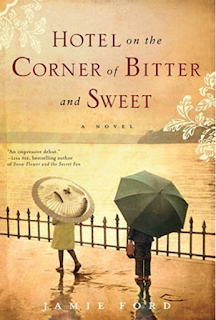
Jamie Ford’s perfectly titled book, Hotel on the Corner of Bitter and Sweet, inspired and touched me. Based on historical facts, the novel is about a middle-aged man reflecting on his childhood in Seattle during World War II. While in grammar school, Henry Lee becomes fast friends with Keiko Okabe and they bond over their non-Caucasian identities. Henry is Chinese and Keiki is Japanese, a not so remarkable fact in 2017, but a defining one in the 1940’s. After the bombing of Pearl Harbor, the United States government orders more than 125,000 Japanese-Americans to be “evacuated” from the Coast to ensure they are not spying for the Japanese. Distraught and confused by the edict, Henry races to the train station to see Keiko before she departs. Henry says, “Each person wore a plain white tag, the kind you’d see on a piece of furniture, dangling from a coat button." This description is a powerful reminder of how fear and racism can result in cruelty and injustice. Keiko and her family are taken first to a temporary relocation center outside of Seattle, and then to a permanent relocation center in Idaho. Possessions of the Japanese families were left at the Panama Hotel, a gateway between Chinatown and Japantown. (The hotel still operates today.)
Henry misses Keiko and feels the eeriness of her nearby empty neighborhood without the Japanese families. Henry’s immigrant parents don’t understand Henry. They simply want him to be perceived as American. When Henry wants to take a bus to visit Keiko in Idaho, Henry knows his parents will be opposed. Henry’s mother says, “You, me, all of us risk going to jail if we help them. I know you have a friend. The one she calls on the telephone. The one from the Rainer School? She is Japanese.” Henry worries about Keiko and wonders how she would cope if she were sent back to Japan; Keiko doesn’t even speak Japanese. Henry navigates his way to see Keiko and her family. They exchange long letters for months until eventually the letters mysteriously stop and they lose touch. Henry stays in Seattle, falls in love, marries, and has a son. Henry has made a sweet life from a bitter circumstance.
Hotel on the Corner of Bitter and Sweet is rich with history; jazz, multiculturalism, an eclectic cast of characters and several plot twists. It explores racism and xenophobia and the painful distance that can exist between immigrant parents and their American offspring. At its heart, this novel is a story about Henry and Keiko’s love in the midst of WWII when they were powerless to affect the trajectory of their lives. The book also explores Henry’s journey toward an understanding of the frailties, vulnerabilities and complexity of his parents whose rigidity and fear hurt him. Though Henry did not have the life he envisioned with Keiko, he exhibits restraint, kindness, and a generosity of spirit. And after his beloved wife Ethel dies of cancer, Henry visits the dilapidated Panama Hotel and finds a couple of Keiko’s possessions in its basement. He wonders where she might be living. Without spoiling the ending, I will say that as I finished the last page, I hoped that Jamie Ford was working on a sequel.

Throughout his life, my beloved Uncle Warren reflected on the factors and events that contributed to the choices he made. And with each passing year, his understanding of those choices expanded in scope and depth. Reading this 1987 Pulitzer Prize winning novel by Peter Taylor reminded me of my uncle Warren who passed away in 2012.
Phillip Carver is forty-nine years old and lives on the Upper West Side of Manhattan with his much younger girlfriend, Holly Kaplan. It is the early 1970’s. Phillip’s two older unmarried sisters, Betsy and Jo, have summoned him back to Memphis (the town of his adolescence) to dissuade their 80-year-old father, George Carver, from remarrying.
By today’s standards, not much happens when Phillip return to Memphis. There is no murder or mayhem, no adultery, no affairs. His sisters have simply scared away their father’s octogenarian bride. There will be no wedding. But, the trip is dramatic because Phillip begins to acquire a new perspective on the family dynamics that resulted in so many incidents of passive aggressive rage. Beneath the saccharin show of Southern manners, George Carver’s four grown children and deceased wife have suffered under George’s single-minded narcissism.
Phillip’s older brother volunteered and died in WWII. And neither Phillip nor his sisters have married or had children. When each of the three surviving siblings falls in love, their father intervenes to stop them from marrying. It is after Phillip receives his summons to Memphis that he understands the actions his father took to sabotage Phillip’s love affair when Phillip was in his early twenties. It is as if a bank of fog blocked Phillip’s view of what transpired and Phillip never wanted to see what was on the other side.
After the initial summons, Phillip Carver returns to Memphis for another visit. He says, “I was discovering that all I cared about now was how I had been treated by my family in the long-ago affair of Clara Prince.” And yet, even as Phillip puts the pieces together of his father’s sabotage, he resolves, “Forgetting the injustices and seeming injustices which one suffered from one’s parents during childhood and youth must be the major part of any maturing process."
Phillip Carver has not forgotten the injustices of his youth, but he arrives at a clearer understanding of the dysfunction of his family and how the rigid Southern social structures reinforced the oppression he and his siblings experienced. Unfortunately, Phillip’s two sisters never forgive their father even as their lives continue to revolve around him. As he ages, they love him while simultaneously seeking revenge, all the while their emotional growth is stunted and they are unable to mature. Phillip escapes, but his sisters are trapped in a world of convivial conversations and inauthentic relationships.
At its core, A Summons to Memphis is Phillip Carver’s understated and methodical reflection on the factors that shaped and stalled his life. With the evolved understanding he acquires by the end of the novel, I hope he is able to live his last thirty years without the ghosts of Memphis tormenting him.

Why does a person change? Because he or she wants to change? Because he or she needs to change? Or, as in the case of Kitty Fain, the protagonist in the novel The Painted Veil, because her very life depends on it. Written by W. Somerset Maugham and published in 1925, this novel explores yet another twist on an archetypal love triangle.
Dr. Walter Fain marries Kitty Garstin even though he is aware that she doesn’t love him. Living in London in the 1920’s when women had limited opportunities for education or employment, Kitty’s primary purpose is to find a husband. So when Kitty’s younger sister becomes engaged, Kitty agrees to marry Walter Fain, a British civil servant who has fallen in love with her. The newlyweds move to Hong Kong where Walter will work for the British Government as a bacteriologist. Kitty treats Walter with disdain and disrespect, behaviors she learned by observing her mother talk to her father. Kitty is pretty, vapid and self-centered. She lacks a moral compass and possesses little regard for other people’s feelings. It may be possible that Maugham imagines her as a metaphor for British Colonialism.
Kitty begins an affair with Walter’s boss, Charles Townsend. When Walter learns of her betrayal, he is devastated. Kitty deludes herself into believing that Charles is in love with her and will divorce his wife; however, she learns quite quickly that Charles has no such intention. With her options narrowed, Kitty has little choice but to travel with her husband to a rural and isolated part of China where he will begin work on solving the cholera epidemic.
Unmoored from the rigid class structure of British society, Kitty must rely on her own innate traits and characteristics. Watching her awareness develop makes the book feel suspenseful. As each chapter unfolds, the reader senses that Kitty and Walter might come to a mutual understanding about their shared past. But Walter’s hurt over Kitty’s betrayal is so deep that he jeopardizes his own happiness to secure Kitty’s suffering. Walter wishes he could forgive Kitty, but he is unable. His equilibrium is the tragic victim of Kitty’s carelessness.
The novel’s power derives from the uncertainty of how Kitty and Walter will deal with this new set of circumstances. Though Walter and Kitty are both victims of their own limitations, Kitty is able to grow. In the jungle, she reflects on her foolishness, her vanity, and her self-centered behavior. Kitty’s growth inspires and provides hope to Maugham’s readers. She does arrive at an understanding of herself and the choices she has made, but not through the luxury of a therapist’s couch. Instead, her understanding is gained through witnessing the suffering and cruelty experienced by her fellow human beings. She leaves her narcissistic bubble and and feels compelled to ameliorate the pain of others. Kitty Fain develops a conscience and a consciousness that allows her to forgive herself and move on. Maugham creates a rich, textured, and hopeful story of how people, sometimes in spite of themselves, can grow and change.

After the anguish of last week’s election, I looked for a book with characters that are kind, decent and removed from our current culture of crass and cruel behavior. I was so pleased to be under Kent Haruf‘s spell in his fictitious town of Holt, Colorado. In this beautiful and heartwarming novel, that was a finalist for the 1999 National Book Award, Haruf introduces his readers to several characters living in a small town on the eastern plains of Colorado. Haruf’s rich dialogue allows the characters to speak for themselves with little intrusion from the author. It’s not a deep psychological exploration, but Haruf provides sufficient psychological clues about people to make the story rewarding to read.
When high school English teacher Maggie Jones, drives up to the cattle ranch of Harold and Raymond McPherson and asks them to consider letting one of her students live with them, they are startled and shaken. The young girl is pregnant and has been evicted from her single mother’s house. The McPherson brothers have spent decades living their days in a predictable routine organized around the feeding, birthing and selling of cattle. They eat three meals a day and read the local newspaper at night. They tell Maggie they will think about it.
In explaining this option to the 17-year old girl, Victoria Roubideaux, Maggie shares why these two old brothers live together without families of their own. “Both their folks died in a highway truck wreck when these old men were younger than you are now.”
The brothers silently contemplate Maggie’s proposal and then decide to let Victoria live with them. Here is the dialogue leading up to their decision.
“All right,” Harold said. “I know what I think. What do you think we do with her?”
“We take her in,” Raymond said.
“Harold looked out into the gathering darkness. I’m talking about-why hell, look at us. Old men alone. Decrepit old bachelors out here in the country seventeen miles from the closest town, which don’t amount to much of a good goddam even when you get there. Think of us. Crotchety and ignorant. Lonesome. Independent. Set in all our ways. How you going to change now at this age of life?”
“I can’t say”, Raymond said. “But I’m going to. That’s what I know.”
Reading Harufs’s book is like traveling to a simpler time. People’s lives seem clearer and more contained. Without cell phones and constant stimulation, many of the characters say very little. They spend time thinking and pondering; they spend time alone with their thoughts. When they do speak, the reader listens. The characters are constrained by many factors including their own personalities and the small town milieu where they live. The novel is not without violence and dysfunction; there are plenty of mental health issues, a teen pregnancy, bullying and a painful divorce. But it is not the gratuitous violence and dysfunction that seems to permeate our culture today.
Since Holt is a small town, most of the characters’ behaviors and comments are restrained. They have the discipline not to say everything that comes to their mind. Each of the characters struggles and makes mistakes. But they do the best they can with who they are and what they have. By the end of the novel, the characters have grown and stretched. By spending time with these kind and decent people, I feel like I have grown and stretched with them.

Ian McEwan’s impressive novel astutely explores complicated psychological dynamics. The year is 1962. Edward Mayhew and Florence Ponting are staying at an inn perched on a bluff overlooking Chesil Beach and the English Channel. Here is the first sentence, "They were young, educated, and both virgins on this, their wedding night, and they lived in a time when conversation about sexual difficulties was plainly impossible.”
Married that morning, this novel describes their disastrous attempt to consummate their marriage. That Edward and Florence share a deep love for one another is never in doubt. Their connection is honest, playful, and respectful. Yet, they both have psychological dimensions of themselves they have not explored. After a lovely wedding and reception, their fears, expectations, and innocence infiltrate the hotel room and their easy rapport dissolves. McEwan’s precise prose describes the wrenching events and powerful emotions that end the marriage before it begins. His carefully crafted sentences operate on multiple levels. He describes the dominant factors that shaped Edward and Florence’s childhoods and offers insight into their responses to their sexual encounter. He alludes to the possibility that Florence’s father sexually abused Florence. But that possibility has not emerged from Florence’s unconscious. Edward, too, has issues. McEwan writes, ”The language and practice of therapy, the currency of feelings diligently shared, mutually analyzed, and were not yet in general circulation.” Even still, I want to climb into the book and tell Florence and Edward: Take a deep breath. You love each other. You can work this out.
Instead, Florence and Edward withdrawal from each other and develop their separate narratives about what went wrong. Given the high emotion of this intimate encounter, they feel embarrassed, ashamed, and angry. Their vulnerability and insecurities prohibit them from authentically sharing their feelings. They lash out, retreat from one another, and return to their prior lives. McEwan describes the multiple layers of miscomprehension: “And what stood in their way? Their personalities and pasts, their ignorance and fear, timidity, squeamishness, lack of entitlement or experiences or easy manners, then the tail end of a religious prohibition, their Englishness and class, and history itself. Nothing much at all."
McEwan shows us their futures without one another. He reminds his readers that one event or even one evening can change the trajectory of a life. At the end of the book, Edward is in his 60’s and is ruminating about his wedding night 40 years ago: “All she had needed was the certainty of his love, and his reassurance that there was no hurry when a lifetime lay ahead of them. Love and patience - if only he had had them both at once - would have surely seen them both through. This is how the entire course of a life can be changed-by doing nothing.” With psychological insight, McEwan provides a vivid portrait of a couple that loves each other - but tragically, in this story, love is not enough.

In my late 20’s, I read the first two novels of John Updike's Rabbit Run novels. Harry “Rabbit” Angstrom is a former basketball star bouncing between youth and adulthood in post WWII America. At age 26, Rabbit abandons his wife and young son and moves in with a prostitute. Updike depicts a world of immature characters, endless lust, serial adultery, and permanent personal isolation.
Though Updike’s writing captivated me, his characters angered me. They were neither wise nor mature. Updike did not seem to offer any insight for transcending the hollowness he describes. The books depressed me and I did not finish the series.
Twenty years later, I read The Maple Stories, published in 2009. Over three decades, Updike had written 18 stories about Joan and Richard Maple’s marriage and divorce. His detailed, clear sentences still amazed me. In these stories about the painful unraveling of the Maples’ marriage, Updike’s pen seemed less pointed. His characters were more appealing and there was a softer, gentler acknowledgement of their suffering. The story Separating, in particular, moved me.
The Maple Stories were on my mind when My Father’s Tears was published after Updike’s death in 2009. Unlike many authors I admire, Updike doesn’t focus on developing his characters’ psychological etiology. Clues about childhood development or traumatic experiences are not scattered in his stories. His books are not psychological in the ways that I appreciate.
Yet, in this last collection of stories, he beautifully captures the ruminations of an older man reflecting on his life. Yes, Updike’s constant themes of unfaithful spouses and sexual restlessness become irritating. However, these final stories focus more on his parents, grandparents, kids, and grandkids. He looks back where he came from and tells the stories that made him who he is. He describes recognizable events and makes them feel sacred.
In the title story, My Father’s Tears, Updike evokes the deep unspoken love of a father for his college bound son. They are saying good-bye at a train station. The son says, “…I was going somewhere, and he was seeing me go. I was growing in my own sense of myself, and to him I was getting smaller. He had loved me; it came to me as never before. It was something that had not needed to be said before, and now his tears were saying it. Before, in all the years and small adventures we had shared, there was the sensation stemming from him, that life was a pickle, and he and I were, for a time, in the pickle together.” This father knows that his son will not return home except to visit. The son continues, “But my father did foresee, the glitter in his eyes told me, the time consumes us--- that the boy I had been was dying if not already dead, and we would have less and less to do with each other. My life had come out of his, and now I was stealing away with it.”
My favorite story is Walking with Elizanne. It is the best story I have read about a high school reunion; in this case, that of David Kern, Updike’s alter ego. “Though the year 2000 inevitably figured in yearbook predictions and jokes, nobody had really believed that a year so futuristic would ever become the present. They were seventeen and eighteen; their fiftieth class reunion was impossibly remote. Now it was here, here in the function room of Fiorvante’s, a restaurant in West Alton, a half-mile from the stately city hospital where many of them had been born and now one of them lay critically ill.” Updike captures the determined denial of young people toward the inevitable passing of time. But would it have changed anything if David Kern and his classmates understood that their 50th reunion would quickly be upon them?
The most poignant line is when David encounters a woman at the reunion named Elizanne. She reminds David that he had once walked her home from their date and kissed her. As she describes that evening to him, he can’t recall it. Later he reflects on their conversation and remembers their date of 50 years ago. He says, “Elizanne, he wanted to ask her, what does it mean, this enormity of our having been children and being old, living next door to death?”
Updike’s ability, in a few sentences, to evoke emotion, capture places, and stimulate empathy is stunning. He does not offer a transcendent moment or resolution, but he offers his readers a moving experience. He is like a hiker who runs ahead to the top of the mountain and comes back to tell the rest of the hikers about the view from the peak. It’s not a perfect view, there are clouds in the sky and obstacles on the trail, but if we are lucky, that is where his readers are heading. His clear and haunting prose invites his readers to ponder the meaning of their lives before they reach a point where they cannot change paths. Updike does not have the answers, but he points out the signposts along the way.

I love this book by my favorite psychoanalyst/author, Irvin Yalom. As he did in his novels, When Nietzsche Wept and The Schopenhauer Cure, Yalom uses his psychoanalytic training and philosophical knowledge to construct a gripping work of historical fiction. He offers plausible theories about the internal lives of the brilliant philosopher Baruch Spinoza and the demented Nazi ideologue Alfred Rosenberg. Yalom expertly alternates between the story of Spinoza’s life as an excommunicated Jew from Amsterdam in the 17th century and Rosenberg’s life as a Nazi in 20th century Germany.
In 2007 Yalom visits the Spinoza Museum in Rijnsburg, 45 minutes outside of Amsterdam. He learns that in 1942, Alfred Rosenberg, the prominent anti-Semitic Nazi ideologue, had organized his henchmen to pack all the books from the Spinoza Museum and take them to Germany. The official Nazi Report about the looting states, “The museum contains possible early works of great importance for the exploration of the Spinoza problem.” Yalom asks himself, "Why would one of the strategists of the plot to eradicate the Jewish population in Europe personally travel to Amsterdam to over see the stealing and preserving of Spinoza’s books? Why not simply burn the museum and its contents?" It turns out that when Rosenberg made anti-Semitic comments in boarding school, the headmaster instructed him to read the German philosopher Goethe’s writings. Goethe admired Spinoza and praised Spinoza in his writings. This does not make sense to Rosenberg. How could his hero, Goethe, admire this Jewish philosopher? It is a question that haunts him.
Spinoza’s orthodox community believed that the Torah was the exact word of God and that science should not be pursued. Spinoza came to believe in a paradigm based on thought, reasoning, science and evidence, not superstition. He was a kind and gentle man, but was still excommunicated from his Jewish community. He left Amsterdam and began a life of reading, writing and contemplation of non-Talmudic authors. As Yalom states, "Spinoza’s ideas paved the way for the Enlightenment." Different from the shallow rote thinking of Rosenberg, Spinoza was curious, analytical and self-reflective. He believed that current thoughts and feelings were most likely shaped by previous experiences. He was a thinker ahead of his time.
By the 1940s, Rosenberg had risen to a high position in the Nazi Party. Yalom includes the venomous lies and disgusting insults written by Rosenberg in his Nazi sponsored newspaper. He then imagines a “therapy” that might explore Rosenberg's petrifying pathology and uncover his obsession with Spinoza and the “Jewish problem.” Yalom suggests that Rosenberg has such an extreme inferiority complex that he develops a compensating “superiority complex." Why the Jewish people are Rosenberg’s particular target is not a point Yalom dwells upon. After all, the odious bigotry of anti-Semitism had permeated many aspects of European culture for centuries. Rosenberg never repented for his involvement in the Final Solution. He was hung at the end of the Nuremberg trials.
The Spinoza Problem is another superb novel by Irvin Yalom. Integrating history, philosophy and psychology, he takes us on another deep dive into understanding why human beings behave the way they do.

Most people wish they could "redo" an event in their past. Julian Barnes in his outstanding book, The Sense of an Ending, explores the role of repression and regret and maturation and memory in the evolution of a person. He extols the virtues of refection, while acknowledging the difficulty of the task. When Tony Webster is 17 years old, he attends a boarding school outside of London in the 1950s. When he learns that his good friend Adrian and his former girlfriend Veronica are romantically involved, Tony feels hurt and rejected. He writes a mean and bitter letter mocking their relationship. Even cursing them. He graduates, marries, pursues a career and has a daughter. He thinks little about Adrian and Veronica and that period of his life.
Forty years later Veronica’s mother passes away. The mother’s lawyer notifies Tony that Veronica’s mother has left him a small sum of money and two documents, one of which is his letter. Tony learns of the letter's ramifications in the lives of his former friends. He views the letter he barely remembers writing. He states,” I reread the letter several times. I could scarcely deny its authorship or its ugliness. All I could plead was that I had been its author, then, but was not it author now. Indeed I didn’t recognize that part of myself from which the letter came.” Tony is remorseful on behalf of his younger immature self, “I was just flailing around, trying to find a way to hurt.”
I don’t want to spoil all the twists and turns in Part 2, but the story hinges on why Veronica’s mother possesses Tony’s letter and wills it to him. Tony meets Veronica again and we understand Tony’s view of the events that had transpired before the letter. There is a question lurking in the narrative, Is Tony’s story truthful? Barnes warns us in the first few pages, “…we need to know the history of the historian in order to understand the version that is being put in front of us.” Now in their 60’s, Veronica says to Tony, "You still don't get it. You never did and you never will." The novel offers a sense of an ending, but not a clear ending. Readers must come to their own conclusions.
Barnes’ brilliantly illuminates the issues of misunderstanding and denial in communication. Memories have motives of their own and feelings can override facts. Human beings can rearrange events to create a parallel narrative that excludes unwanted information and emotions. In this age of twitter posts, I am struck by the importance of considering what we say and do. Impulsive actions often hurt. Humans want to be rational, but when it comes to love, loss, pride and shame, we are captive to our emotions. We can only understand our lives by looking at our pasts; we must attempt to make good choices in the present.
![The Fire Next Time by James Baldwin [Go to Non-Fiction Review]](https://images.squarespace-cdn.com/content/v1/631f464d2bdd593ed956ba59/1663364336586-9RU91CFBC6FP3IH2M40G/baldwin.jpeg)
![Love’s Executioner by Irwin Yalom [Description by Bookshop.org ]](https://images.squarespace-cdn.com/content/v1/631f464d2bdd593ed956ba59/1663358183312-BYZ35A2MQEUFB6FIKEO7/Irwin_Yalom.jpeg)
![Sophie’s Choice by William Styron [Description by Bookshop.org]](https://images.squarespace-cdn.com/content/v1/631f464d2bdd593ed956ba59/1663357594700-R90SNY3WOR60YMC5B5P7/William_Styron+.jpeg)
![Death of A Salesman of Arthur Miller [Description by Bookshop.org]](https://images.squarespace-cdn.com/content/v1/631f464d2bdd593ed956ba59/1663363288514-6V2BFVX1JQ9XCPCMXU0R/Arthur_Miller.jpeg)
![Atonement by Ian McEwan [Description by Bookshop.org]](https://images.squarespace-cdn.com/content/v1/631f464d2bdd593ed956ba59/1663355070661-GJFS9LLJ0RCNWINQNM0D/Atonement_Ian_McEwan.jpeg)
![Never Let Me Go by Kazuo Ishiguro [Description by Bookshop.org]](https://images.squarespace-cdn.com/content/v1/631f464d2bdd593ed956ba59/1663363407216-IWJX6CFL94Z8YKJZKZ2R/Kazuo_Ishiguro++.jpeg)
Over a decade has passed since the release of M. L. Stedman’s engrossing debut novel, The Light Between Oceans. Her new novel, A Far-Flung Life, was well worth the wait. Stedman writes with empathy and compassion for the moral conundrums her characters face. The novel explores how people live in the aftermath of tragedy, the secrets they hold close, and the ways love and sacrifice can mend wounded souls.
This multigenerational story begins in 1958 in isolated Merideth Downs, a one-million-acre sheep station in Western Australia. Though the land is vast and beautiful, its ever-changing weather patterns and intrusive wildlife are unforgiving. Generations of the McBride family have farmed sheep in this rural area since 1829. Details of every birth, marriage, death, weather event and sheep activitiees are recorded in logbooks, creating a constant sense of the family’s place in both the past and future of the station. The McBride’s closest neighbors live at another sheep station 100 miles away.
Phil and Lorna McBride have three children. One day, while Phil is driving with his two sons, he swerves to avoid a kangaroo and crashes. Phil and his eldest son, Warren, are killed, while the youngest, Matt, is badly injured. Despite their profound grief, Lorna and her daughter, Rosie, try to carry on as they tend to Matt and hope for his survival. Matt does survive, though he doesn’t completely heal.
That fiery crash sparks a series of events that alter the lives of the three remaining McBrides. As the narrator observes, “It’s a reminder that solid ground, unchanged for millions of years, can rearrange itself without warning or permission. You just have to live with the new terrain. Repair what roads and fences you can. Start from scratch for the rest of it.”
At this point in the story, a disturbing plot thread emerges, and those involved must decide how to proceed. Stedman navigates this thread with sympathy, not judgment. In the hands of a less skilled writer, the book might be too difficult to read. But with Stedman’s skill and insight, the story becomes a message of acceptance, understanding, and love. These are good people wrestling with major moral dilemmas and balancing self-sacrifice with happiness.
In addition to the McBride family, other characters harbor secrets that the community considers taboo. Yet these characters are steady, conscientious members of that community, while the few folks who behave badly appear small and petty by comparison.
What Stedman’s novel conveys is that if we knew what another person has endured, we might never judge anyone harshly. The story is filled with instances of good people trying to protect those they love.
As I finished the last page, I felt appreciation for this beautiful book, which shows deep respect and understanding for the complexities of being human. M. L. Stedman’s A Far-Flung Life is both heartbreaking and hopeful. Highly recommend. 5/5