Non-Fiction Reviews
Though Fiction is my focus, these non-fiction books are important and compelling.
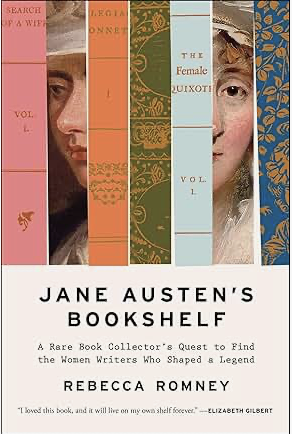
Rare book collector Rebecca Romney’s book is a literary adventure. Written in a warm and welcoming tone, the book is filled with fascinating information. A devoted Austen fan since she was young, Romney had never paused to consider Austen’s literary influences. She simply loved Austen’s six novels and concurred with scholars and lay people that Austen was “one of the greatest writers from the early 19th century.”
One day, she was invited to peruse the collection of a fellow rare book dealer. Among the items she bought was the novel Evelina by Frances Burney, one of the most successful novelists of Austen’s lifetime. Romney then read Burney’s second novel, Cecilia, published in 1782. It was in this second novel that Romney first read the words “pride and prejudice.” Romney curiosity was piqued. She thought – of course -Austen must have been inspired by the authors she was reading. She didn’t write in a bubble. Like an investigator, Romney starts to discover the women writers who influenced Austen’s writing and determine why their books have disappeared from our bookshelves.
Using her rare book dealer skills, Romney follows the clues that Jane Austen left in her novels. (i.e. In Northanger Abbey, Austen refers to the novels of three women authors.) She also reads correspondence between Austen and her family members, where Austen shares her opinion of the books she reads. One woman author leads Romney to the next. By the end of her search, Romney had discovered, acquired, and read books by eight published women writers. She finds their novels interesting, clever and witty. In doing so, Romney recreates a version of Austen’s bookshelf. She discusses their lives, their struggles and their publications. The eight women are Frances Burney, Ann Radcliffe, Charlotte Lennox, Hannah More, Charlotte Smith, Elizabeth Inchbald, Hester Lynch Thrale Piozzi, and Maria Edgeworth.
Romney’s book doesn’t diminish Austen’s preeminence as a writer. Rather, Romney’s meticulous research and insightful analysis offer a fresh perspective on Austen’s work, making Romney’s book a valuable addition to the literary discourse. She also provides a better understanding of the many reasons that these financial and literary successful novels have disappeared. Not surprising, sexism and paternalism play a persistent role.
No one description can capture the content of this book. But if you like history and literature, and especially if you are a Jane Austen fan, you will enjoy this book. 4/5

‘The 1619 Project’ is an astounding achievement by Nikole Hannah-Jones and her co-authors. This historical compilation of material focusing on the four hundred years of the Black experience in America will become a valued resource and touchpoint for generations to come. ‘The 1619 Project’ is a must-read to truly comprehend the oppressive history of our country. Despite overt hostility by many white Americans, healing, reconciliation, and progress cannot occur without an understanding of the horrific past that has led us to our troubled present.
The book begins in 1619 when a ship, ironically called The White Lion arrives in America carrying twenty to thirty enslaved Africans. The book ends in May 2020, the year George Floyd is murdered by a Minneapolis police officer. The initial transporting and enslavement of Africans set in motion the brutal exploitation of Black people that has persisted in America in various forms for the last four centuries. Floyd’s recent murder by the police punctuates the point that Black Americans continue to be oppressed by prejudice and violence. Though the book describes persistent injustice, there are also beautiful descriptions of the many impressive achievements and contributions of Black Americans.
Comprised of essays written by different authors, the eighteen chapters cover topics from music and medicine to politics and punishment. Each essay speaks to the history of the Black experience while revealing the oppressive origins of numerous American institutions. A poem or piece of fiction precedes each chapter. The joining of these two literary forms is powerful.
The book is deep and detailed. Here are two quotes by the lead author, Nikole Hannah-Jones, that summarizes the book’s focus.
“On the contrary, facing the truth liberates us to build the society we wish to be. One of the criticisms of the project is that we focus too much on the brutality of slavery and our nation’s legacy of anti-Blackness. But just as central to the history we are highlighting is the way that Black Americans have managed, out of the most inhumane circumstances, to make an indelible impact on the United States, serving as its most ardent freedom fighters and forgers of culture. The enslaved and their descendants played a central role in shaping our institutions, our intellectual traditions, our music, art, and literature, our very democracy. The struggle of Black Americans to force this country to live up to its professed ideals have served as inspiration to oppressed people across the globe. Too long have we shrouded and overlooked these singular contributions. They form a legacy of which every American should be proud.”
“We sometimes forget – and I would argue it is an intentional forgetting-that the racism we are fighting today was originally conjured to justify working unfree Black people, often until death, to generate extravagant riches for European colonial powers, the white planter class, and all the ancillary white people, from Midwestern farmers to bankers to sailors to textile workers who earned their living and built their wealth from that free Black labor and the products that labor produced. The prosperity of this country is inextricably linked with the forced labor of the ancestors of more than 30 million Black Americans, just as it is linked to the stolen land of the country’s Indigenous people.”
Without a truthful accounting and apology of America’s racist origins, healing and progress are not possible. Nikki Hannah-Jones and her talented colleagues have documented the history of Black Americans. In another time, this book could provoke changes to unjust policies and an acknowledgment of America’s transgressions past and present. Given the overt racism and hostility to democracy currently permeating our country, immediate change may not be possible. But this powerful, well-researched and beautifully written book will endure and with it the seeds of hope.

In the preface of Mimi Lemay’s magnificent memoir What We Will Become, Lemay writes, “There are no villains here, only flawed human beings. We are all a unique composition of our desires, beliefs, greatness and limitations.” This quote sets the tone for an authentic and empathic story about becoming one’s true self.
As soon as Joe and Mimi Lemay’s second daughter Em can speak, Em tells her parents, “I am a boy.” When Em and her big sister play imaginary games, Em dresses and act like a boy. When Em starts changing her clothes multiple times a day, Mimi and Joe believe their child might be obsessive-compulsive. They wonder: is this a phase? Maybe she will be gay? They conclude she is too young to be thinking about these issues. But soon, Em begins growling like a dog. Em only wants to wear boy’s clothes and asks to be called boys’ names at home. Em’s tantrums escalate while Mimi and Joe search for the best way to help their child. They meet with doctors and social workers at Children’s Hospital, talk with Em’s pre-school teacher and voraciously read about child development. Months pass and at each juncture, Em persists in wanting to be treated like a boy.
A breakthrough occurs when the family takes a trip to Disney World. Since they are away from home, Joe and Mimi allow Em to get a boy’s haircut and wear boy’s clothes. They witness a transformation. Em, who is usually sullen and testy, exhibits a lightness each time a person identifies him as a boy. Em appears happy and joyful. When they return home, they allow Em to start kindergarten identifying as a boy. Em becomes Jacob. Lemay expresses anxiety about this decision and is aware of the potential pitfalls. And though she feels sad about the loss of her daughter, her intuition tells her this is the right decision.
Children often repeat or complete the problems that plagued the prior generation. As Mimi wrestles with how to best parent her child, she shares that she, too, has been on an internal journey to find her religious identity. Miriam Netzer was born in 1976 in Jerusalem, Israel. Her parents divorced when Mimi was a toddler; Mimi and her brother lived with their observant Orthodox mother in the United States. When Mimi is in 5th grade, she requests that people call her Mimi instead of Miriam. Her mother persists in calling her Miriam. The Netzer family life revolves around observing the edicts of Orthodox Judaism. Mimi attends Orthodox schools and keeps the thousands of rules required of this sect of Judaism. Mimi’s mother, Judith, is steadfast while her daughter Mimi questions the lessons taught by the Orthodox rabbis. Mimi objects most to the daily prayer her brother is required to say, “Blessed art Thou, O Lord, Master of the Universe, who has not made me a woman.” Several schools ask Lemay to leave. Lemay’s intelligence and curiosity propel her to confront authorities who want obedience to this version of faith. Lemay's knowledge of the Torah’s valuable lessons enriches this memoir as she intersperses stories into the narrative. She doesn’t want to discard her faith; she wants to be less observant.
Because of Lemay’s struggles leaving her religious community, she has profound compassion for her child. She and her son both pay a high price to live authentic lives. In an ironic twist, Mimi’s mother’s rigidity fosters in Mimi great flexibility, which ultimately allows Em to become Jacob. What We Will Become is a layered, intimate and heartful memoir. Mimi Lemay and her husband Joe, have given their child the greatest gift a parent can give a child, the freedom to be one’s authentic self.

Pulitzer Prize-winning journalist Jose Antonio Vargas’, ‘Dear America, Notes of an Undocumented Citizen’ is a well-written and heartbreaking account of his experiences with our country’s broken immigration system and diminishing moral vision. Though the book includes immigration statistics, historical records and sociological analysis, its strength derives from Vargas’ personalization of our country’s punitive and punishing immigration policies. Look no farther than recent news reports about children being separated from their parents at the Mexican border to know that lawmakers must take action. The complication: an increasing number of policymakers oppose accepting more immigrants, illegal or legal. It appears they want to keep people of color out of our country. Vargas’s book illustrates the critical importance of compromise and the necessity for a transparent process for immigration. A resolution will benefit not just immigrants but repair the soul of our country.
In 1993, when Vargas was 12-years old and living in the Philippines, his mother told him they were going to live with her parents in America. He would fly first with an “uncle,” and soon, his mother would follow. The “uncle” turned out to be a smuggler whom his grandfather had paid. Vargas’s story echoes the experience of millions of children (many who are now referred to as Dreamers) who were brought to the United States illegally by parents who wanted a better life for their children.
He moved into his grandparents’ house in Mountain View, California, in Silicon Valley. Though his Mom’s arrival kept getting delayed, he worked hard to become “American.” He was bright, curious and became very involved in his middle school and high school. Everything changed when he turned 16. Without telling his grandparents, he went to the DMV to obtain his driver’s permit. The bureaucrat told him his green card was fake. He biked home in a panic. His grandfather said in Tagalog, “You are not supposed to be here.” Those words haunted him for years.
And yet, he couldn’t return to the Philippines either. His passport was fraudulent. He says of his large extended family that had immigrated legally, “They had conspired to send me to America to give me a better life without realizing they had created a nightmare for me. And I was scared. I couldn’t stay legally. I couldn’t leave legally either. I was trapped.”
Vargas shifts into overdrive to “earn” his place in America. He confides in trusted adults in his school community who embrace him. They help him apply to college, obtain a scholarship and navigate newspaper internships. Vargas feels free writing and reporting. “I realized that writing was the freest thing I could do, unencumbered by borders and legal documents and largely dependent on my skills and talent.” Soon he writes for several eminent publications, including the San Francisco Chronicle, Washington Post and the New Yorker.
Yet, the cost of lying, passing and hiding extracts a substantial emotional price. Vargas’ anxiety soars as he fears exposure. He makes “illegal” choices as he continues working and living in a legal no-man’s land. He asks his readers,” If you wanted to have a career if you wanted to have a life, if you wanted to exist as a human being, what would you have done?” When he turns thirty, he decides to share his undocumented legal status publically. He notes how pundits, policymakers, and American citizens don’t understand the immigration system. People say, “Just get to the back of the line and all will be good,” and Vargas wants to scream, “THERE IS NO LINE. THERE IS NO PROCESS. IN THE EYES OF THE LAW, I DO NOT EXIST.”
Vargas’s book is both insightful and inspiring. He understands the political and racial dimensions of this issue. He says, “When white people move, then and now, it’s seen as courageous and necessary, celebrated in history books. Yet when people of color move, legally or illegally, the migration itself is subject to the question of legality. Most immigrants, he reminds us, love America, obey the laws and pay their taxes.
For Jose Antonio Vargas and his fellow Dreamers, the United States is their home. By sharing his undocumented status, he has sacrificed a great deal. His journey continues to be painful, with no resolution in sight. He reminds us of what many Americans seem to forget: except for Native Americans, we are all immigrants.

Full Disclosure: Alex Kotlowitz is a good friend.
Alex Kotlowitz’s 1991 New York Times bestseller There Are No Children Here chronicles the lives of Pharaoh and Lafayette Rivers, two young brothers living in the Henry Horner Homes project on the West Side of Chicago. Perceptive, poignant and painful, that groundbreaking book detailed how poverty and violence robbed these boys of their childhoods.
Kotlowitz’s newly published book An American Summer reads like a sequel. In the twenty years after There Are No Children Here, “14,033 people were killed, another roughly 60,000 wounded by gunfire.” These statistics are shocking. Returning to West and South Side neighborhoods, Kotlowitz updates us on residents he first met in the 1980s and introduces us to people connected to the 172 victims of violence in the summer of 2013.
Why has this violence persisted? Kotlowitz makes this observation; “These are young men and women who are burdened by fractured families, by lack of money, by a closing window of opportunity, by a sense that they don’t belong, by a feeling of low self-worth. So when they feel disrespected or violated, they explode, often out of proportion to the moment, because so much other hurt has built up and then the dam bursts. They become flooded with anger.” In a series of stories, we witness this dynamic. When a gang member sees a sign of disrespect, a small disagreement can escalate into murder and mayhem. The inclination to clarify misunderstandings or think through decisions is missing. These troubled African-American and Hispanic communities are like powder kegs of raw emotion.
Why residents of these communities have not turned their anger toward the Chicago power structure that ignores their plight confounds me. Kotlowitz reflects on this: “You grow up in a community with abandoned homes, a jobless rate of over 25 percent, underfunded schools and you stand outside your home, look at the city’s gleaming downtown skyline, and its prosperity, and you know your place in the world.” So instead of demanding respect from those who live in these bastions of privilege, people in this other Chicago demand respect from their local rivals.
Weaving together correspondence and personal interviews, Kotlowitz illuminates the thoughts and feelings of people living in this war zone. He shows the hopes and dreams of parents and the fears and frustrations of siblings and spouses. He also captures the energy, support and sacrifices by teachers and counselors. Many of the young men feel remorse, guilt and doubt about their role in the violence. One young man wants punishment. Another feels he let his family down. One doesn’t want to utter his victim’s name because it will make his crime feel real.
Bail hearings, courtroom trials and prison visits dominate people's lives. Innocent bystanders die in the crossfire and PTSD infiltrates the community. Many kids fear they will die young. Residents of these neighborhoods know not one, but several people who have died from gun violence. The madness continues, in part, because witnesses rarely come forward. In one chapter we learn, “Even though neighbors, family, friends, witnesses and the police are certain who killed Ramaine Hill, there has not been, and may never be an arrest or prosecution.” Retaliation shooting is commonplace for those who do testify.
An American Summer bears witness to the human toll of relentless violence. Like Studs Terkel, Upton Sinclair and Elliot Liebow, Kotlowitz shows us the complexity, humanity and nuances of people’s lives. While he offers no specific solution, he makes evident that poverty, racism, educational inequality, scarcity of jobs and the ubiquity of guns are the root causes of this tragedy. Instead of consciously (or unconsciously) blaming the people growing up in these harsh conditions, we should all be ashamed that our fellow citizens are abandoned to this fate.

This review was published in the San Francisco Examiner on February 17, 2019
http://www.sfexaminer.com/inheritance-gripping-memoir-family-love-identity/
In her thoughtful and gripping new memoir, “Inheritance”, Dani Shapiro recounts the shock and sorrow of discovering that she was conceived by artificial insemination. Not only is her father not her biological father, she loses her proud identity as a one-hundred-percent Ashkenazi Jew. Fifty-four years old, an only child with deceased parents, Shapiro feels like an earthquake has destroyed the foundation of her life. She is left to determine what of her identity remains and how she will integrate this revelation into her life.
This book is a fascinating read by a gifted writer. At one level, it is a mystery: Who is her biological father? At another level, it is a psychological drama. Why didn’t her parents tell her? At yet another level, it is an investigation into artificial insemination. Are there records from this defunct clinic?
While she pursues answers to these questions, she absorbs each new fact with understanding, empathy and grace. Shapiro’s memoir is made richer by the ruminations of rabbis, relatives, therapists and doctors with whom she consults.
Shapiro describes a difficult childhood. Her parents, Paul and Irene, had a complicated marriage, burdened by bitterness and resentment. Her mother’s volatile personality had a corrosive effect on the household. But her father’s unconditional love and acceptance sustained Shapiro. She went to Yeshiva, spoke Hebrew and spent Saturday mornings with him at synagogue. He came from a long line of respected Orthodox leaders, which gave Shapiro a sense of grounding, pride and belonging.
Yet Shapiro often felt like an outsider. Seared into her memory is a survivor’s comment, “We could have used you in the ghetto, little blondie. You could have gotten us bread from the Nazis.” Early on, she experiences the feeling of being included and excluded from her community. Shapiro says, “Now I know that it was the kernel of truth embedded in that memory that kept it intact for me.”
The book’s most intriguing theme is the impact of secrets. Had her parents just deceived her or had they also deceived themselves? Did they come to believe Paul was her biological father? She concludes about her parents, “If it wasn’t thought, it wasn’t so. If it wasn’t spoken, it hadn’t happened. Except that secrets, particularly the most deeply held ones, have a way of leaching into everything surrounding them.”
Using social media and genealogical websites, Shapiro finds her biological father, now a doctor and medical ethicist she calls Ben Walden. When Shapiro watches him lecture on YouTube, she is startled by their resemblance. She sends him an inquiry and he confirms he donated sperm to a clinic in Philadelphia in the 1960s. One strand of the story follows the complicated, beautiful evolution of their relationship.
Sprinkled with literary, psychoanalytic and philosophical references, the book ponders assumptions about identity. By the end, Dani Shapiro seems to have found peace. The central enigma of her life is known. “Their trauma became mine–had always been mine. It was my inheritance, my lot. My parents’ tortured pact of secrecy was as much a part of me as the genes that had been passed down by my mother and Ben Walden.”
Though Shapiro will probably continue to wrestle with the implications of this genetic surprise, she feels blessed by the man she comes from AND the man who loved her into being. Shapiro says of her father, Paul, “I was connected to him on the level of neshama (Hebrew word for soul), which had nothing to do with biology, and everything to do with love.” In the end, love is her beautiful inheritance.
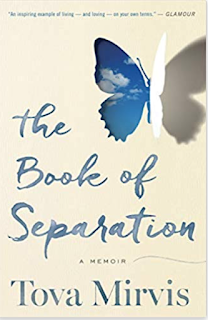
When my dear friend Karen gave me Tova Mirvis’ memoir, The Book of Separation, I was quite pleased. I had read Mirvis’ novels, The Ladies Auxiliary and Visible City and thought she wrote with insight and passion. This memoir’s honesty is harrowing as she wrestles with leaving her marriage and her religion to veer from the path that generations of her family had followed. Finding one’s own way is a terrifying proposition for a person who has always lived within the strict religious and social strictures of Modern Jewish Orthodoxy.
Tova Mirvis grew up in an Orthodox home with her parents and two siblings in Memphis, Tennessee. Her youthful memories are warm and wistful when her days filled were filled with love and certainty. She grew up knowing who she was (or thought she was) and what her parents, the community and God expected of her. Every aspect of her life was influenced by the family’s local synagogue and she believed that God was watching her every move. As she grew older and more reflective and thought she might want to be a writer, she begins to question her belief in God and the multiple Talmudic rules regarding food, clothing, friends, transportation and relationships.
Nonetheless, she becomes engaged to her Orthodox husband just twelve weeks after meeting him at Columbia. The mandated rituals related to her marriage illuminate the second-class status of women and anger her. Yet she proceeds, while her husband-to-be never seems to consider deviating from the edicts that govern his life. They have three kids and except for a few small concessions, she obeys the rules. She wears the required wig and prescribed modest clothes, she keeps a Kosher home and observes the relevant rituals for each Holiday. Yet, it was becoming more difficult to adhere to the letter of the law. She and her husband constantly argue. Though Mirvis probably wanted to protect his privacy, the book would have been stronger if she had offered examples of their arguments.
Mirvis’ anger is most apparent when discussing the dictates governing sexual relationships even between married couples. After being told for years that desire is bad, once a woman is married she is considered impure. Sex is regulated by religious rules and women are required to visit the mikvah each month to be cleansed and inspected.
Being a writer made Mirvis’ path harder. She states, “You can’t create freely if you’re always aware of where the borders of permissibility lie.” She understood that her questioning would provoke anger and judgment, “I knew that in a highly codified world, the inner life posed a threat. I knew that these rabbis’ mission was to keep people in side the bounds of the laws. They didn’t believe there were other good or true ways to live, didn’t want their children of their students or their congregants to think that there was a legitimate choice to be made.”
Mirvis tells her readers early in her memoir that Tova means good. She is haunted by the possibility of not being good and therefore not being loved. “This, more than anything was the iron bar across the exit door – love was what tied you and kept you inside. Love, was what you risked losing if you wanted to choose for yourself.”
Mirvis’ ability to write in painstaking detail about the requirements of life on the “inside” is impressive. As angry as she becomes, her descriptions are not cruel and she does not condemn those who remain in the community and adhere to the regulations that chaffed against her consciousness. At the end of the memoir, Mirvis doesn’t leave Judaism, but she leaves the orthodox community. Her parents, her brother and her sister still love her. They have not shunned her. They have allowed her to find her way outside the community as they continue within. As her children age, her memoir will be a gift to them. They will read of her struggle and may even come to understand it. As she says to her son, “ You’re allowed to change, even when it’s painful. You’re allowed to decide who you want to be.”

As spring turns to summer, newspapers and magazines devote entire sections to books recommendations. Some provide shorts lists and some long reviews. As I peruse these lists, I delight in pondering the book possibilities for this summer.
To add another dimension to this enjoyable endeavor, my husband recently gave me Pat Conroy’s 2010 book, My Reading Life. I have admired Pat Conroy’s since I read his well-known novel The Prince of Tides in the 1980’s. Conroy’s novels draw from his social isolation as a kid moving from military base to military base and the physical and emotional abuse he endured from his fighter pilot dad, Don Conroy. Conroy writes like a poet when he describes a place, he thinks like a psychologist when he writes about people and he transports his readers into his stories with his lyrical prose.
"My Reading Life" is not a work of fiction; rather it is a collection of fifteen essays. Taken together, these essays represent a homily of respect and reverence for the role that novels played in Pat Conroy’s life.
In his first essay, Conroy shares the origins of his obsession with books and the critical contributions they made to his well being. Not to be too Freudian, but his first essay is like a prayer of thanksgiving to his mother, Peg Conroy. He says, “I tremble with gratitude as I honor her name”. He says of his mother, “Novels taught her everything she needed to know about the mysteries and uncertainties of being human.”
Many of the benefits that Conroy ascribes to his mother’s reading life, apply to Conroy as well. Because his family constantly moved and his father terrorized his family, he felt a deep loneliness. Books and libraries became safe places where he could escape the isolation he felt. It wasn’t until he went to high school in Beaufort, South Carolina that he felt some sense of stability. In his essay titled, The City, Conroy states, “At any time, I could take a sudden departure from the fighter pilot’s house and find myself drifting through the tumult of Paris described in a book by Balzac. I could find myself on Whitman’s river-shaped Manhattan or be in Daisy Buchanan’s arms when I woke up with a hangover in the Great Gatsby. I’ve used books to take me on journeys all over the world, to outer space and to forbidden planets beyond.”
In other essays, Conroy acknowledges with gratitude his relationship with a series of father figures that embraced him. First among these men is his beloved English teacher Gene Norris. He says, “Gene Norris didn’t just make his students love books; he made us love the entire world. The world of books was a sacred grove to him.”
He writes about his love of bookstores and collecting books. His shares his experience of teaching literature to African-American kids on Daufuskie Island and writing his novel The Great Santini in Paris. He knew that rigorous reading would improve his writing. Yet his primary motivation for writing was more therapeutic. He says, “Writing is the only way I have to explain my own life to myself.”
Conroy celebrates dozens of novels and their authors in these essays and offers meaningful musings on their importance to him and to the literary canon. He admires Proust, Balzac, Wolfe, Hemingway, Austen, Dickens, Eliot, Wolfe, Steinbeck, Salinger, Fitzgerald, Dickens and Dickey but in his essay The Count he asserts that War and Peace is the finest novel ever written.
As you consider your own summer reading list, I would recommend My Reading Life. It will inspire you and remind you of the magical, mysterious and mystical moments that can be experienced when reading a compelling novel or this collection of Conroy’s beautiful and wise essays.

In his memoir Between Them, the writer Richard Ford attempts to describe the lives of his parents Edna and Parker Ford both born in Arkansas in the first decade of the twentieth century. It is gripping to see a writer of Ford’s talents string together words that so vividly bring his parents’ lives into focus. In two different essays written thirty years apart, Ford seeks to make a permanent acknowledgment of his parents’ time on this earth and through his writing better understand them. He says, “The fact that lives and deaths often go unnoticed has specifically inspired this small book about my parents and set its task. Our parents’ lives, even those enfolded in obscurity, offer us our first, strong assurance that human events have consequences.”
Ford’s parents’ lives were ordinary by most measures, but of course, they were the center of Ford’s identity. He describes their outward lives almost as a timeline filled in with dates and places. Yet, he is interested in their inner lives, elusive to him then and elusive still in this 2017 book. They had both lived and died and Ford was left to consider all he knew about them and all that he did not. And isn’t that true for all of us: we have incomplete knowledge of our parents’ lives. As a way of explanation, Ford says, “There had already been so much important life before me –of which I knew little, and that to them did not bear talking about since it did not include me.”
Ford’s parents fell in love. They married in 1928 and did not have him until 1944. As he grew up, Ford felt loved by his parents yet peripheral to their deep connection. During those prior fifteen years, Ford’s mother traveled with her husband from town to town while he made sales calls selling starch for the Faultless Company. When Ford was born, his parents decided they needed a home base. They chose Jackson, Mississippi, the center of his father’s territory. In a very poignant passage, Ford imagines the loss his father might have felt after his wife stopped traveling with him. “And how was it for him? Driving, driving alone? Sitting in those hotel rooms, in lobbies, reading a strange newspaper in the poor lamplight; taking a walk down a street in the evening, smoking? Eating supper with some man he knew off the road? Listening to the radio in the sweep and hum of an oscillating fan. How was it being a father this way – having a wife, renting a house in a town where they knew almost no one and had no friends, coming home only weekend, as if this were home?” And what of his mother, this dramatic change to her life? When Ford became an adult he never asked them.
Ford’s book spoke to me. In our busy modern lives, we avoid asking meaningful questions of those we love until it is too late. His book speaks to his parents’ external lives while longing to understand their inner lives. His analysis is beautifully written, but not psychologically penetrating. He doesn’t seem to probe too deeply about the effects of Edna and Parker Ford in shaping who he grew up to be. Yet, in the afterword, Ford summarized, “I was fortunate to have parents who loved each other and out of the crucible of that great, almost unfathomable love, loved me. Love as always confers beauty." Whatever distance Ford felt towards his parents, he felt sustained and supported by their imperfect love.

Utter the name Freud and people will often respond with obvious emotion. Even if they have never read one of Freud’s two-dozen books, his thousands of letters or one of the many biographies, Freud’s name evokes a reaction, and not always positive (which of course means something). While Darwin explored the biological evolution of humans, Galileo explored the heavens, and Columbus discovered new continents, Freud set out on a different type of journey. He sought to discover the vast unexplored territories that exist within each of us. Freud didn’t want to simply describe human behavior; rather he wanted to understand the hidden sub-conscious motivations of individual human behavior.
Though I have read several books about different aspects of Freud’s life, I recently reread Adam Phillips’ incisive and illuminating 162-page biography, Becoming Freud The Making of an Analyst. Using lucid language, Phillips, a psychoanalyst himself, insightfully conveys Freud’s journey from young Jewish medical school student to the creator of psychoanalysis. Phillips argues that because Freud experienced persistent anti-Semitism, he reconciled himself to pursuing a less conventional professional path. In addition, Phillips believes that Freud was fortunate that the power of religious explanation was losing its authority toward the end of the 19th century. Freud did make some erroneous judgments and conclusions, yet his quest to develop words to connect to emotion was unprecedented. Phillips acknowledges these limitations yet also explores the confluence of factors that propelled Freud toward his theories of the internal emotional development of human beings, something that didn’t exist prior to Freud. In this, he reminds us that in attempting to uncover the continent of the unconscious Freud remains the original explorer or the human psyche.
Here are my six favorite Philips’ quotes that succinctly capture the essence of a few of Freud’s theories.
“Freud will show us how and why we bury the facts of our lives, and how, through the language of psychoanalysis, we can both retrieve these facts and describe them in a different way.” p. 4
“In Freud’s view we are defensive creatures simply because we have so much to defend ourselves against; our fears of the external world are second only to our fear of the internal world of memory and desire, and both are warranted (it was Freud that made the ordinary word “defense” such an important part of common currency). “ p. 8
“What some modern people couldn’t help but notice after Freud, through their symptoms, their dreams, their slips of the tongue and their bungled ambitions, -especially modern people who were no longer religious believers was how unconscious they were, how removed from a clear sense of their own intentions, how determinedly ignorant they were about their pleasure.” p. 14
“And the truths of psychoanalysis Freud would find, are often revealed by the repetitions in people’s lives, in the things that keep happening to them, and the things they keep doing despite themselves, and that therefore insist on being thought about.” p.28
“What he called the “transference” in his fragment of an Analysis of a Case of Hysteria (the Dora case) what the patient transferred on to the doctor as expectation, hope, and fear –Freud would see as the essential clue to the patient’s suffering. p. 130
“The dream, like the joke, reveals people, from a psychoanalytic point of view, to be in hiding; consciously in hiding from the disapproving others, but unconsciously hiding from themselves. “ p.144
Though people criticize Freud, I for one, am grateful for his desire to understand people, not judge them. Adam Phillips’s excellent book provides a clear and concise description of Freud’s trajectory toward becoming an analyst. Phillips acknowledges Freud’s important breakthrough in identifying a language that helps people understand their behavior and the behavior of others. No matter what you think of Freud, his contribution to humanity is akin to that of other early scientists. We remember him not because every one of his ideas is still considered correct, but because he started us down the road to a better understanding of the human condition.

In the About Me section of this blog, I mentioned that I am fascinated by the question of why people behave the way they do. Of course the answer is complex, multi-faceted, and ultimately unknowable. Nonetheless, I keep thinking about the question. I recently read Anne Ancelin Schutzenberger’s intriguing book: The Ancestry Syndrome: Transgenerational Psychotherapy and the Links in the Family Tree. Though I don’t generally review non-fiction books, her theory grabbed my imagination.
For those who suffer or simply seek self-understanding, Schutzenberger advocates for a therapy that focuses on discovering important events multi-generationally. She is interested not only in the lives of one’s parents but in significant events across that person’s family tree. A quote on the first page by St. Augustine reveals her thesis, “The dead are invisible; they are not absent."
Schutzenberger believes that we all unknowingly repeat family patterns until we understand them. She states, “It seems the unconscious has a good memory, likes family bonds and marks important life events by repetition of date or age. This is the anniversary syndrome.” Drawing on Sigmund Freud, J.L. Moreno, Carl Jung, and many other psychologists and philosophers, Schutzenberger outlines how events and traumas can pass between generations. Using case studies and examples from her practice, Shutzenberger argues that the study of one’s ancestors can often unlock the source of troubling feelings and finally stop the repetition of unhealthy behaviors.
It makes sense to me that family patterns can persist through generations. What Schutzenberger adds to the discussion is the theory that a person can unconsciously experience the emotional fallout of an injurious event that was initially experienced by an unknown ancestor. Shutzenberger’s most vivid examples are ones that involve trauma. She discusses the impact of African American enslavement, the Armenian genocide, and the Jewish Holocaust. “We continue the chain of generations, and, knowingly or not, willingly or unwillingly, we pay debts of the past: as long as we have not cleared the slate, an 'invisible loyalty' impels us to repeat and repeat a moment of incredible joy or unbearable sorrow, an injustice or tragic death. Or its echo.” Her case studies are fascinating. She quotes Freudian analysts Nicholas Abraham and Maria Toruk, “The phantom is a formation of the unconscious that has never been conscious – for good reason. It passes - in a way yet to be determined – from the parent’s unconscious to the child's."
What seems to permeate Schutzenberger’s work can be summed up by another Abraham and Toruk quote, “What haunts us are not the dead, but the gaps left within us by the secrets of others.” This book may or may not be your cup of tea but it does add another fascinating dimension to the discussion of why people do what they do.

Most of the books I read and review are fiction. But given the ubiquity of racial issues in the news, I recommend this National Book Award winner Between the World and Me by Ta-Nehisi Coates. In this short and powerful book, Coates shares a letter he wrote to his 15-year old son, Samuri, about his experience of inhabiting a black body in America.
As incidents of violence toward black men multiply, Coates empathizes with what his son might feel. “I am writing you because you saw Eric Garner choked to death for selling cigarettes; because you know now that Renisha McBride was shot for seeking help; that John Crawford was shot down for browsing in a department store.” In an illuminating section, he reflects back on the fear that gripped his parents and his fellow teenagers, “I think back on those boys now and all I see is fear of the bad old days when the Mississippi mob gathered round their grandfathers so that the branches of the black body might be torched, then cut away. The fear lived on in their practiced bop, their slouching denim, their big T-shirts, the calculated angle of the baseball caps, a catalog of behavior and garments enlisted to inspire the belief that these boys were in firm possession of everything they desired.”
America struggles to overcome discrimination through legislation, adjudication, and cultural changes. However, I believe that until the psychological scars of slavery are acknowledged and a formal apology for slavery is made, it will be difficult for our country to move forward. Yes, progress has been made; we elected a black man President. But, we hardly live in a post racial society. Look at the Republican nominee who persists in his accusation that President Obama is not an American. It’s racism with a different facade. Paul Waldman, a Washington Post reporter, writes, “It’s an unfathomable cruel and dispiriting message to send to African Americans. It says to them, no matter how smart and hard-working you are, no matter how much you achieve, no matter how carefully you make yourself unthreatening to the white majority, no matter how deftly you manage to move through the most elite institutions in America and dazzle everyone with your talents, you will still not be accepted as a genuine citizen of this country. You could become president of the United States and they will literally demand to see your papers, and even when you give in to this vile demand they will still deny that you are American.”
Race is not buried deep in America’s collective consciousness. It seems just under the surface ready to emerge at any moment, often in violence. As Coates, his son, and the rest of America watch African Americans shot and killed, Coates points out how this violence echoes the years of slavery and Jim Crow. In contrast to Germany and South Africa, who apologized for the horror their countries inflicted on others, a complete acknowledgement of the odious and reprehensible institution of slavery has not occurred in America. Like an adult who resists discussing a traumatic childhood with a therapist, the elected leaders of our country resist discussing the injustices of our country’s childhood.
Coates writes lyrically and poetically about the indignities and discrimination African Americans endure. The white majority (“those who believe themselves to be white”) live in denial that America was built on the backs of black men and women. Coates advises his son, “But you cannot arrange your life around them and the small chance of the Dreamers coming into consciousness. Our moment is too brief. Our bodies too precious.”
It is tragic that even as progress is made, there are many regressive forces trying to push the country back in time. As Coates says to his son toward the end of his letter, “You have been cast into a race in which the wind is always at your face and the hounds are always at your heels.” Between the World and Me is not an easy read, but it is an important one.
James Baldwin’s The Fire Next Time is a searing indictment of the systemic racism perpetrated by white Americans against their Black brethren. Written in 1962 and 1963, the two essays that comprise the book describe the suffering and humiliation African-Americans have endured in America. Though some progress has been made since publication, this book seems as powerful now as in the 1960s. Look no further than the murder of George Floyd by four Minneapolis police officers to see the persistence of racism and violence against Black Americans.
In the last few weeks, however, White Americans finally seem more receptive to viewing the long list of murders as part of a systemic problem, rather than another aberration. Black Lives Matter signs have sprouted in many communities and scores of companies, sports teams, and government entities are making long-overdue changes. Yet, so much work must be done.
There are a plethora of excellent books about race currently on the bestseller lists, yet Baldwin’s book is seminal. His prose is mesmerizing with its psychological, political, literary and religious underpinnings. The two pieces are a passionate plea for white Americans to understand our history, end the violence and cease discrimination in America’s institutions. Baldwin is not optimistic. He recognizes that most people prefer superiority to equality. It is hard to do justice to Baldwin’s writing. Instead, I will share a few quotes.
In Baldwin’s letter to his nephew, he writes,
“You were born where you were born and faced the future you faced because you were black and for no other reason. The limits of your ambition were, thus, expected to be set forever. You were born into a society which spelled out with brutal clarity, and in as many ways as possible, that you were a worthless human being. “
“The really terrible thing, old buddy, is that you must accept them (white people). And I mean that very seriously. You must accept them and accept them with love. For these innocent people have no other hope. They are, in effect, still trapped in a history which they do not understand; and until they understand it, they cannot be released from it. They have had to believe and for many years, and for innumerable reasons, that black men are inferior to white men. Many of them, indeed, know better, but, as you will discover, people find it very difficult to act on what they know.”
In the second article titled Letter From A Region In My Mind, Baldwin describes the injustice Black Americans experience.
“The brutality with which Negroes are treated in this country simply cannot be overstated, however unwilling white men may be to hear it. In the beginning-and neither can this be overstated – a Negro just cannot believe that white people are treating him as they do; he does not know what he had done to merit it. And when he realizes that the treatment accorded him has nothing to do with anything he had done, that the attempt of white people to destroy him -for that is what it is – is utterly gratuitous, it is not hard for him to think of white people as devils.”
“I am, then, both visibly and legally the descendant of slaves in a white, Protestant country, and this is what it means to be an American Negro, this who he is - a kidnapped pagan, who was sold like an animal and treated like one, who was once defined by the American Constitution as ‘three-fifths’ of a man, and who, according to the Dred Scott decision, had no rights that a white man was bound to respect.”
Not surprisingly, Baldwin emigrated to France in the early 1950s. He believed that America must end the “racial nightmare” not just for African Americans but for the benefit of all Americans.
In these times of political chaos and racial violence, Baldwin’s views remain prophetic and critical to our democracy.