
Recent Reviews

The Spinoza Problem by Irvin D. Yalom
I love this book by my favorite psychoanalyst/author, Irvin Yalom. As he did in his novels, When Nietzsche Wept and The Schopenhauer Cure, Yalom uses his psychoanalytic training and philosophical knowledge to construct a gripping work of historical fiction. He offers plausible theories about the internal lives of the brilliant philosopher Baruch Spinoza and the demented Nazi ideologue Alfred Rosenberg. Yalom expertly alternates between the story of Spinoza’s life as an excommunicated Jew from Amsterdam in the 17th century and Rosenberg’s life as a Nazi in 20th century Germany.
In 2007 Yalom visits the Spinoza Museum in Rijnsburg, 45 minutes outside of Amsterdam. He learns that in 1942, Alfred Rosenberg, the prominent anti-Semitic Nazi ideologue, had organized his henchmen to pack all the books from the Spinoza Museum and take them to Germany. The official Nazi Report about the looting states, “The museum contains possible early works of great importance for the exploration of the Spinoza problem.” Yalom asks himself, "Why would one of the strategists of the plot to eradicate the Jewish population in Europe personally travel to Amsterdam to over see the stealing and preserving of Spinoza’s books? Why not simply burn the museum and its contents?" It turns out that when Rosenberg made anti-Semitic comments in boarding school, the headmaster instructed him to read the German philosopher Goethe’s writings. Goethe admired Spinoza and praised Spinoza in his writings. This does not make sense to Rosenberg. How could his hero, Goethe, admire this Jewish philosopher? It is a question that haunts him.
Spinoza’s orthodox community believed that the Torah was the exact word of God and that science should not be pursued. Spinoza came to believe in a paradigm based on thought, reasoning, science and evidence, not superstition. He was a kind and gentle man, but was still excommunicated from his Jewish community. He left Amsterdam and began a life of reading, writing and contemplation of non-Talmudic authors. As Yalom states, "Spinoza’s ideas paved the way for the Enlightenment." Different from the shallow rote thinking of Rosenberg, Spinoza was curious, analytical and self-reflective. He believed that current thoughts and feelings were most likely shaped by previous experiences. He was a thinker ahead of his time.
By the 1940s, Rosenberg had risen to a high position in the Nazi Party. Yalom includes the venomous lies and disgusting insults written by Rosenberg in his Nazi sponsored newspaper. He then imagines a “therapy” that might explore Rosenberg's petrifying pathology and uncover his obsession with Spinoza and the “Jewish problem.” Yalom suggests that Rosenberg has such an extreme inferiority complex that he develops a compensating “superiority complex." Why the Jewish people are Rosenberg’s particular target is not a point Yalom dwells upon. After all, the odious bigotry of anti-Semitism had permeated many aspects of European culture for centuries. Rosenberg never repented for his involvement in the Final Solution. He was hung at the end of the Nuremberg trials.
The Spinoza Problem is another superb novel by Irvin Yalom. Integrating history, philosophy and psychology, he takes us on another deep dive into understanding why human beings behave the way they do.
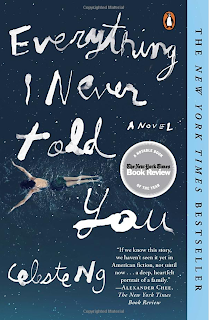
Everything I Never Told You by Celeste Ng
This poignant novel by Celeste Ng explores the deleterious effects of emotional isolation, especially in a family. James and Marilyn Lee are parents to teenagers, Nathan and Lydia, and their younger sister, Hannah. The parents do their best and still let their three kids down. They are not bad people, just wounded people. Like a forensic psychologist, Celeste Ng pieces together the factors that lead to the death of middle daughter, Lydia. It is a tragic story.
James, a gifted Chinese American student, meets his wife, Marilyn, when he is a young professor at Harvard and Marilyn is one of his undergraduates. They had both grown up as only children, isolated, alone and distant from their own parents. They fall in love, get married and cling to each other on their own emotional island. Marilyn has dreams of becoming a doctor while James seeks acceptance as a respected professor of American history. When James is denied tenure, probably due to his ethnicity, they retreat to a small college town in Ohio.
I feel for the Lee Family and admire Ng’s excavating of their relationships. Though Marilyn and James are bright, their emotional capacities are limited. They lack the skills to help one another. When kids arrive, they simply expand their islands of isolation. Marilyn gives up her dream of becoming a doctor, causing her great pain. The kids feel oppressed by their parents’ yearnings and desires for them. Nathan, the oldest, reminds James of his own isolation as a young person and Lydia the middle daughter becomes the repository of her mother’s thwarted ambitions. Hannah, the youngest daughter, is somewhat neglected. Marilyn and James love their kids, but they can’t connect to who they really are. They offer no message: Be who you are. We love you. The parents are distracted and anxious as they project and transfer their feelings onto Nathan and Lydia. The kids feel their parents’ vulnerabilities and want to protect their parents from the truths about their high school lives. There are plenty of subplots in the book as well as undercurrents of racism and sexism. Ng’s novel provides an excellent exploration of this heartbreaking family dynamic.
The book’s title is Everything I Never Told You, but really it should be - Everything We Never Told Each Other.

The Sense of an Ending by Julian Barnes
Most people wish they could "redo" an event in their past. Julian Barnes in his outstanding book, The Sense of an Ending, explores the role of repression and regret and maturation and memory in the evolution of a person. He extols the virtues of refection, while acknowledging the difficulty of the task. When Tony Webster is 17 years old, he attends a boarding school outside of London in the 1950s. When he learns that his good friend Adrian and his former girlfriend Veronica are romantically involved, Tony feels hurt and rejected. He writes a mean and bitter letter mocking their relationship. Even cursing them. He graduates, marries, pursues a career and has a daughter. He thinks little about Adrian and Veronica and that period of his life.
Forty years later Veronica’s mother passes away. The mother’s lawyer notifies Tony that Veronica’s mother has left him a small sum of money and two documents, one of which is his letter. Tony learns of the letter's ramifications in the lives of his former friends. He views the letter he barely remembers writing. He states,” I reread the letter several times. I could scarcely deny its authorship or its ugliness. All I could plead was that I had been its author, then, but was not it author now. Indeed I didn’t recognize that part of myself from which the letter came.” Tony is remorseful on behalf of his younger immature self, “I was just flailing around, trying to find a way to hurt.”
I don’t want to spoil all the twists and turns in Part 2, but the story hinges on why Veronica’s mother possesses Tony’s letter and wills it to him. Tony meets Veronica again and we understand Tony’s view of the events that had transpired before the letter. There is a question lurking in the narrative, Is Tony’s story truthful? Barnes warns us in the first few pages, “…we need to know the history of the historian in order to understand the version that is being put in front of us.” Now in their 60’s, Veronica says to Tony, "You still don't get it. You never did and you never will." The novel offers a sense of an ending, but not a clear ending. Readers must come to their own conclusions.
Barnes’ brilliantly illuminates the issues of misunderstanding and denial in communication. Memories have motives of their own and feelings can override facts. Human beings can rearrange events to create a parallel narrative that excludes unwanted information and emotions. In this age of twitter posts, I am struck by the importance of considering what we say and do. Impulsive actions often hurt. Humans want to be rational, but when it comes to love, loss, pride and shame, we are captive to our emotions. We can only understand our lives by looking at our pasts; we must attempt to make good choices in the present.
