Fiction Reviews
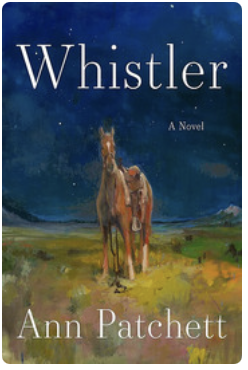
Ann Patchett’s moving new novel Whistler is a tender meditation on connection, memory, and healing. Though divorce, grief, and trauma run through the story, the novel is uplifting, not bleak. Patchett writes with characteristic insight about childhood experiences, both remembered and buried, that quietly shape the adults we become. As in Commonwealth (2016) and The Dutch House (2019), the aftermath of divorce occupies the emotional center of the novel, and is also depicted with insight, humor, and grace.
A chance encounter at the Metropolitan Museum of Art in New York City reunites 53-year-old Daphne Fuller with her former stepfather, Eddie Triplett. Eddie was married only briefly to Daphne’s mother, and 40 years have passed since he and Daphne last saw one another. Still, his brief presence in her childhood left an indelible mark. Their interests aligned, their banter came easily, and Eddie’s warmth offered comfort to nine-year-old Daphne. She loved him. Together, they had survived a traumatic car accident that deepened their bond: it was Eddie’s kindness and courage in that dire moment that helped keep them alive as they waited to be rescued. Soon after the accident, Daphne’s mother divorced Eddie and contact between them ceased.
When Daphne and Eddie meet again in the novel’s opening chapter, the past returns with startling force. Daphne is overcome with emotion. Daphne says, “And with that I bowed my head and covered my face. I hadn’t known there was something in me to break, but there it was and break it did. I stepped into an open crack in time and fell backwards.”
Later, she realizes, “…somewhere deep inside myself, in a place inaccessible to me since I was nine, I had missed him every day of my life.”
As adults, Daphne and Eddie are given the rare chance to recover what time seemed to have taken from them. They spend long hours together retracing the paths their lives took in the decades apart and eventually speaking openly about the night of the accident. Through Daphne and Eddie, Patchett beautifully shows how certain people remain lodged in the heart and how love can endure beneath the surface of ordinary life. Whistler is a wistful novel illuminating that healing, even if delayed, is possible. 5/5
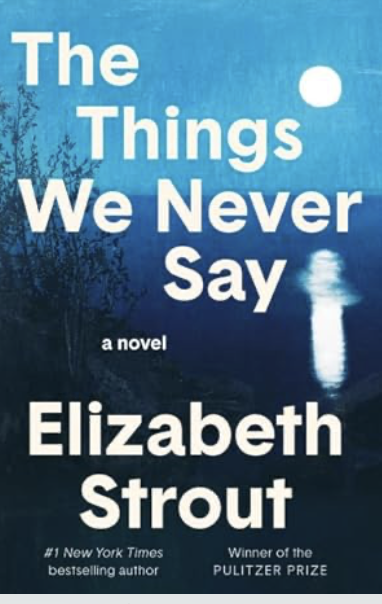
Elizabeth Strout has written another gem. She has a remarkable ability to deeply probe the psyches of her characters while delivering a perceptive and absorbing read. In this novel, her 11th, she dives even deeper into that well.
Artie Dam, a beloved high school history teacher, is depressed. He feels alone and isolated—not because he lacks people to talk to or spend time with; he doesn’t. He is surrounded by people who love him: his wife of 30 years, his grown son, his fellow teachers, his students, and his friends. Rather, it is an internal angst that plagues him, leaving him with the sense that most thoughts are meant to remain solitary, not shared. The divisive divisions in this country don’t help.
When Artie learns a profound secret about his life, he must decide how to proceed with this knowledge. The revelation forces him to recognize that we don’t truly know ourselves—and sometimes not even the people closest to us. Toward the book’s ending, he thinks he might know why people never say the thoughts closest to their hearts. “Because to say anything real was to say things nobody wanted to know, or if they wanted to know, they would not care in the right way. Or even understand. It’s a private thing to be alive.”
Strout continues to explore the human condition with persistence and curiosity. Though the book is psychologically astute, its ethos is heavy and existential. Author Elizabeth Day’s blurb on the back sums up this novel beautifully: “Strout is a brilliant chronicler of the ambiguity and delicacy of the human condition.” Highly recommend. 5/5
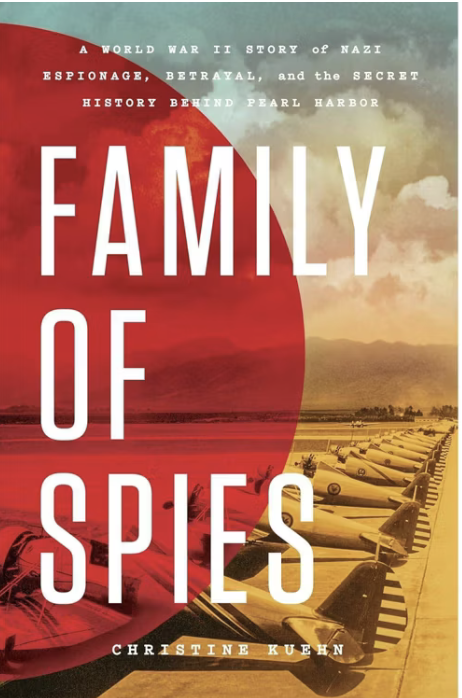
Family of Spies, by Christine Kuehn, is a gripping account of a family secret that lay hidden for generations and reveals a shocking history. It tells the true story of Kuehn’s family, who worked as spies for the Nazis and reported to the Japanese before the attack on Pearl Harbor. None of this was known to the author until she received a letter from a screenwriter asking about the German spies in her family. Kuehn thought it was a joke or some kind of mistake. As a child, Christine Kuehn asked her father about his parents and siblings, but he was always elusive. The idea that her grandparents and Aunt were German spies seemed impossible.
Still, the letter gnawed at her. Christine and her husband went to their local bookstore and reviewed the indexes of every book about Pearl Harbor. To her astonishment, they discovered that her grandparents, Otto and Friedel Kuehn, were indeed spies for America’s enemies, as was her now elderly Aunt Ruth. Eventually, Kuehn’s father admitted the truth about his family. Not wanting to burden his daughter or face his own shame, he had kept his family’s treasonous past secret. He couldn’t, or wouldn’t, recall the gritty details of their involvement. Even though his parents tried to protect him from their activities, he carried the weight of their crimes for his entire life.
Determined to learn more, Kuehn began researching her relatives’ journey from Germany to their internment after Pearl Harbor and eventual return to Germany. Her investigation spanned decades, and each new revelation brought new shock. Her grandparents eagerly joined the Nazi party after WWI and never turned away from its cruelty. Christine’s uncle, Leopold, worked for Joseph Goebbels, a barbaric leader in Hitler’s regime. Her Aunt Ruth even dated him. It was Goebbels who sent the Kuehn family to Hawaii in 1936 and paid them well for the secrets they passed to Germany and Japan. The information her grandparents and Aunt shared helped the Japanese in their attack on Pearl Harbor. Another stunning piece of knowledge Kuehn was forced to absorb.
I wish she had spent more time probing deeper into the Kuehn family’s motivations. Was their betrayal driven solely by ideology? Where did they develop these thoughts? Was it greed alone? Or had they become so deeply tangled in their tasks that they could no longer change course?
Although the story ended tragically for her family, Christine Kuehn courageously confronted the past and was brave enough to share it. She skillfully blends meticulous research with a compelling, fast-paced narrative. The book reads like a spy thriller, weaving together past and present, Her work reminds us of the power of uncovering hidden truths and that personal stories are integral to understanding our history. 4/5
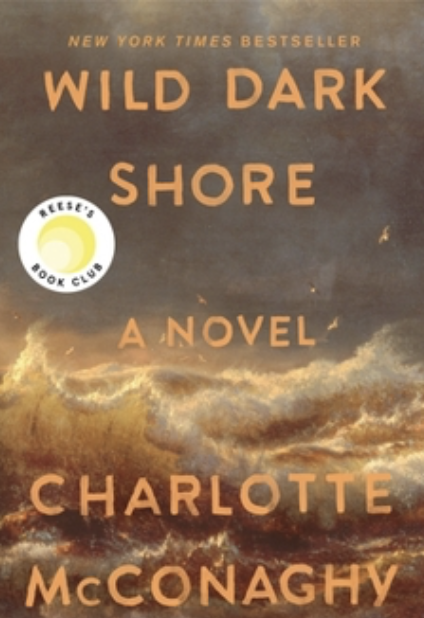
Reading a Chalotte McConaghy novel assures you that you are in the hands of a talented writer. Her latest book, Wild Dark Shore is a beautiful and atmospheric story woven together with a gripping mystery. This novel is both a family drama and a haunting homage to humanity’s indifference toward the ongoing climate crisis threatening our planet.
Dominic Salt and his three children serve as caretakers on Shearwater island, located near Antarctica. They live in the island’s lighthouse. The children have a deep affection, though complicated relationship with their widowed father who continues to grieve for their mother who died during the birth of the youngest child. The Salt family has been part of a scientific community dedicated to studying climate change and protecting the world’s largest seed bank. However, as the permafrost melts and ocean levels rise, the island becomes unsustainable. All the scientists and researchers have already been evacuated. Dominic and his family await the final boat to ferry them home to Australia. The growing isolation and anticipation intensify the novel’s tension.
As they wait for their departure, a mysterious woman named Rowan washes ashore. The Salt family cares for her as she recovers, all the while questioning how and why she arrived on their remote island. Like the Salt family members, Rowan harbors secrets that slowly come to light. McConaghy skillfully propels the story forward by narrating from five distinct points of view. Some plot twists are frustrating and require suspending belief, but nonetheless, the story remains compelling.
McConaghy’s vivid descriptions of the natural world, especially aquatic life including dolphins, otters, sea lions, whales, seals, penguins are remarkable. She describes the changing tides and the howling winds and the interdependence of all species with reverence and beauty.
The story takes place in the future, yet the alarming realities of climate change make the events seem imminent. In fact, McConaghy based Shearwater Island on her visit to Macquarie Island a subantarctic island halfway between Tasmania and Antarctica. In 2016, the Svalbard Global Seed Vault’s tunnel flooded due to melting permafrost.
Despite the novel’s eerie and ominous tone, it ultimately explores human resilience and the breathtaking beauty and complexity of nature. While some may dismiss the issue, McConaghy’s compelling novel reminds us that climate change is real. 4/5
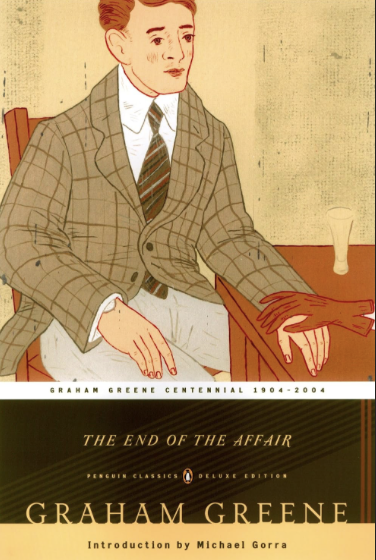
Graham Greene’s 1951 novel, The End of the Affair delivers a powerful narrative that blends elements of mystery, tirade and confession. Set in London during the Blitz, this audacious story revolves around an adulterous love affair and structured with the suspense and intricacy of a well-constructed spy novel. Graham Greene’s insightful prose captures the anxiety and consciousness of his characters with stunning clarity.
Maurice Bendrix is the narrator and a narcissistic one at that. As a writer, researching the life of a civil servant for a new novel, Maurice befriends his civil servant neighbor Henry Miles. This connection soon leads Maurice into an intense passionate four-year affair with Henry’s wife Sarah. Throughout the affair, Maurice never expresses any sense of guilt instead he is consumed by his obsession with Sarah. His narcissistic emotional dependence on her grows and he becomes belligerent and needy, frustrated by her refusal to leave her husband. Sarah, while not in love with Henry and lacking a sexual relationship, explains to Maurice that she remains with her husband because he is a good man. Suddenly after four years, Sarah ends the relationship without explanation, leaving Maurice devastated and filled with hatred.
Without revealing too much more about the plot, the novel takes many unpredictable turns as Maruice believe in the possibility of either retaliation or rekindling of their relationship. Greene’s writing is compelling as he leads readers through the unexpected twists with emotional intensity. By the conclusion, the characters engage in deep reflection about the Catholic faith, a recurring theme in Green’s work.
The book delves into the rawness of human emotion, feelings so powerful that rational thought cannot subdue them. Loyalty is another central theme. To whom do people owe their loyalty: themselves, family, church or country. Greene’s portrayal of the human condition is profound, though not always flattering. He depicts the characters in this love triangle with precision. The novel explores the contrasts between love and loyalty, selfishness and selflessness and the constant struggle between emotion and reasoning. Though 75 years old, The End of the Affair remains a suspenseful exploration of the human condition. 4/5
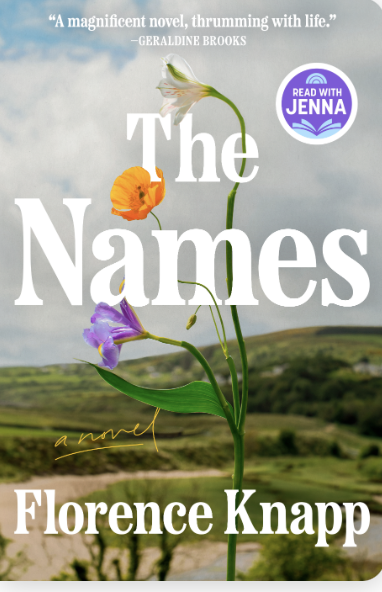
Can a person’s name change the course of a life? This is the profound question Florence Knapp investigates in her novel The Names. Spanning thirty-five years, the book employs an inventive structure to reveal how a single decision can create subtle, subconscious feelings that seep into family relationships. With remarkable skill, Knapp illuminates the ways emotional signals shape the dynamics within a family.
At the heart of the story is Cora Atkins, a mother trapped in an abusive marriage. As she prepares to register her newborn son's birth, she contemplates three possible names for him: “Bear,” suggested by her nine-year-old daughter, Maia; “Julian,” meaning “father sky,” which is Cora's personal preference; or “Gordon,” the name of her husband and his father. The novel delves into each of these naming possibilities. Chapters alternate between scenarios in which the boy is named Bear, Julian, or Gordon. Every seven years, the narrative revisits the boy’s life, effectively presenting three interwoven novellas within a single novel.
While the narrative contains elements of hope, the overall tone is heavy and challenging. Cora’s husband, a respected physician, is an abusive narcissist. The father’s attitude toward his son shifts based on the chosen name ranging from derision or indifference or pride. The boy’s mother and sister also treat him differently in each scenario. Ultimately, the novel is less about the importance of a name and more about the consequences of domestic abuse on children. The true focus is on Cora’s response to her husband’s abuse and whether she chooses to leave or remain. This shapes the family’s complex dynamics and influences her children’s futures.
The Names is a haunting novel. Though at times painful, it is written with skill and rouses deep reflection. By the conclusion, the story offers glimpses of hope and the possibility of healing. Overall, it is a compelling and well-crafted novel. 4/5.

Happy Holidays. Hoping that 2025 was filled with family, friends and many enlightening books. Thanks for visiting
readsreading.com
Warmly, Kathy
“I declare after all there is no enjoyment like reading!” — Jane Austen
“Reading fiction not only develops our imagination and creativity, it gives us the skills to be alone. It gives us the ability to feel empathy for people we've never met, living lives we couldn't possibly experience for ourselves, because the book puts us inside the character's skin.” — Ann Patchett

Virginia Evans’s novel The Correspondent radiates warmth, wisdom, insight, and humor. Structured as a collection of letters and emails, the narrative beautifully explores the inner world of a woman’s life while offering her unique perspective on the human experience. The book also celebrates the value and magic of the written word making this novel my favorite of 2025.
Each morning, 73-year-old Sybil Van Antwerp sits down to write letters, a daily ritual she has maintained for much of her life. Her correspondence includes neighbors, colleagues, authors, her brother, her children, her best friend, and one person to whom she writes without ever sending the letters. Expressing her thoughts and emotions through correspondence s becomes her way of connecting with others, while also maintaining distance. Sybil is divorced, a mother of two living children and a retired lawyer. Her personality is marked by stubbornness, sarcasm, and sassiness, yet she also possesses a strong sense of manners and decorum.
Self-sufficiency has long been her pride, but she is gradually losing her sight. Uncomfortable as it is, she finds herself needing help from other people. Ironically, as her vision narrows, her world broadens. This vulnerability seems to make her correspondence more revealing. She seems to be gaining deeper insights about herself and the people in her life. She writes to her daughter, “I know you think of me as your mother only, but please remember, inside, I am also just a girl.”
This period of change leads Sybil to seek forgiveness and to forgive those who have wronged her. She writes with increasing humility and grace. As the narrative unfolds, readers become acquainted with her family and associates, witnessing her steady personal growth. The novel ultimately celebrates the power of writing as a tool for self-discovery.
The Correspondent is an uplifting and perceptive book, offering readers a heartfelt celebration of emotional evolution and the enduring significance of the written word. Highly recommend. 5/5.

Heather Clark’s novel, The Scrapbook, is a haunting, sensual, and melancholy narrative that offers a fascinating and unique perspective on the enduring impact of World War II. Through exquisite prose and multi-layered psychological insight, Clark crafts a story deeply rooted in how the complexities of history influence the present.
At the heart of the novel is Anna, an American senior at Harvard in 1996, whose life is shaped by a scrapbook left to her by her grandfather. This cherished artifact contains photographs from his time as a young soldier in World War II, including powerful images from his participation in the liberation of Dachau and the seizure of the Eagle’s Nest which Hitler used for social functions. The scrapbook becomes a touchstone for Anna, guiding her thoughts and actions as she begins her own adult life.
Anna’s fascination with the past deepens when she meets Christoph, a visiting German student. Their connection quickly turns into infatuation, leading Anna to follow Christoph to Germany. Like Anna, Christoph is obsessed with World War II, though he holds complicated feelings about his grandfathers’ roles in Hitler’s army. He is simultaneously judgmental and defensive of them, ultimately weighed down by a sense of inherited guilt. For example, he quotes German philosopher Theodor Adorno’s observation to Thomas Mann from the late 1940s: “It was as if the Germans truly believed they had never been Nazis. They had completely repressed their obedience to Hitler.”
As Anna’s first romantic relationship unfolds, she is swept up by Christoph’s intensity. Together, they visit sites featured in her grandfather’s scrapbook, engaging in intellectual discussions about the war, German architecture, art and literature. Despite the passage of fifty years since the end of the war, their love is haunted by unresolved historical trauma. Anna grapples with difficult questions: Does Christoph’s grandfather’s complicity mean Christoph himself is capable of similar actions? Should he be held accountable for the misdeeds of his ancestors?
While the backdrop of their relationship is WWII, their difficulties are not solely the result of their families’ histories. Instead, their eventually dysfunctional relationship is shaped by their youth and Anna’s naivety. In highlighting the uncertainties of young love, some aspects of their interactions did not feel entirely convincing. Their personality traits and relationship also hint at the dynamics between their countries during the war.
Heather Clark’s outstanding novel wrestles with profound themes of inherited guilt, obsessive love, and the trauma that echoes through generations. The Scrapbook is a serious and thought-provoking exploration of how, despite the decades, WWII continues to shape identity and relationships. 4.5/5
(Thanks to my friend Karen for giving me this book!)

Monica Wood’s novel How To Read A Book may not have the most compelling title, but within its pages lies a story rooted in grace and compassion. (Thanks to my sister-in-law Mary for recommending.) The story also illustrates how books possess the remarkable ability to influence, and even heal, those who read them. 4/5
Violet Powell was released from prison after serving time for killing a local teacher while driving under the influence. During her incarceration, Violet was part of a book group led by Harriet Larson. The book group served as a turning point in Violet’s life. Harriet Larson, a widow who leads the prison book group, purchases her books at the Portland, Maine bookstore where Frank Daigle works as the handyman. Each of these three individuals have endured personal trauma. When they encounter each other at this bookstore, their lives intersect dramatically as they realize their tragedies are intricately connected.
The narrative highlights how sharing personal stories and connecting through books can foster understanding and healing. By reflecting on the motivations and struggles of fictional characters, the characters in this novel better comprehend themselves and others. The books they read also serve as a source of comfort and guidance to them.
At its heart, the novel explores the ideas of chosen families, second chances, and redemption. In our current world often defined by mean-spiritedness, cruelty and judgment, this story offers a message of forgiveness, friendship, and the importance of found family. The novel ultimately reminds us that everyone is capable of change and connection.
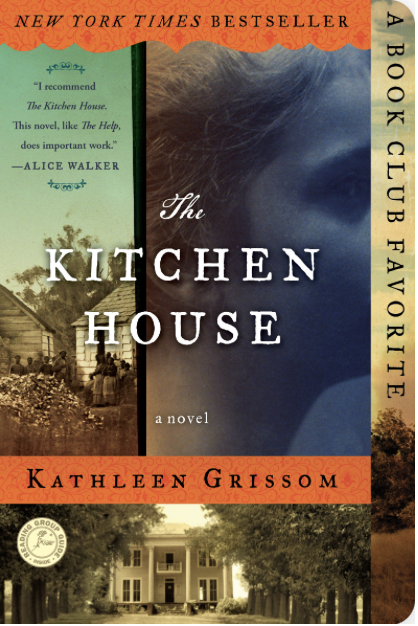
The Kitchen House by Kathleen Grissom offers a unique and intimate perspective on the institution of slavery in America during the late 1700s. The story centers on Lavinia, a young white Irish girl who, after losing her parents on a ship bound for America, finds herself brought to a Virginia tobacco plantation by the ship’s captain. Lavinia is left in the Kitchen House, where she lives alongside the other slaves, all of whom are Black. At just seven years old, Lavinia is traumatized by the loss of her parents and is thrust into a world she cannot fully comprehend.
Lavinia quickly becomes attached to the slaves, especially Belle, the captain’s illegitimate daughter. Belle takes Lavinia under her wing, becoming a maternal figure and teaching her to cook, clean, and wait on the captain’s family. Lavinia’s bond with Belle and her family grows stronger over time, and she feels immense gratitude for their love and care. However, Lavinia’s skin color sets her apart in the eyes of the captain’s family.
As Lavinia grows older, she becomes aware of the rigid cruelty of the caste system based on skin color that governs life on the plantation. Her slave family attempts to educate her about the rules and expectations, but Lavinia struggles to understand the social structure that separates her from those she loves. Lavinia simply loves Belle and the other members of the Kitchen House and learns that she cannot openly express her affection toward them.
The historically based novel powerfully illustrates the absurdity of this racial hierarchy and exposes the ways in which white people projected their own negative behaviors onto their Black slaves. The fast-moving plot incorporates a diverse cast of characters and explores complex themes of loyalty, identity, and belonging. Lavinia must eventually assume a new role dictated by her skin color, and her loyalties to those she loves are put to the test.
The Kitchen House provides a distinctive perspective on the deep bonds of hope and love that can exist within chosen families, even in the face of cruelty and injustice. The story allows readers to empathize with the characters’ struggles and appreciate the difficult choices they must make as they navigate the harsh realities of plantation society.
Overall, the novel is a moving exploration of human connection and the enduring hope that sustains people through adversity. This novel is a compelling read, filled with emotion and historical authenticity. 4/5.
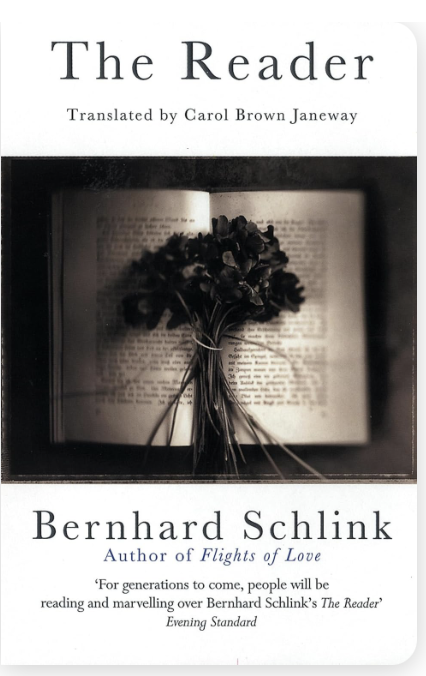
I picked up Bernhard Schlink’s The Reader without knowing what it was about and quickly became engrossed. The novel explores the Holocaust’s impact on postwar Germans through the relationship of Hanna Schmitz a 36-year-old woman, and Michael Berg, a 15-year-old boy. The story is provocative andphilosophical while packed with startling plot twists.
Instead of detailing the horrors of the Holocaust, the story delves into profound questions of guilt, morality, secrets and cowardice as experienced by the protagonists. It thoughtfully explores how the younger generation of Germans—the so-called “second generation” wrestles with the appalling actions of their elders who were involved with the Nazi regime. The book incites readers to reflect on how people can resist conformity, especially when prevailing cultural norms become unjust or cruel. The novel raises important issues of shame, complicity, and the struggle to act with integrity in the face of wrongdoing.
Beautifully written, suspenseful, and intellectually engaging, The Reader is clearly deserving of its many literary awards. I highly recommend this book. 5/5

Non-Fiction
Daniel Mendelsohn’s most recent book explores his experience reading the Odyssey with his father. After hearing him on my favorite podcast, The History of Literature, I quickly bought and loved the book. Offering literary interpretation and reflections on Mendelsohn’s relationship with his father, the work combines memoir, scholarly analysis, and travelogue.
Mendelsohn, a Classics Professor at Bard College, is recognized for his exceptional writing. His comprehensive understanding of the Odyssey (he just published a new translation) is noteworthy. Homer’s ancient story is about Odysseus’ journey back to his home after the Trojan War. Between fighting in the war, being held captive and traveling home, he has not seen his wife and son for twenty years. The book addresses universal themes such as the cycle of life, transitions, journeys, recognition, fidelity, loyalty, familial relationships, and the experiences of childhood and parenthood. Mendelsohn shows how the characters’ emotions in this 3,000-year-old epic remain relevant today.
The narrative is enriched by the presence of Mendelsohn’s 81-year-old father, Jay Mendelsohn. In 2011, Jay decides to participate in his son’s seminar on the Odyssey at Bard College, travelling from his home in Long Island each week. Although he initially promises to observe rather than contribute, he promptly voices his perspective in the first class. He explains why he believes Odysseus is not a hero. This viewpoint leads to lively discussions with his son and other students throughout the semester. I loved the questions Professor Mendelsohn asks his students. For instance, he says, “When the exterior, the face and body have changed beyond recognition, what remains? Is there an inner ‘I’ that survives time?”
After the course concludes, Daniel and his father embark on a personal journey to Greece. Their cruise, which traces Odysseus’s legendary journey from Troy to Ithaca, becomes a metaphor for their journey of understanding and reconciliation. By combining their academic experience, travels, and engagement with the text, they gradually arrive at a deeper understanding of one another, making their story deeply relatable and emotionally resonant.
Knowing little about the Odyssey, I was surprised by how much I enjoyed this book. I appreciated Mendelsohn’s example of how literature can facilitate meaningful dialogue and understanding. Both he and his father share their respective experiences as son and father. Ultimately, Mendelsohn’s book highlights that we are all on a journey with ourselves and those we love, a quite simple and extraordinarily complex dynamic. 4/5

The Bright Years, Sarah Damoff’s debut novel, is my favorite book (thus far) in 2025. The narrative focuses on a multi-generational family navigating the complexities of alcoholism, concealed truths, and personal tragedy. While challenging subjects, the book avoids becoming overly somber, instead presenting a narrative infused with dignity and hope. Damoff’s beautiful prose and insightful observations contribute to the novel’s poignancy and tenderness.
The story follows Lillian and Ryan Bright, who meet in a Fort Worth public library in 1979, fall in love, and eventually marry. Significant aspects of their histories remain undisclosed: Ryan conceals his father’s alcoholism, while Lillian does not reveal that she gave up a child for adoption. Their lives are initially marked by happiness and the birth of their daughter, Georgette. Yet, the convergence of hidden pasts gradually complicates their relationship. As Ryan succumbs to alcohol dependence, the family’s once-bright years begin to darken. Damoff offers nuanced insight into the origins of Ryan’s addiction and skillfully examines its psychological impact on his family.
Despite these adversities, the motif of healing and connection permeates the novel. Lillian Bright’s reflection that “time can wash dirt off a memory until it is revealed as something else entirely” encapsulates the book’s exploration of forgiveness and hope. Through her vivid depiction of complex characters, Damoff emphasizes optimism and compassion amid hardship. The Bright Years shows that healing is possible. 5/5

Quiet and wise, Andrew Porter’s novel The Imagined Life is a literary and psychological gem. His elegant prose is intimate, layered, and lovely. Porter’s profound exploration of thought-provoking themes, such as the impossibility of understanding one’s parents’ inner lives and the delayed effects of childhood events on adults, draws readers into an intricate web of family dynamics.
Until recently, Steven Mills resided with his wife and son in Berkeley, California. Facing challenges in his marriage and career, he embarks on a quest to make sense of his father’s disappearance. His father had been a distinguished English professor at a Southern California college. In 1984, when Steven was 12 years old, his father disappeared after being denied tenure. The narrative alternates between Steven’s vivid memories of the year preceding his father’s abandonment and his present emotional journey to uncover the truth about his father’s desertion.
Many years had passed without Steven and his mother searching for his father. Their rage and relief seemed to immobilize them. Now, decades later, Steven travels throughout California, meeting with his father’s former friends and colleagues, gathering their perspectives and asking if and where his father might be living. When Steven realizes how deep his father’s abandonment had rooted itself inside him, something shakes free.
Andrew Porter’s nuanced novel delves into loss of innocence, family dynamics, mental health, and secrets. In addition to his beautiful writing, Porter deftly depicts the complexity and contradictions inherent in every person. While the novel’s tone may be melancholy, the ending offers hope that healing is possible. 5/5

Midwife Martha Ballard is the heroine of this gripping mystery. She was born in 1735 and died in 1815. This fictionalized account of her life feels authentic and compelling thanks to her diligent daily diary entries and an award-winning biography by Laurel Thatcher Ulrich.
The novel, which has received acclaim for it engaging storytelling, starts as a “who done it” but becomes an homage to Martha Ballard and her commitment to justice and equality for women. The frozen river itself becomes a powerful symbol within the story, representing the rigid societal structures that Martha fights to crack open.
The story opens in 1789, a time of significant change and upheaval for the newly formed United States and its judicial system. Ballard is called to examine the body of a man who was found frozen to death in the Kennebec River. The deceased is identified as one of two well-respected men who were accused of rape two months earlier. As the midwife and healer of Hallowell, Maine, Martha had documented the details of that assault. Martha believes the man was murdered. But when a Harvard-trained male doctor declares the man’s death is accidental, Martha is compelled to investigate. While doggedly delivering babies and healing town folks, she attempts to discover what happened to this man and how it might relate to the rape.
As the story unfolds, Ballard’s unwavering determination to uncover the truth serves as the backbone of the narrative. Ballard’s husband, Ephraim, taught her how to read and write, a skill not available to most women. Their love story is inspiring. Martha’s daily diary becomes a vital tool in piecing together the mystery. Through her investigation, she encounters resistance from powerful figures in the community. Her pursuit of the truth challenges the deeply entrenched patriarchal norms. Her quiet resilience and intellect shine as she navigates a world where women’s voices are often dismissed. How she developed this courage is one of the engaging threads of the story.
Ultimately, “The Frozen River” is more than a murder mystery. It is a profound exploration of courage, justice, and the unyielding resolve of a woman who dared to seek the truth in an age when silence was the easier path. Lawhon’s pays tribute to Martha Ballard’s legacy and her steadfast commitment to gender and class equality. She was truly a heroine of her time. 4/5
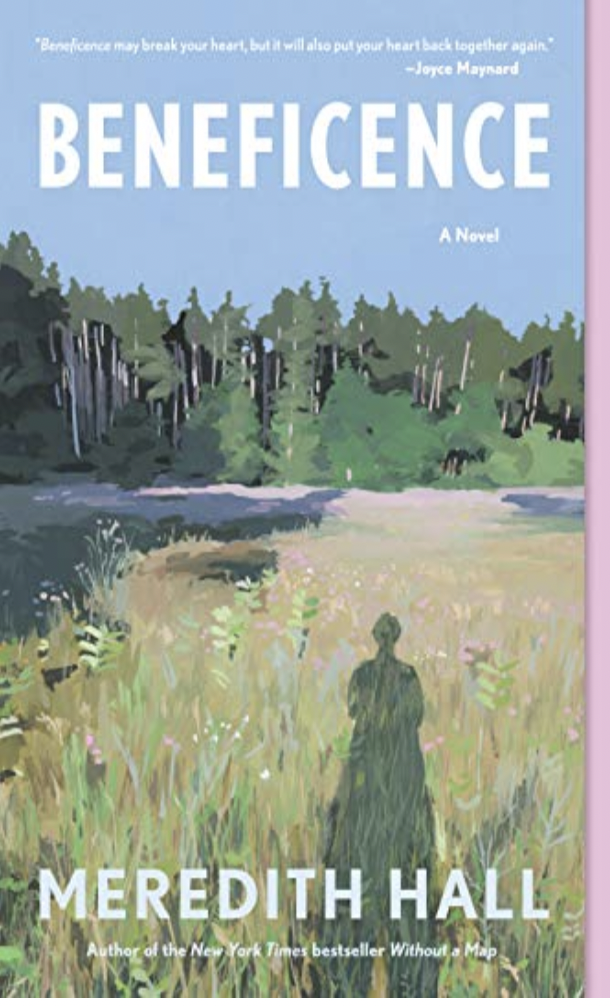
Meredith Hall’s prose sounds like poetry and feels like a prayer. Filled with grace and heartache, the novel poignantly portrays a 1950s Maine farming family who experiences a tragic loss. Hall skillfully details the psychological and emotional nuances of this family’s grief and their struggle to forgive themselves and each other.
The book is intimate, wise, and soulful. While the story may not resonate with every reader, Beneficence is a powerful meditation on grief and resiliency. 4.5/5
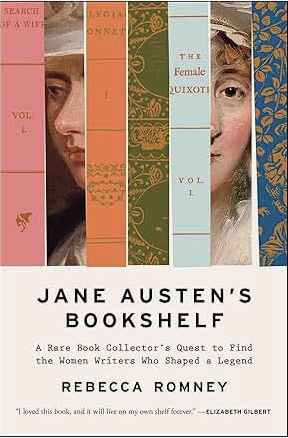
Rare book collector Rebecca Romney’s book is a literary adventure. Written in a warm and welcoming tone, the book is filled with fascinating information. A devoted Austen fan since she was young, Romney had never paused to consider Austen’s literary influences. She simply loved Austen’s six novels and concurred with scholars and lay people that Austen was “one of the greatest writers from the early 19th century.”
One day, she was invited to peruse the collection of a fellow rare book dealer. Among the items she bought was the novel Evelina by Frances Burney, one of the most successful novelists of Austen’s lifetime. Romney then read Burney’s second novel, Cecilia, published in 1782. It was in this second novel that Romney first read the words “pride and prejudice.” Romney curiosity was piqued. She thought – of course -Austen must have been inspired by the authors she was reading. She didn’t write in a bubble. Like an investigator, Romney starts to discover the women writers who influenced Austen’s writing and determine why their books have disappeared from our bookshelves.
Using her rare book dealer skills, Romney follows the clues that Jane Austen left in her novels. (i.e. In Northanger Abbey, Austen refers to the novels of three women authors.) She also reads correspondence between Austen and her family members, where Austen shares her opinion of the books she reads. One woman author leads Romney to the next. By the end of her search, Romney had discovered, acquired, and read books by eight published women writers. She finds their novels interesting, clever and witty. In doing so, Romney recreates a version of Austen’s bookshelf. She discusses their lives, their struggles and their publications. The eight women are Frances Burney, Ann Radcliffe, Charlotte Lennox, Hannah More, Charlotte Smith, Elizabeth Inchbald, Hester Lynch Thrale Piozzi, and Maria Edgeworth.
Romney’s book doesn’t diminish Austen’s preeminence as a writer. Rather, Romney’s meticulous research and insightful analysis offer a fresh perspective on Austen’s work, making Romney’s book a valuable addition to the literary discourse. She also provides a better understanding of the many reasons that these financial and literary successful novels have disappeared. Not surprising, sexism and paternalism play a persistent role.
No one description can capture the content of this book. But if you like history and literature, and especially if you are a Jane Austen fan, you will enjoy this book. 4/5

Adam Haslett’s new novel Mothers and Sons is both powerful and challenging. Powerful because he writes beautifully and astutely about family dynamics, the complexity of people’s interior lives and how secrets can grow like ulcers.
Peter Fisher is a 40-year-old work-acholic lawyer in New York City who helps immigrants apply for asylum. In fact, his job requires that he probe the most painful parts of his clients’ lives to prove that his client’s lives would be in danger if they returned to their country of birth. Immersed in this role, he isolates himself from friends and family. He rarely visits his mother Ann who leads a women’s retreat center in rural Vermont. Ann and Peter have been estranged for two decades since Peter was involved in a tragedy when he was in his teens. They buried the secret of what happened beneath the overwhelming demands of their jobs. Both Ann and Peter listen to people’s stories, empathize and assist. Yet, when one of Peter’s asylum-seeking client’s story echoes his own, Peter’s begins to understand that he had unconsciously altered the trajectory of his life. He reaches out to his mother. Only by discussing their shared secret are Peter and Ann finally able to escape the lingering anxiety that haunted them.
Mothers and Sons may not be a good fit for every reader but Haslett’s novel illustrates his deep appreciation for the healing power of hearing other people’s stories and reflecting on the stories we tell ourselves. 3.5/5

In his newest novel, Colm Tóibín delves deep into the inner lives of his characters, revealing their thoughts and emotions. His emphasis is not on what his characters do but on how they think about their deeds. Combining a keen sense of Irish cultural norms with psychology, this book tackles the complexity of human communication and connection.
In Tóibín’s previous novel Brooklyn, a young woman named Eilis Lacey immigrated from Enniscorthy, Ireland, to Brooklyn, New York, and eventually married Tony Fiorello. When her older sister unexpectedly died, Eilis returned to Ireland and began a summer romance with local Jim Farrell. Neglecting to mention her marriage to anyone in Enniscorthy, Eilis found herself torn between her husband in Brooklyn and her feelings for Jim Farrell in Ireland. In the end, she returned to Brooklyn.
When Long Island begins in the 1970s, it has been twenty years since Eilis’ abrupt departure. Eilis and her husband have moved to Long Island and have two teenagers. Tony’s parents and brothers and their families live in the same cul-de-sac are intimately involved in Eilis’s family. And they constantly remind her that she is not Italian. When a man knocks on her door and tells Eilas that Tony has fathered a child with his wife, Eilis is shocked. The man states that after the baby is born, he or she will be brought to Eilis and Tony’s home. Eilis leaves Long Island and returns to Enniscorthy. She has no plan, but a determination that she will not raise the child. In Enniscorthy, she sees the still unmarried Jim Farrell. The story digs into the dynamic between Eilis, Jim, and Elias’ childhood friend, Nancy Sheridan, who has been dating Jim Farrell. Love and loyalty, betrayal and misunderstanding make their interactions complex and poignant.
Tóibín ability to mine his characters’ interiors makes the book riveting. He captures the contrast between the characters’ convivial public banter and their private angst and stresses. Even with those to whom they are closest, these characters rarely share their thoughts and feelings. Instead, they withhold, obfuscate or refrain from speaking. Living in Enniscorthy makes a person feel both supported and suffocated.
Though readers see the characters become assertive as they better understand their needs, I wish Tóibín had included more about their upbringings to shed light on why they make the choices they do. Nonetheless, there is no murder or mayhem, just good people with flaws and virtues navigating their lives as best they can. 4.5/5

Patti Callahan Henry’s new novel reminds us that stories are essential to the human experience. The sharing of stories provides connection and comfort, especially during troubled times. The Secret Book of Flora Lea is part WWII saga, part mystery and part character analysis. Except for a couple plot points, I found the story engrossing and quite enjoyable.
Hazel Linden and her sister Flora are sent by train from London to the countryside in September of 1939. This was under the English government’s Operation Pied Piper, a mass evacuation plan to protect children from imminent German bombings during World War II. To help her little sister cope with being separated from their mother, Hazel, age 14, tells her five-year-old sister stories about a magical land called Whisperwood. They close their eyes and visit this imaginary world and Hazel tells Flora,”You are always safe in Whisperwood.”
In 1960, Hazel found solace in a London bookstore. Her sister Flora was last seen sitting by the Thames River in the English countryside twenty years ago. The police believe she drowned. Since Flora’s disappearance, Hazel has trudged through her life, attending university, securing a job, and living independently. Yet, she is filled with grief and traumatized by what happened. She feels enormous guilt about her sister’s disappearance. When a manuscript titled Whisperwood and the River of Stars arrives at Hazel’s bookstore, Hazel embarks on a search to find out who wrote this book and if the arrival of the book means her sister might be alive.
Chapters rotate between 1940 and 1960, each one a testament to the power of storytelling. Henry’s writing and her depiction of Hazel’s internal life after her sister’s disappearance are described well. Yes, the ending might be too tidy , but I felt it was gratifying and plausible. More importantly, all the characters are decent people who want to be kind. In our own troubled times, a happy ending feels like a gift. 4/5

James Joyce’s The Dead is a perfect book to read during the Holidays. This seemingly simple story about an Irish family’s annual Holiday dinner is a complex and layered narrative. Joyce’s language is not just lush, but it also offers profound psychological insight. Some scholars interpret this story as a critique of the Catholic Church, Irish parochialisms, and the treatment of women, which are undoubtedly present. However, for this reader, the true allure of this novella is Joyce’s profound psychological insight into his protagonist’s inner life.
The Year is 1914. Gabriel Conway and his wife Gretta arrive at the Dublin home of Gabriel’s aunts and niece for their annual post-New Year’s dinner. Though there are many guests, Gabriel, as the family’s sole surviving male, is welcomed as the guest of honor. He is described as an educated but anxious man whose sense of self may be more fragile than the respect bestowed upon him. Once he arrives, the evening of eating, drinking, laughing, singing and dancing can begin. Tradition dictates that Gabriel will carve the goose and offer the toast. As the ubiquitous snow falls gently outside, Gabriel speaks of the lives of the assembled guests and acknowledges the dead relatives they miss.
At the end of this joyful evening, as the guests bundle up to leave, Gabriel sees his beloved wife, Gretta, sitting in the stairwell, listening to another guest sing a lovely song. Transfixed, she looks like she has been transported to another world. Her thoughts and feelings seem unknowable to him. When they return to their hotel room, Gabriel queries Gretta and is flattened by what she tells him. He does not respond with empathy but with narcissistic rage, as he wonders if he truly knows his wife. Does he even know himself? Has he deceived himself about their relationship? Has he misunderstood who he is? Joyce’s ability to capture Gabriel’s crushing feelings and internal reflections with such psychological acumen is exquisite. This powerful short story is as beautiful as it is perceptive about the intricate complexities of the human soul. 5/5


Amanda Peters’ astute debut novel delves into family bonds, secrets, and trauma. This heartbreaking story chronicles the inner lives of Joe and Norma the two narrators who must survive a life altering tragedy that is intensified by white privilege and systemic racism.
Each summer, Indigenous workers travel from Nova Scotia to Maine to pick blueberries. In the summer of 1962, a couple from the Mi’kmaq tribe arrives with their five children. “When we arrived from Nova Scotia, midsummer, a caravan of dark-skinned workers, laughing and singing and traveling through their overgrown and rustling world, the local folks turned their backs, our presence a testament to their failure to prosper.” One summer day, four-year-old Ruthie vanishes after she and her six-year-old brother Joe have eaten lunch. Joe blames himself as he was last to see Ruthie. The local police department perform a perfunctory search but do not find the little girl.
Meanwhile, a white, affluent couple lives in a nearby town with their daughter Norma. Norma is well taken care of but has dreams and memories of a prior life that her mother attributes to an over-active imagination. Norma says, “I think I’ve always known that something was out of place. But when I was young, I understood it was me. Then I quickly forgot why. And the dreams persisted.” As she grows older, Norma realizes her parents have been keeping a secret from her.
There is no mystery. Readers learn early what happened to Ruthie. The narrative tension derives from the impact of this trauma event on Ruthie, Joe, and all those affected by her disappearance. Each of the characters suffers and copes with their pain differently.
What’s fascinating is how each character psychologically struggles and adapts to the trauma over decades. Even still, the two narrators possess a quiet dignity even while the memory of that day and its aftermath haunts them. Ruthie’s family never returns to pick berries in Maine, but they never give up hope that she will return to them.
Though I could quibble with certain aspects of the novel, The Berry Pickers is one of my favorite books of 2024. Peters movingly depicts the invisible ties that bind a family. I admire her insights about the shadows of trauma and the secrets that haunt people’s lives. Highly recommend. 4.5/5
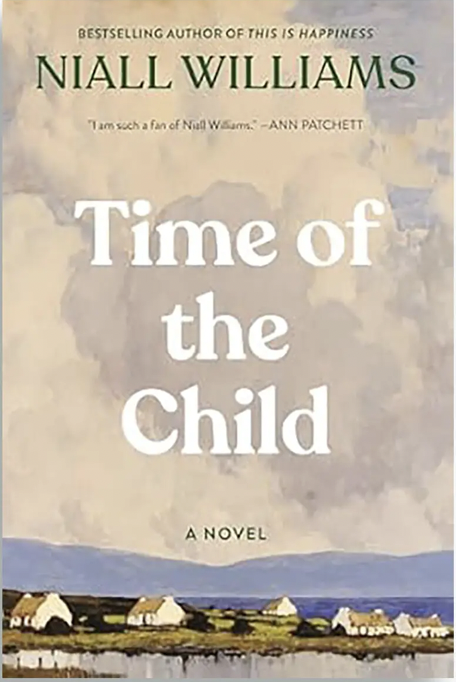
Tender and touching, Niall Williams’s Time of the Child is an inspired book for the holiday season. Like his extraordinary novel, This Is Happiness, this tale takes place in the fictitious village of Faha on the western coast of Ireland. Known for his gorgeous prose, Williams does not disappoint. He has written a heartwarming story about Faja’s transformation after an infant is left at the church.
Faha is a poor, rural and isolated community with an eclectic mix of personalities. Everyone knows everyone else’s business. The Catholic church is the beating heart of the village and the moral arbiter of human behavior. The story takes place during the Advent season of 1962. Jack Troy is a widower and village doctor. He lives with his spinster daughter Ronnie, who assists with his medical practice. When an abandoned baby is left in their care, their lives change dramatically. The intense love Jack and Ronnie feel for this infant them with a new sense of purpose. But they know that If the church authorities learn of the child, they will claim her. Jack and Ronnie wrestle with how to handle this situation with its moral and logistical complications.
William’s prose is dense and filled with profound insights into people’s limitations and strengths. Though the novel brims with the characters’ inner thoughts, I wish Williams had included more dialogue. Despite living in the same home, Jack Troy and his daughter Ronnie do not share their thoughts or feelings. It is as if there is a word limit in their home. And thus, they exist in the solitary musings of their own minds. But the miracle of this baby changes their dynamic for the better.
In these troubled times, reading about good but imperfect people is comforting. Williams has lifted up the lives of these villagers into a magical, almost mystical message about living and loving. Williams shows his readers the power of goodness and love in his beautiful novel Time of the Child. 4/5

In 2019, Jodi Picoult and Jennifer Finney Boylan published their heartbreaking novel Mad Honey. My review will be short to avoid spoiling the plot. This story explores many social issues, including domestic abuse, trans relationships, injustice in the legal system, and suicide. And though these topics can seem overwhelming, the novel, at its core, is a tender coming-of-age story about two teenagers who fall in love. Picoult and Boylan’s thoughtful narrative offers insights, not judgment.
Olivia McAfee leaves her abusive marriage to a cardiac surgeon in Boston. She and her son Asher move to New Hampshire for a fresh start. Asher is a sophomore in high school who falls in love with Lily, the new girl in town. Lily and her mother, Ava, have also fled a toxic situation in California. Both Olivia and Ava are now single mothers wanting to protect their children from their painful pasts. Yet when Lily is found dead, Asher becomes the prime suspect. Despite their best efforts, the history and secrets of both families take center stage when Asher stands trial for Lily’s murder.
Writing a novel with another author must be complicated, and mostly Picoult and Boylan succeed. They have put their readers in the shoes of their characters and shared the character’s complex inner lives. And they have done so with compassion and understanding. Isn’t that one of the goals of a novel? Thanks to my DJKS book club for suggesting this book. 4/5

Allison Pataki’s powerful novel brings the brilliant feminist Margaret Fuller to life. Delving into the historical record, Pataki celebrates this intellectual heroine who changed 19th century American thinking only to fade into the shadows of history.
Born in 1810, Fuller was a talented journalist, writer, translator and teacher who advocated for women’s equality. Her demanding father was determined to provide her with the same education as a boy. He tutored her himself. Fuller spoke multiple languages and read Shakespeare, Virgil, and Goethe while she was young. By all accounts, her genius stunned all those whom she encountered. Later, she taught school in Boston and Providence and, in 1839, became the first woman editor of Ralph Waldo Emerson’s transcendentalist journal called The Dial. Later that year, Fuller became the editor of Horace Greeley’s New York Tribune, where she wrote opinion pieces and literary criticism.
She was a feminist before feminism entered the lexicon and forged a path for women’s suffrage before an organized movement emerged in the United States. Ignoring the restrictive roles dictated by men, she unapologetically advocated for women’s equality and became a model of an independent woman. She said, “We do a great disservice to all people, male and female when we relegate a lady’s talents only to the hearth and home.” In 1845, she published her groundbreaking book Woman in the Nineteenth Century, a feminist critique that bemoaned the injustices inflicted upon American women.
Pataki’s novel starts slow, but gains momentum after the first few chapters. Though Fuller’s articles and books dominated the bestseller lists in the 1840s, it is curious that her legacy has not endured like her friends Emerson, Henry David Thoreau, Louise May Alcott, Nathaniel Hawthorne, Elizabeth Barret Browning, and Edgar Allen Poe, all of whom are characters in this novel.
This fact makes Allison Pataki’s novel even more important. Not only is it the first fictionalized account of Margaret Fuller’s life, but it is also an acknowledgement of her fierce advocacy for women’s equality, the end of slavery and prison reform. As Susan B. Anthony said, “Fuller possessed more influence on the thoughts of American women than any woman previous to her time.” If you haven’t read about Margaret Fuller, I recommend this novel.
Thanks to my sister-in-law Mary for giving me this book. 4/5
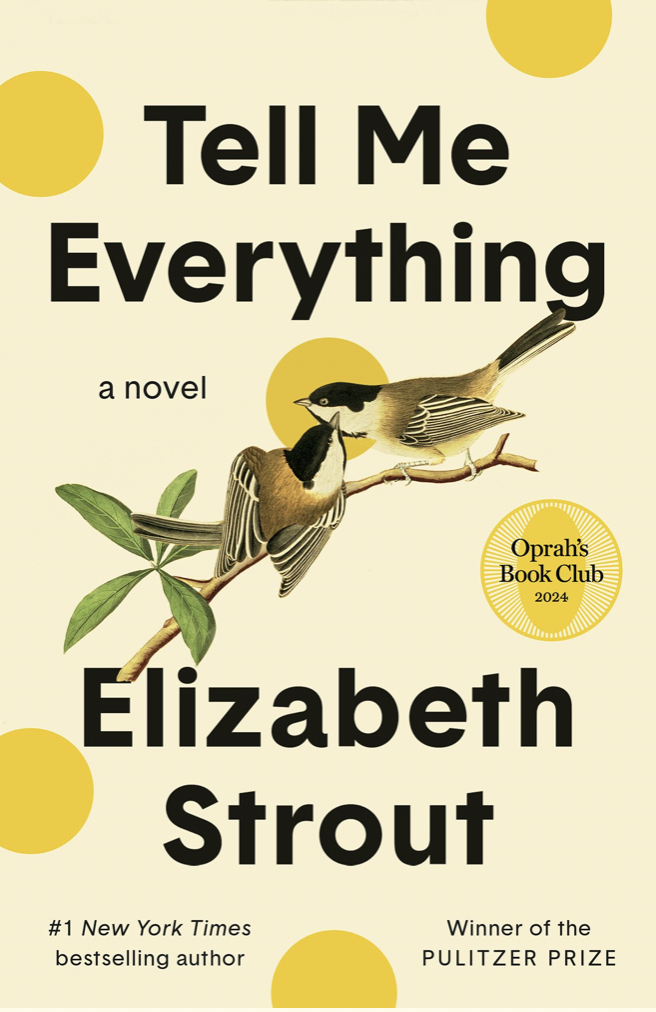
With great insight, Elizabeth Strout’s newest novel probes the complexity of human relationships. How well can we know another person? How well can we know ourselves? She concludes not well: “We are all such mysteries.” But her novel offers an antidote to this isolation. Listening to other people’s stories connects us to them and causes us to empathize with their plight. Exchanging stories is a gift we can give to ourselves and others.
This character-driven novel takes place in the fictional town of Crosby, Maine. We have met the protagonists in Strout’s prior books: Bob Burgess, Lucy Barton, and Olive Kittridge. The plot revolves around their deepening friendships, the stories they share, and the murder of an elderly woman on the outskirts of town.
Strout’s characters are defined by the traumas (often unknown to others) that shaped their journey. Her characters’ ordeals occurred in their childhoods and have been the engine (consciously or unconsciously) driving their lives. Olive Kittredge says, ‘If you don’t think everyone is broken in some way, you’re wrong.” The novel’s characters have endured sexual abuse, suicide, alcoholism, disease, divorce, poverty, and the guilt of accidentally killing a parent.
The novel has a wistful tone as the characters wrestle with themselves and those they encounter. They share their fears and worries, their joys and pleasures, and the stories they hear about other people in town. Just when you are about to judge a character’s cruel action or poor choice, the character’s background is revealed, and you feel compassion instead.
The book can sometimes feel like a quirky collection of short stories. Still, Strout weaves them into an existential narrative about how people overcome their hardships and connect with others. Lucy Barton states, “People just live their lives with no real knowledge of anybody.”
In this world filled with so much suffering, Strout suggests that listening to others without judgment is a gift of love and the only antidote to the existential loneliness of our minds. This novel is poignant, provocative and packed with insights. I highly recommend Tell Me Everything. 5/5
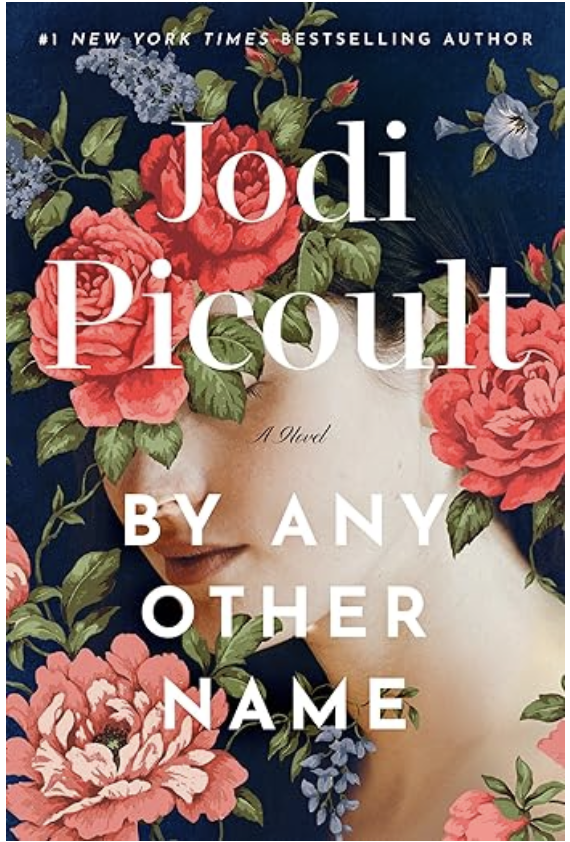
Jodi Picoult’s By Any Other Name is a must-read for Shakespeare lovers. This novel is a thought-provoking story based on research about the real-life Emilia Bassano, who lived in the 16th century and might have authored some of William Shakespeare’s plays. A second thread follows Melina Green, a fictional playwright living in present-day NYC. Male producers steadily reject her work until a friend submits one of her plays using a man’s name. Compelling and engaging, this novel celebrates the talents of two women seeking to bring their words to life despite the prejudice they face.
Because the book details the customs of Elizabethan England, including facts about Bassano’s life, the notion of her authorship of Shakespeare’s plays seems plausible. Collaborating and selling plays were part of the theater milieu. Bassano received a robust private education as a young girl and then was forced to become a mistress to Lord Chamberlain who oversaw all theater productions in England. Like other writers, she could have sold her plays to Shakespeare. That she was a talented writer is not in question. After years of prohibition, in 1611, Bassano was the first woman whose poetry was published in England.
Shakespeare, the writer and actor, is also a character in the novel. However, the narrative offers many facts (sources are listed in the author’s notes) and questions whether Shakespeare wrote all the plays attributed to him. Among the facts that caught my attention: he wrote strong female characters and yet had two daughters who could not read or write, he never traveled to the locations where some of his plays took place, and there is no record that Shakespeare played a musical instrument. Yet, his plays collectively have more than two thousand musical references. When he died, he left no books or manuscripts. Nor is he buried in Westminster Abbey like other revered writers of England.
As I pondered Picoult’s hypothesis, I reminded myself that history is written by those in power. The men in charge of the theater would not consider women capable of such erudition. But even if the novel’s premise is not proved over time, By Any Other Name is an engrossing story that highlights two women writers, one real and one fictional, living centuries apart, yearning for their voices to be heard. The story is a reminder that despite progress, parity between men and women has yet to be achieved. I highly recommend this novel. 4/5
Four Letters of Love is a story about the mystical, often inexplicable ways people find their beloved. It’s hard to describe the beauty and grace of Niall Williams’ writing. His touch is light, his insights powerful, and each sentence overflows with lyricism. His reverence for the lush landscape of western Ireland and the people who dwell there can be felt in every line.
The book’s back cover states that Isabel Gore and Nicholas Coughlan are destined to be together. And though it’s frustrating that they don’t meet until the last third of the book, Williams seems intent on setting the stage first. In the early chapters, he reveals Isabel and Nicholas’ complicated backstories and the emotional forces that shaped them. These stories include childhood wounds, guilt and the complicated dynamics of each set of parents. Williams dissects and untangles those emotional strands with care and wisdom, adding context to their eventual meeting.
When Nicholas visits the island across the sea from Galway to seek a painting his father made, he falls hard for Isabel, and eventually she for him. Given their prior paths, the probability of their encounter is low, and their eventual meeting seems unlikely. To complicate matters, Isabel is already married. Yet out of the chaos and unpredictability of the world, Niall Williams suggests that sometimes blessings appear. Love’s path is not always straightforward, and Nicholas and Isabel’s connection takes time to take hold. The depth of their bond reveals itself most fully through Nicholas’ love letters.
Here is the short chapter in which he describes meeting Isabel for the first time.
“Some things do not bear telling. I think my father knew this. I think he knew how words can sometimes flatten the deepest emotions or pin them like wild butterflies stunned out of magnificent flight, flimsiest souvenirs of what moved and coloured air like silk. Better to image it. Imagine music playing, imagine light falling through the clouds into the morning street and the scent of the island following us as we walked to find the shop. Imagine there was nothing unlovely in the world, and that we walked as proof of miracles, our feet barely touching the path and smiles playing on our faces as the thousand birds sang in the sky. Imagine goodness floated from us into the city air and cars slowed to unwind windows and breathe the thick perfume that smelled like white candles and fresh linen. Imagine all the aches of the world had secretly mended, and music heralded the news, rising along allegro with notes like joy and laughter pealing as we opened the door. This is how I came to see Isabel Gore for the first time.”
Four Letter of Love is a gorgeous novel. Niall Williams pierces his characters’ hearts, reaches into their souls, and conveys their thoughts and feelings in beautiful, poetic prose. Highly recommend. 5/5