
Recent Reviews

My Father's Tears by John Updike
In my late 20’s, I read the first two novels of John Updike's Rabbit Run novels. Harry “Rabbit” Angstrom is a former basketball star bouncing between youth and adulthood in post WWII America. At age 26, Rabbit abandons his wife and young son and moves in with a prostitute. Updike depicts a world of immature characters, endless lust, serial adultery, and permanent personal isolation.
Though Updike’s writing captivated me, his characters angered me. They were neither wise nor mature. Updike did not seem to offer any insight for transcending the hollowness he describes. The books depressed me and I did not finish the series.
Twenty years later, I read The Maple Stories, published in 2009. Over three decades, Updike had written 18 stories about Joan and Richard Maple’s marriage and divorce. His detailed, clear sentences still amazed me. In these stories about the painful unraveling of the Maples’ marriage, Updike’s pen seemed less pointed. His characters were more appealing and there was a softer, gentler acknowledgement of their suffering. The story Separating, in particular, moved me.
The Maple Stories were on my mind when My Father’s Tears was published after Updike’s death in 2009. Unlike many authors I admire, Updike doesn’t focus on developing his characters’ psychological etiology. Clues about childhood development or traumatic experiences are not scattered in his stories. His books are not psychological in the ways that I appreciate.
Yet, in this last collection of stories, he beautifully captures the ruminations of an older man reflecting on his life. Yes, Updike’s constant themes of unfaithful spouses and sexual restlessness become irritating. However, these final stories focus more on his parents, grandparents, kids, and grandkids. He looks back where he came from and tells the stories that made him who he is. He describes recognizable events and makes them feel sacred.
In the title story, My Father’s Tears, Updike evokes the deep unspoken love of a father for his college bound son. They are saying good-bye at a train station. The son says, “…I was going somewhere, and he was seeing me go. I was growing in my own sense of myself, and to him I was getting smaller. He had loved me; it came to me as never before. It was something that had not needed to be said before, and now his tears were saying it. Before, in all the years and small adventures we had shared, there was the sensation stemming from him, that life was a pickle, and he and I were, for a time, in the pickle together.” This father knows that his son will not return home except to visit. The son continues, “But my father did foresee, the glitter in his eyes told me, the time consumes us--- that the boy I had been was dying if not already dead, and we would have less and less to do with each other. My life had come out of his, and now I was stealing away with it.”
My favorite story is Walking with Elizanne. It is the best story I have read about a high school reunion; in this case, that of David Kern, Updike’s alter ego. “Though the year 2000 inevitably figured in yearbook predictions and jokes, nobody had really believed that a year so futuristic would ever become the present. They were seventeen and eighteen; their fiftieth class reunion was impossibly remote. Now it was here, here in the function room of Fiorvante’s, a restaurant in West Alton, a half-mile from the stately city hospital where many of them had been born and now one of them lay critically ill.” Updike captures the determined denial of young people toward the inevitable passing of time. But would it have changed anything if David Kern and his classmates understood that their 50th reunion would quickly be upon them?
The most poignant line is when David encounters a woman at the reunion named Elizanne. She reminds David that he had once walked her home from their date and kissed her. As she describes that evening to him, he can’t recall it. Later he reflects on their conversation and remembers their date of 50 years ago. He says, “Elizanne, he wanted to ask her, what does it mean, this enormity of our having been children and being old, living next door to death?”
Updike’s ability, in a few sentences, to evoke emotion, capture places, and stimulate empathy is stunning. He does not offer a transcendent moment or resolution, but he offers his readers a moving experience. He is like a hiker who runs ahead to the top of the mountain and comes back to tell the rest of the hikers about the view from the peak. It’s not a perfect view, there are clouds in the sky and obstacles on the trail, but if we are lucky, that is where his readers are heading. His clear and haunting prose invites his readers to ponder the meaning of their lives before they reach a point where they cannot change paths. Updike does not have the answers, but he points out the signposts along the way.

The Spinoza Problem by Irvin D. Yalom
I love this book by my favorite psychoanalyst/author, Irvin Yalom. As he did in his novels, When Nietzsche Wept and The Schopenhauer Cure, Yalom uses his psychoanalytic training and philosophical knowledge to construct a gripping work of historical fiction. He offers plausible theories about the internal lives of the brilliant philosopher Baruch Spinoza and the demented Nazi ideologue Alfred Rosenberg. Yalom expertly alternates between the story of Spinoza’s life as an excommunicated Jew from Amsterdam in the 17th century and Rosenberg’s life as a Nazi in 20th century Germany.
In 2007 Yalom visits the Spinoza Museum in Rijnsburg, 45 minutes outside of Amsterdam. He learns that in 1942, Alfred Rosenberg, the prominent anti-Semitic Nazi ideologue, had organized his henchmen to pack all the books from the Spinoza Museum and take them to Germany. The official Nazi Report about the looting states, “The museum contains possible early works of great importance for the exploration of the Spinoza problem.” Yalom asks himself, "Why would one of the strategists of the plot to eradicate the Jewish population in Europe personally travel to Amsterdam to over see the stealing and preserving of Spinoza’s books? Why not simply burn the museum and its contents?" It turns out that when Rosenberg made anti-Semitic comments in boarding school, the headmaster instructed him to read the German philosopher Goethe’s writings. Goethe admired Spinoza and praised Spinoza in his writings. This does not make sense to Rosenberg. How could his hero, Goethe, admire this Jewish philosopher? It is a question that haunts him.
Spinoza’s orthodox community believed that the Torah was the exact word of God and that science should not be pursued. Spinoza came to believe in a paradigm based on thought, reasoning, science and evidence, not superstition. He was a kind and gentle man, but was still excommunicated from his Jewish community. He left Amsterdam and began a life of reading, writing and contemplation of non-Talmudic authors. As Yalom states, "Spinoza’s ideas paved the way for the Enlightenment." Different from the shallow rote thinking of Rosenberg, Spinoza was curious, analytical and self-reflective. He believed that current thoughts and feelings were most likely shaped by previous experiences. He was a thinker ahead of his time.
By the 1940s, Rosenberg had risen to a high position in the Nazi Party. Yalom includes the venomous lies and disgusting insults written by Rosenberg in his Nazi sponsored newspaper. He then imagines a “therapy” that might explore Rosenberg's petrifying pathology and uncover his obsession with Spinoza and the “Jewish problem.” Yalom suggests that Rosenberg has such an extreme inferiority complex that he develops a compensating “superiority complex." Why the Jewish people are Rosenberg’s particular target is not a point Yalom dwells upon. After all, the odious bigotry of anti-Semitism had permeated many aspects of European culture for centuries. Rosenberg never repented for his involvement in the Final Solution. He was hung at the end of the Nuremberg trials.
The Spinoza Problem is another superb novel by Irvin Yalom. Integrating history, philosophy and psychology, he takes us on another deep dive into understanding why human beings behave the way they do.
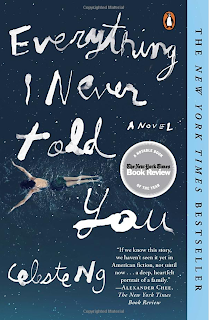
Everything I Never Told You by Celeste Ng
This poignant novel by Celeste Ng explores the deleterious effects of emotional isolation, especially in a family. James and Marilyn Lee are parents to teenagers, Nathan and Lydia, and their younger sister, Hannah. The parents do their best and still let their three kids down. They are not bad people, just wounded people. Like a forensic psychologist, Celeste Ng pieces together the factors that lead to the death of middle daughter, Lydia. It is a tragic story.
James, a gifted Chinese American student, meets his wife, Marilyn, when he is a young professor at Harvard and Marilyn is one of his undergraduates. They had both grown up as only children, isolated, alone and distant from their own parents. They fall in love, get married and cling to each other on their own emotional island. Marilyn has dreams of becoming a doctor while James seeks acceptance as a respected professor of American history. When James is denied tenure, probably due to his ethnicity, they retreat to a small college town in Ohio.
I feel for the Lee Family and admire Ng’s excavating of their relationships. Though Marilyn and James are bright, their emotional capacities are limited. They lack the skills to help one another. When kids arrive, they simply expand their islands of isolation. Marilyn gives up her dream of becoming a doctor, causing her great pain. The kids feel oppressed by their parents’ yearnings and desires for them. Nathan, the oldest, reminds James of his own isolation as a young person and Lydia the middle daughter becomes the repository of her mother’s thwarted ambitions. Hannah, the youngest daughter, is somewhat neglected. Marilyn and James love their kids, but they can’t connect to who they really are. They offer no message: Be who you are. We love you. The parents are distracted and anxious as they project and transfer their feelings onto Nathan and Lydia. The kids feel their parents’ vulnerabilities and want to protect their parents from the truths about their high school lives. There are plenty of subplots in the book as well as undercurrents of racism and sexism. Ng’s novel provides an excellent exploration of this heartbreaking family dynamic.
The book’s title is Everything I Never Told You, but really it should be - Everything We Never Told Each Other.
