
Recent Reviews
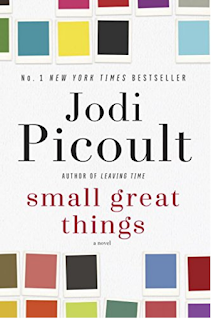
small great things by Jodi Picoult
I thoroughly enjoyed Jodi Picoult’s powerful and important novel small great things. The book provides a critical contribution to our country’s current discussions on race relations. Atticus Finch states in To Kill a Mockingbird, “You never really understand a person until you consider things from his point of view.” Picoult’s novel attempts to understand American race relations in 2015 by considering three points of view.
After Turk and Brittany Bauer’s baby is born in a small hospital outside of New Haven, they name him Davis after the President of the Confederacy, Jefferson Davis. The Bauers are proud white supremacists. When Ruth Jefferson, a Black woman with more than 20 years of nursing experience, introduces herself to the young couple and begins to tend to their newborn, Turk and Brittany ask to speak to Ruth’s supervisor. Soon there is a post-it note on Davis Bauer’s file: No African American personnel to care for this patient. Their baby then dies while Ruth is in the room and the white supremacists sue Ruth for murder. Kennedy McQuerrie, a white woman, becomes Ruth’s public defender and a trial ensues.
Picoult knew that people might question the legitimacy of a white woman writing a book about racism. Yes, it is true that Maya Angelou, Toni Morrison, Zadie Smith, Colin Whitehead. Ta-Nahisi Coates and others offer a more authoritative depiction of discrimination. But Picoult is seeking to reach white readers who have not yet acknowledged their white privilege. Picoult states, “It’s about who has institutional power. Just as racism created disadvantages for people of color that make success harder to achieve, it also gives advantages to white people that make success easier to achieve." During the trial when Ruth Jefferson wants to object to a statement being made by her lawyer, Kennedy McQuarrie, she catches herself and thinks, “Well, better for the jury to hear it from one of their own.” That I believe is Picoult’s intent.
The book depicts plenty of intense scenes involving race. The police arrest and drag Ruth from her middle class neighborhood and place her in jail. Turk Bauer describes the joy he feels when he beats up random Black or gay people. But the incidents Picoult captures so well are the daily indignities that Ruth endures. For instance, after shopping together at TJ Maxx, a security guard stops Ruth to inspect her receipt while waving white Kennedy through the door.
Ruth Jefferson works hard to succeed. She knows how to keep a low profile. She graduates from college and then Yale School of Nursing. For twenty years, she earns excellent performance reviews from the hospital. She tells her son that if you play by the rules, you can get ahead in life. As she awaits her trial, she asks Kennedy, “How can I say with a straight face to my son, ‘You can be anything you want in this world’ – when I struggled, studied, and excelled and still wound up on trial for something I did not do.”
Picoult brings to light the ways in which African-Americans are asked to repress their cultural customs and traditions in order to fit into the white dominant culture. Ruth’s sister, Adisa, who has changed her name from Rachel to embrace her African heritage, says to Ruth, “It’s their world Ruth. We just live in it.”
Kennedy McQuarrie initially believes she does not participate in any kind of systemic racism. She sees people like the Bauers and believes that they are the racists. Since Kennedy works as a public defencer with many African Americans, she thinks, how could I possibly be racist? But part of what Picoult is pointing out is that the institutions of power give white people advantages. Picoult says, “Like ghosts, white people move effortlessly through boundaries and borders. Like ghosts, we can be anywhere we want to be.”
After Kennedy has spent time attempting to understand the world through Ruth’s perspective, she says to the jury, “It’s about systems that have been in place for about four hundred years, systems meant to make sure that people like Turk can make a heinous request as a patient, and have it granted. Systems meant to make sure that people like Ruth are kept in their place.” She also says, “I’ve gotten a boost from the color of my skin, just like Ruth Jefferson suffered a setback because of hers.”
Small great things is an ambitious and engaging novel. It helps us to experience and understand other people’s perspectives. Though Picoult does not offer a deep psychoanalysis, she does offer a general explanation of the forces and dynamics that shape the actions and views of her characters.
“Small great things” is a reference to a sentence in a Martin Luther King’s speech, when King exhorts people to do small things in great ways to combat racism. And that is exactly what Jodi Picoult is asking us to do.

The Secret Life of Bees by Sue Monk Kidd
The Secret Life of Bees by Sue Monk Kidd is one of my favorite books. Published in 2002, I have now read this beautiful novel three times.
The year is 1964, racism is rampant, and Martin Luther King and his followers are fighting for equal rights. Lily Owens is 14 years old and lives with her abusive father Terrance Roy and is taken care of by a kind African-American housekeeper, Rosaleen. Lily longs to know about her deceased mother and, more importantly, Lily wants to know that her mother loved her despite her father’s cruel taunts suggesting otherwise.
When Rosaleen attempt to register to vote in Sylvan, South Carolina, three white men taunt her and accuse her of stealing. They beat her and - because it is 1964 - she is arrested. While visiting Rosaleen in the hospital after the ugly incident, Lily and Rosaleen escape. In a sparse but treasured bag of her mother’s possessions, Lily cherishes a picture of a Black Madonna with the words Tiburon, South Carolina written on the back. Eventually, Rosaleen and Lily arrive in Tiburon and are curiously welcomed to the home of May, June, and August Boatright, three African-American sisters who keep bees and sell their Black Madonna Honey. Rosaleen and Lily have found a welcoming space.
In the Boatwright home, there is plenty of patience, lots of love, and many wonderful characters. Lily doesn’t tell them the totality of her story and they don’t tell her what they know about her. Eventually, Lily asks August why August never told Lily that she knew her mother. August replies, “Because you weren’t ready to know about her. I didn’t want to risk you running away again. I wanted you to have a chance to get yourself on solid ground, get your heart bolstered up first.”
Finally feeling safe, Lily sheds the weight of her sorrow with August. She says, “It was scary, my secrets spilled out across the room, like a garbage truck had backed up and dumped its sorry contents across the floor for her to sort through.” Lily sobs as she shares the stories and feelings that have consumed her little life. August listens and comforts Lily, “She was like a sponge absorbing what I couldn’t hold anymore.”
Filled with spiritual themes, this novel provides an example of what our world might feel like if there was a divine mother figure rather than a paternalist father deity. At one level, the book is the articulation of an unconscious desire for a feminine divinity and a repudiation of a dominant male deity. Lily and August spend time in the honey house where August explains to Lily the beehive’s social structure. The queen bee, Lily learns, is central to the functioning of the hive, a parallel to the power of the Madonna. The Boatright sisters are part of a group of African-American women who call themselves Daughters of Mary. They embrace Lily and encourage her to feel empowered despite life's setbacks. And they should know. August says, “Our lady is not some magical being out there somewhere, like a fairy godmother. She’s not the statue in the parlor. She’s something inside of you.”
Kidd’s book deftly deals with family dynamics, civil disobedience, mental illness, race relations, friendship, mothering, religion, and spirituality, all subjects that interest me. The book is spiritually compelling and emotionally resonant. Lily comes to know her own mother through the love of these three sisters and the Daughters of Mary. There is tenderness in Kidd’s writing. She conveys understanding and empathy. She allows us the privilege of walking in Lily’s shoes and to experience her healing as Lily comes to an understanding of her mother and her own role in her mother’s death. By the end of the book, Lily forgives herself and begins to heal and feel worthy of love. If you are looking for a book that engages your mind while touching your heart, I highly recommend The Secret Life of Bees.

The Good Psychologist by Noam Shpancer
There is a lot to love about Noam Shpancer’s quirky novel about a psychologist who sees patients during the day and teaches would-be therapists at night. For people who have never been in therapy, the book is a wonderful introduction to the therapeutic process. For those who have spent time in therapy, the book provides a deeper understanding of this unique and complex process from the perspective of the therapist.
The reader is introduced to the good psychologist, a middle aged divorced practitioner, who is thoughtful, reflective, and intentional. In keeping with the principle of clinical distance, Shpancer does not even tell us his name; however, we do meet the psychologist’s patients and experience their sessions. The primary plot involves an abused exotic dancer who has developed anxiety about performing. I am not sure why Shpancer chooses this client given his otherwise ordinary and pedagogical tone. Nonetheless, the book is serious about therapy and the potential to heal large or small pieces of oneself through describing, analyzing, and understanding one’s actions with the guidance of a trained therapist. The good psychologist says, “ The therapist is like a driving instructor, not a chauffeur.”
The book effectively introduces both the theory and practice of therapy. The novel’s strength is the way the good psychologist shares his thoughts as he teachers his classes and treats his patients. He illuminates the ways in which patients do or don't form a bond with him as illustrative of how that person might form relationships in his or her life. The novel also shows how components of therapy such as payments, missed appointments, and tardiness reveal emotional patterns about a patient that can be deconstructed in the therapeutic process. And he touches on the ways Freudians, cognitivists, and Behaviorists might differ in their approaches to helping a client confront their pain.
The relationship between a therapist and a patient is simultaneously limited and limitless. The good psychologist is well aware of this fact. He says, “In trying to map the depth of the internal realm, all we have at our disposal are primitive tools: conversations, observation, and introspection. And even with all our tools, we are lucky to ever break through even the outermost layer.” Yet he persists because there are few better options for helping people understand their internal worlds. He says, “One hour a week of battering against the walls cannot breach a fortress built over many long years. The lessons learned in a session must be translated into everyday practice. The shape of one’s life, in the final analysis, emerges from the sum of one’s everydays.” And he believes he does help facilitate change in people’s everyday lives.
Inevitably, the good psychologist’s issues emerge. Though we learn about neurosis, anxiety, OCD, and panic attacks through his patients, the psychologist’s angst feels like aching melancholy and existential loneliness. I wonder if knowing the enormous complexity of the human psyche leads him to a self imposed isolation. As the novel ends, we don’t learn the good psychologist’s name, but we do learn about his lonely life, his hurting heart, and the blurring of professional boundaries. The good psychologist exposes us to the theory, the practice, and sometimes the magic of therapy, but now he needs to find himself a good psychologist.
