Recent Reviews

The Nightingale by Kristin Hannah
Kristin Hannah’s enthralling novel The Nightingale explores the impact of the German occupation of France in WWII on the lives of two sisters, Vianne and Isabelle Rossignol. The book opens with Vianne, now an elderly woman living in Oregon, viewing artifacts from her life during WWII, a life that she never shared with her surgeon son because it would cause them both grief and despair.
Hannah then transports the reader to 1939 and the story of how each sister responded to the escalating tensions in France. Vianne, the older sister, struggles with her rambunctious, bold, and brash younger sister who suffers from grief over their mother’s death and the pain of their father’s abandonment. Hannah fully captures the complexity of the sisters’ relationship. As the Nazis begin their occupation of France each sister responds to the ensuing horror differently, but both heroically. Though Vianne believes her sister leaves their small village in the Loire Valley to pursue a love affair, Isabelle actually joins the Resistance and smuggles downed pilots from France over the Pyrenees into Spain. Isabelle’s code name is The Nightingale.
Vianne’s courage is just as compelling. While Vianne’s husband is off fighting the Germans in Russia, Vianne wrestles with the agonizing choice of whether to abandon the family farmhouse when the local Nazi commandant takes over a room in her home. She decides to stay in this sadistic situation. When the Jews in the village are being rounded up, her best friend Rachel begs Vianne to save her son Ari. Vianne does so at great risk and raises Ari as her own. Saving Ari gives Vianne the courage to participate in a clandestine effort to help other Jewish children escape extermination.
The novel depicts the methodical and incremental cruelty enacted by the Nazis in French towns. Jewish citizens are forced to accept one humiliating edict after another, each time hoping that that it will be the last. Initially, Jews are only able to stand in the food lines after all the non-Jews. Then they are prohibited from working certain jobs and, before long, all Jews in Vianne’s village have been rounded up and put on trains to the concentration camps. Though some villagers attempt to defend their Jewish neighbors, the Nazi’s brutality affects every person. It is a horror show.
The end of the novel is quite satisfying as Vianne does get her wish. I won’t reveal the specifics, but Vianne’s son finally learns about his mother’s prior life. She says, “I have spent a lifetime running from it, trying to forget, but now I see what a waste that it was.” Kristin Hannah's ambitious story explores family dynamics, the horrors of the Holocaust, the brutality of the Nazi occupation, the bravery of some people and the cowardice of others, the important and often-unacknowledged role of women in wartime, and the way extraordinary circumstances reveal a person’s moral character. As Vianne states at the end of the book, “If I have learned anything in this long life of mine, it is this: in love we find out who we want to be; in war we find out who we are.”

The Underground Railroad by Colson Whitehead
Colson Whitehead’s novel, The Underground Railroad, captures the horror of slavery. The writing is exquisite and complex while the plot is both straightforward and sprinkled with magical realism. Cora, a young woman, lives on a cotton plantation in Georgia with an overseer as cruel as Simon Legree. Cora escapes with a fellow slave named Caesar to catch a train heading north on the Underground Railroad. In Whitehead’s telling, Cora boards an actual locomotive running beneath the ground. The novel follows Cora as she stops in different states, each with a different approach to dominating and exploiting African Americans. At every stop, Cora experiences humiliation and degradation and lives in terror that Ridgeway, the slave catcher, or someone else will capture her. The draconian Fugitive Slave Act punishes anyone who assists escaped slaves.
There are some Underground Railroad stations that are located in states that treat African-Americans relatively better. Yet each state has its own approach to denigrating African-Americans through emotional, physical, or spiritual torture. And as if the terror of being sold and separated from family isn’t enough, the brutality of the violence Mr. Whitehead describes is grotesque and gruesome. He writes, “Cora had seen men hung from trees and left for buzzards and crows. Women carved open to the bones with the cat-o’-nine-tails. Bodies alive and dead roasted on pyres. Feet cut off to prevent escape and hands cut off to stop theft.” In one scene, the plantation owners’ guests are served lunch while one of Cora’s fellow slaves is whipped in front of them and then he is doused with oil and roasted. Who are these people? Psychologically speaking, it is hard to make sense of their atrocious actions. How have they convinced themselves that this abhorrent behavior is acceptable? Though they think of African-Americans as barbarians, it is these plantation owners, overseers, slave catchers, and acquiescent Southerners who are the barbarians in this horror show as they project their own barbarism onto their slaves. It is a painful book to read.
A couple of decent folks emerge in the book, but it is dark from beginning to end. I can’t imagine how difficult it must have been for Colson Whitehead to write this book. He is a deserving recipient of both the 2016 National Book Award and the 2017 Pulitzer Prize. All Americans should read this book. It is yet another reminder that our government has offered no formal apology or financial reparations to the descendants of slaves. Though in a different form, the scourge of racism persists today. Only when the United States government and its citizens confront and engage with this horrible history will we, as a country, heal and move forward.
Pachinko by Min Jin Lee
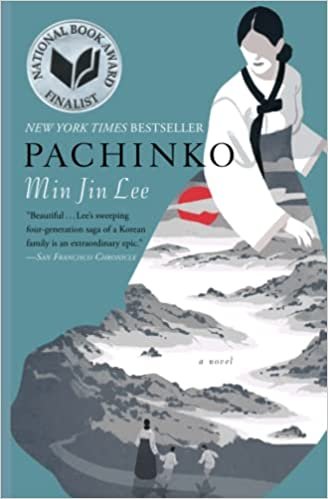
In her exceptional debut historical novel Pachinko, Min Jin Lee follows four generations of a Korean family. It is a heart-wrenching and soulful story about how family members endure and adjust to the colonization of Korea by the Japanese in 1910, their immigrant status in Japan, and the subsequent division of their homeland after WWII. The book also probes family dynamics as each individual wrestles with his or her new identity as a Korean immigrant contending with racism and discrimination by the Japanese.
Hoonie and Yangjin, a poor couple living in a fishing village on the southern tip of Korea, have a daughter named Sunja. When Sunja is in her teens, she meets a married man, Hasan, and becomes pregnant. Hasan offers to provide for Sunja and their son, but Sunja does not want the life he offers. Sunja’s mother speaks to a minister who is moving from Korea to Japan. Despite her pregnancy, the kind minister asks Sunja to marry him, allowing Sunja and her mother to escape the shame and humiliation of Sunja’s illegitimate pregnancy.
Sunja and her new husband Isek move in with Isek’s brother and his wife in Osaka, Japan where they face occupational limitations. As Sunja’s oldest son grows, he sees being Korean as “a dark, heavy rock." His greatest, secret desire is to be Japanese. Sunja’s younger son’s girlfriend wants to move to America. “To her, being Korean was just another horrible encumbrance, much like being poor or having a shameful family that you could not cast off. Why would she ever live there? But she could not imagine clinging to Japan, which was like a beloved stepmother who refused to love you, so Yumi dreamed of Los Angeles. There, no one would care that we are not Japanese.”
Sunja’s sons eventually operate Pachinko parlors in Japan, a permitted occupation for Koreans. Similar to pinball, the balls bounce around the Pachinko machine and land in random locations. And like life, Pachinko players must make decisions based on where the balls land even if the game is rigged. For Koreans, getting ahead is nearly impossible irrespective of how hard they work. The Japanese limit their opportunities and then ridicule them for not rising in the Japanese social hierarchy - a predictable pattern in systemic racism.
The family members labor and suffer but remain devoted to one another as they adapt to their changing circumstances. They experience joys and triumphs as well as despair and pain. Lee elucidates the superstitions and traditions that serve the family well and cause them to suffer. As Lee states in the opening line, “History has failed us, but no matter.” Min Jin Lee, however, succeeds in writing this epic family story that illuminates how one Korean family perseveres beneath the weight of prejudice and pain.
