
Recent Reviews
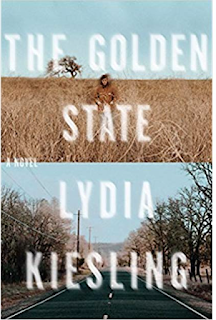
The Golden State by Lydia Kiesling
This review was published in the San Francisco Examiner on December 26, 2018
http://www.sfexaminer.com/golden-state-evocative-story-mother-crisis/
“The Golden State,” an impressive and insightful debut novel by San Francisco writer Lydia Kiesling, is a book about motherhood, aging, loss and love.
Written with humor and wisdom, it combines a coming-of-age story with a transformational California road trip. In Jack Kerouac’s “On the Road,” Sal Paradise is a Beat Generation wanderer. His road trip takes him to San Francisco on a restless odyssey. In Kiesling’s novel, Daphne Nilsen is an overwhelmed millennial mother who leaves San Francisco in search of a way forward.
Daphne, in her early 30s, works at the Institute for the Study of Islamic Societies and Civilizations at UC Berkeley. Her Turkish husband Engin has been waiting in Istanbul for five months for a bureaucratic visa snafu to be resolved. He longs to return to San Francisco and restart his life with Daphne and their 16-month-old daughter, Honey. While waiting, the couple use Skype to stay connected and plot immigration tactics.
Daphne feels isolated and alone taking care of Honey. When a student Daphne advised is involved in a horrific car crash in Turkey, Daphne is devastated. She feels responsible for the tragedy and the news triggers painful emotions about her own troubles.
She leaves work, packs her car, retrieves Honey from day care and bolts from the Bay Area. Her destination is the fictional town of Altavista in the high California desert where multiple generations of her family had lived. She and Honey begin their escape by way of El Cerrito, Richmond, the Nut Tree and Sacramento.
Daphne has no plan. She is pulled viscerally to the quiet beauty of Altavista and the tidy doublewide mobile home she inherited from her mother. In those peaceful surroundings she had felt the loving embrace of her parents and grandparents.
At a town diner, Daphne meets a forthright and philosophical 92-year-old woman named Alice, who has driven from Colorado to visit a sacred spot from her lost life with her husband. Daphne learns that Alice’s husband died 50 years earlier, the first of many losses she has suffered. Alice’s reflections and her resilience impress Daphne. She muses, “I feel there is something accusatory in her tone, as if to say, ‘I didn’t have some little meltdown like you seem to be having over nothing.’” This imagined rebuke actually empowers Daphne.
With minimal punctuation and few paragraph breaks, the novel feels like an intimate conversation. Ten chapters shape the story: one for each day she is away from the Bay Area on her pilgrimage to the high plains. Kiesling is best when she describes the exhilarating love and enervating boredom Daphne experiences caring for Honey. Though she is sometimes resentful, Daphne’s love for Honey is fierce, her devotion total. Yet fears haunt her: “Why did I have a child? To have a child is to court loss.”
Like the caterpillar in the book she reads to Honey, Daphne needs energy to advance to the next stage of her life as she sorts out how she arrived at her breaking point and how to move forward. An orphan without siblings, a wife deprived of her husband and a single parent with a job and a toddler, Daphne has been plodding along unconscious of her accumulating grief.
Visiting her safe space, laden with meaning and memories, she better understands both the emptiness and fullness of her life. By the novel’s end, we understand the full contours of Daphne’s existential crisis and we are now rooting for her to find her golden state.

The Weight of Ink by Rachel Kadish
Rachel Kadish’s The Weight of Ink is possibly my favorite book of 2018. In every page, I could feel Kadish’s passionate commitment to her characters and to the historical period she describes. Her appreciation of the written word is evident as she captures both the smallest details and largest historical themes. At one level the novel is a mystery to be solved. Yet due to Kadish’s skills as a writer and thinker, we are exposed to other levels of inquiry and thought: philosophy, the nature of love, religious viewpoints, moral obligations, the existence of God, gender roles and the power of the past to affect the present. No lightweight list of ideas to contemplate.
The novel opens in 2000. Helen Watt is a Professor of History at a University in London. When a former student asks her to examine a cache of old letters discovered in a 350 year-old-home he recently inherited, Helen is astounded by what she finds. She knows immediately these letters, written in Hebrew and Portuguese from the 1660s, are historically significant.
The novel then shifts to London in 1657. We meet Ester Valasquez, a young woman in her late teens who was adopted by Rabbi HaCoen Mendes after her parents died. Rabbi Mendes and Ester have left Amsterdam and traveled to London where the Rabbi will lead a small Jewish community. Because he was tortured for not renouncing his faith during the Inquisition, Rabbi Mendes is now blind. Though the rabbi does not support women reading or writing, Ester is a skilled scribe and secretly assists with his correspondence.
Though 400 years separate Helen and Ester, both women seek to utilize their intellectual gifts. Their identities are intrinsically connected to their ability to think and express themselves by writing down their thoughts. Ester says, “.... the unpooling of ink has brought me much comfort always, and often have I written what I would not speak.” However, the religious, social and political customs of that time period do not allow women that option. Esters complains, “A woman’s body was a prison in which her mind must wither.” Nonetheless, Ester develops a way to communicate her own thoughts even as she continues to scribe for the Rabbi. This bold decision contributes to the mystery of these letters three centuries later. In 2000, women participate fully in academia. However, Helen Watt still faces sexism and isolation by the male colleagues in her department. Yet because of brave women like Ester Valequez, Helen Watt publishes her thoughts under her own name.
Kadish’s novel also illuminates the unfair and precarious plight of the Jews. Though fortunate to be in London and not Spain, the Jewish community of London in the late 17th century is at the mercy of the clerical and political leaders of London. An acquaintance of Ester says, “… to be a Jew in this world, I understand is a danger. If a Jew speaks the truth of his faith in the wrong moment, though that faith harms none, he brings down untold wrath.” Kadish depicts the texture of oppression the Jewish community faced during this time.
Rotating between two time structures can be difficult. Often readers connect to the characters in one time period but not characters in the other. In The Weight of Ink I felt immersed in the characters’ struggles from both time periods. At 560 pages, The Weight of Ink is not a short read, but it is an emotionally, intellectually and worthwhile one.
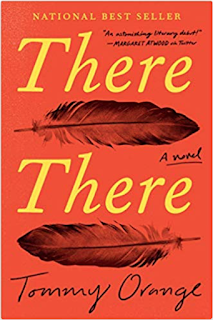
There There by Tommy Orange
Review published in the San Francisco Examiner on October 28, 2018
http://www.sfexaminer.com/oaklands-urban-indians-come-life-exquisite/
Tommy Orange’s There There has been a Bay Area bestseller for a reason. His novel is exquisitely wrought and tells the story of twelve characters who plan to attend a “Big Oakland Powwow”. They are not traveling from rural reservations. As Orange says, they are “Urban Indians” who call Oakland home. They live in a cityscape where BART stations, the Oakland Coliseum, and the Grand Lake Theater mark the terrain.
The book’s title is borrowed from Gertrude Stein. When her Oakland home was torn down and her old neighborhood redeveloped, she observed that the “there” of her childhood had ceased to exist. As one of the novel’s characters, Dean Oxendene states, “But for Native people in this country, all over the Americas, it’s been developed over, buried ancestral land, glass and concrete and wire and steel, unreturnable covered memory. There is no there there.”
Orange begins this uniquely structured book with a prologue recounting the cruel history of efforts to eradicate the Native American peoples. He describes the betrayal and brutality that the Native Americans endured as they negotiated with successive waves of Europeans including the Pilgrims. He reminds us how violent a history it has been.
Each subsequent chapter is the story of a single character. We learn their histories and hopes, their strengths and sorrows as they prepare for the powwow. They each have their own reasons for attending - some practical, some profound. Orange writes, “We made powwows because we needed a place to be together.” Many of the characters work at the Indian Center. They struggle with alcohol, drugs, poverty, mental illness, violence and shame. We meet Tony Loneman who was born with Fetal Alcohol Syndrome. We meet Orvil, Loother, and Lony Red Feather whose mother committed suicide. We meet Calvin Johnson who is bipolar and whose brother is a drug dealer. Each of the character’s stories is emotional, raw and intimate. As we learn about them we understand why their lives are so difficult. Orange points us to a James Baldwin belief, “People are trapped in history and history is trapped in them.”
Yet, these characters are not as bitter as one might expect, though most live on the edge. Rather, they navigate their present lives while carrying the psychic pain of their ancestors’ suffering. These Urban Indians persevere and find their own unique ways of expressing their Native heritage in Oakland.
The characters vary by tribe, age, gender and attitude. About their collective past, they have different interpretations. They voice fervent beliefs and existential observations. Tony Loneman says of his ancestors, “They must not’ve had street smarts back then. Let them white man come over here and take it from them like that.” Another character Opal Viola Victoria Bear Shield says, “Don’t ever let anyone tell you what being Indian means. Too many of us died to get just a little bit of us here, right now, right in this kitchen.”
Orange weaves together these individual stories as the plot plays out in surprising ways at the powwow at the Coliseum. The Natives have come to dance, celebrate, sell crafts and just be together as Natives. But a few of the characters have nefarious plans. Violence lurks, the dancing ends, and the powwow crescendos to a chilling climax.
Tommy Orange’s book is a literary burst of pain and rage leavened by understanding and empathy. Orange has reimagined and updated the story of the Native people of our country. He has a sympathetic ear for the psychological burden that the past brings to the present. There There is the work of a talented and urgent new voice on the literary scene.
