
Recent Reviews
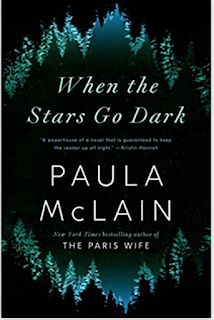
When the Stars Go Dark by Paula McLain
This review was published in the San Francisco Examiner on May 9, 2021.
Paula McLain’s new novel ‘When the Stars Go Dark’ is an inspired psychological thriller. The mystery revolves around the abduction of a young girl and a woman detective obsessed with finding her. Though the story pursues the question of “who done it,” McLain is especially interested in the “why”of the crime. The fast-paced narrative is enriched with insights about trauma, foster care, forgiveness, returning home, and redemption.
Anna Hart is a seasoned San Francisco Police Department detective consumed by her work. She investigates sex crimes and crimes against children. Though brave and bold, she is burdened by her past. When Anna was eight, her mother died of a heroin overdose. Her father was away in prison. After a dozen foster homes, Anna’s luck improved when she turned ten and was placed with a wise older couple, Hap and Eden Strater. They lived in the small village of Mendocino on the rugged California coast. In Mendocino, Anna had spent the happiest years of her otherwise harrowing childhood. Hap and Eden’s love built Anna’s confidence and lessened her sorrow. They also cultivated in her a reverence for the healing power of the nearby forests.
Unfortunately, tragedy finds Anna again as an adult. This new tragedy is a mystery until the end of the book. But we do know it strains her marriage. Anna’s husband seeks a separation. Devastated, Anna returns to Mendocino. But returning to Mendocino does not provide the respite Anna expects. She learns that a fifteen-year-old girl named Cameron Curtis is missing. Soon Anna is working on the case. Cameron’s disappearance has eerie echoes of the disappearance of Anna’s high school friend Jenny Ledford, two decades before when Anna lived in Mendocino. That unsolved crime still haunts the community. Anna becomes obsessed with finding Cameron. The plot twists and turns as Anna interviews Cameron’s family, friends and associates for clues and motives. The novel’s suspense is heightened by references to the terrifying string of sexual assaults and snatchings that traumatized the Bay Area at that time. Most notorious was the abduction of Polly Klaas, who was taken from her Petaluma home in 1993.
Though the kidnapping of young girls is a disturbing topic, the novel, while heavy, is not gruesome. Instead, the narrative focuses on Anna’s efforts to understand Cameron’s inner thoughts and the psychology of the suspects who might be responsible for Cameron’s disappearance. Anna wonders why predators become predators and why victims become victims. Not simple questions. But Anna believes that in some cases, predators and victims can share unconscious communication, like an invisible signal. In addition, her experiences as a detective had revealed that shame and self-loathing can make some victims feel unworthy of love and vulnerable to dangerous predators.
Anna’s foster parents, Hap and Eden, had taught her the skills needed to navigate nature. These lessons serve Anna well, as she solves the mystery of Cameron’s disappearance in the gripping final chapters. Fortunately, she also comes to a greater understanding of her own grief and sadness with the help of a memorable psychic.
In her author’s note at the end of the novel, McLain shares that she spent her childhood in foster care and is a survivor of sexual abuse. The novel’s insight and intensity no doubt stem from this truth. ‘When the Stars Go Dark’ is beautifully written and psychologically astute. McLain has created a riveting story that illuminates a tragic subject with wisdom, grace, and even hope.

The Bohemians by Jasmin Darznik
This review was published in the San Francisco Examiner on April 11, 2021.
We all struggle to see other people. Distraction, fear, prejudice, and apathy blind us. But every so often, someone brings strangers into sharper focus, and we are able to really see them. In her new novel ‘The Bohemians,’ Jasmin Darznik has written a compelling story about the legendary photographer Dorothea Lange. Darznik imagines how Lange refined her skills in 1920s San Francisco and went on to create piercing, iconic images of powerless people enduring the hardships of the Great Depression. Her photographs helped Americans, in that perilous time, to see each other in a new way.
The novel begins in 1918 when twenty-three-year-old Lange arrives in San Francisco from the East Coast. Afflicted by polio as a child, Lange develops a deep sense of empathy toward others. She also learns to pay attention to what she sees around her. These traits serve her well as she cultivates her craft as a photographer. Once in San Francisco, Lange dreams of opening a portrait studio. Her talent becomes well known, but financial backing for women is scarce. Indefatigable, she eventually strikes a deal with a businessman who loans her money. She opens her studio a block off Union Square and befriends a group of Bohemians that include other respected women photographers. These non-conforming writers, musicians and artists widen the lens of Lange’s evolving social consciousness.
Around her, diverse social forces are competing for power in San Francisco. At the bottom of the social structure are Chinese Americans. Laws restrict where Chinese Americans can live and work. Lange employs a Chinese assistant in her studio. (This woman is known to history only as “Ah-yee” or “Chinese Mission Girl.) In the novel, Darznik envisions a business partnership and authentic friendship between Lange and her assistant, whom she names Caroline Lee. This propels the plot forward and allows Lange to see firsthand the discrimination, bigotry, and disregard Lee encounters. Few repercussions exist for police brutality, human trafficking, or unjust labor practices toward Chinese Americans. Another character is based on California Senator John Phelan, whose 1920 campaign slogan was Keep California White. It is as if Lange is stunned by the photo developing in her darkroom. Soon she stops snapping pictures of the wealthy elite and starts taking pictures of ordinary people.
Though ‘The Bohemians’ focuses on Lange’s formative years, the story does touch on Lange’s later contributions. In the early 1930s, with the Depression in full force, many Americans lack food, shelter, and clothing. Lange and her artist husband, Maynard Dixon, decide to document the suffering they see. Lange takes a shot of a breadline in San Francisco which she titles White Angel Breadline. Her skill enables her to reveal the story of those she photographs. Lange says, “I had to make myself useful. Somehow, I had to get people to see.” Eventually, Lange’s images of unemployed fathers and weary migrant mothers appear in newspapers. People who had been hidden become visible to politicians and policymakers.
I would have liked to hear more about the decades after Lange’s pivot from the privileged to the poor. That said, Darznik delivers an immersive story of an era that resonates with our own. Her characters live through the Spanish Flu, anti-Asian hostility, and xenophobic deportations. As we struggle with our own pandemic, Darznik reminds us that this is a painful pattern. By writing about a woman who helped the world see hardship and injustice, Darznik inspires us to truly see the others in our own time.
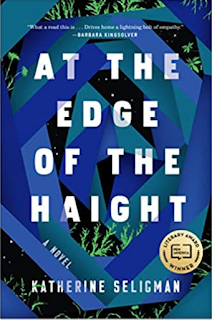
At The Edge of the Haight by Katherine Seligman
This review was published in the San Francisco Examiner on February 28, 2021
https://www.sfexaminer.com/entertainment/novel-insightfully-looks-at-the-lives-of-homeless-people/
The homeless are more often discussed than understood. No doubt that’s why Katherine Seligman’s ‘At the Edge of the Haight’ received the PEN/Bellwether Prize for Socially Engaged Fiction. Her absorbing novel introduces us to a group of young people living in San Francisco’s Golden Gate Park. We learn their names and family backgrounds. We witness their daily trials and become immersed in the odyssey of their lives.
Maddy Donaldo, the narrator and protagonist, is a twenty-year-old woman without a home. When she was young, her truck driver father abandoned the family. Her mother found work as a cashier at Safeway but then suffered a psychotic break. After Maddy aged out of the foster care system in Los Angeles, she boarded a bus to San Francisco.
In San Francisco, she learns how to survive in the Park and nearby streets. She finds a group of young people with whom she feels some connection, especially a young man from Arizona named Ash. In the Park, they hide their sleeping bags on tree branches by day and sleep under trees at night. The individuals in the group seem both detached and dependent on one another. With no notice, they disappear and reappear in each other’s lives. Their choices are frustrating. Many are emotionally wounded and use drugs and alcohol to ease their pains.
Though Maddy sometimes sleeps at a Haight shelter, she feels safer in the Park. She does, however, take advantage of the shelter’s showers, clothing, and free food. Police harassment and threats of violence from other homeless people make each day a challenge. Given the persistent emotional isolation Maddy has endured, she has few expectations for her life. She is tough and resilient but also tender and vulnerable. Her dog Root, whom she found when she first arrived in the City, is her most reliable companion.
Maddy’s life changes dramatically when she follows Root into a cluster of bushes in the Park. There she sees a young man on the ground bleeding to death; his assailant stands nearby. The plot develops as Maddy struggles with the aftermath of this traumatic incident. The police want Maddy to testify, the dead boy’s parents want to adopt her, and the murderer wants to make sure she doesn’t tell anyone what she saw. Navigating these conflicting demands causes Maddy to expand her thinking and imagine alternatives for her life.
As the story unfolds, Seligman shows the many causes of housing instability for young adults. Many young people are thrown out of their homes. Some have mental illnesses. Some come from poverty, but not all. Sometimes their parents have their own financial troubles and emotional afflictions. Other parents can no longer deal with their child’s behavioral or neurological differences. But whatever their prior struggles, all these young adults share the belief that they have no other place to go. To complicate matters, many are wary of help. Maddy wrestles with such feelings before fate turns in her favor.
‘At the Edge of the Haight’ is not a political polemic or policy paper; rather, it is a book about people living on the edge. Seligman’s skills as a journalist are evident in the story’s realism. Her detailed descriptions allow the reader to imagine the harrowing day to day lives of those living with constant housing insecurity. Seligman has created characters for whom the reader feels empathy and engagement. Without being heavy-handed, she is challenging us to understand, rather than ignore or condemn. When Maddy was young, her mother said to her, “You can’t judge people because you just never know why they do what they do.” Katherine Seligman has written a novel that does not judge but instead offers insight.
