
Recent Reviews

An American Summer by Alex Kotlowitz
Full Disclosure: Alex Kotlowitz is a good friend.
Alex Kotlowitz’s 1991 New York Times bestseller There Are No Children Here chronicles the lives of Pharaoh and Lafayette Rivers, two young brothers living in the Henry Horner Homes project on the West Side of Chicago. Perceptive, poignant and painful, that groundbreaking book detailed how poverty and violence robbed these boys of their childhoods.
Kotlowitz’s newly published book An American Summer reads like a sequel. In the twenty years after There Are No Children Here, “14,033 people were killed, another roughly 60,000 wounded by gunfire.” These statistics are shocking. Returning to West and South Side neighborhoods, Kotlowitz updates us on residents he first met in the 1980s and introduces us to people connected to the 172 victims of violence in the summer of 2013.
Why has this violence persisted? Kotlowitz makes this observation; “These are young men and women who are burdened by fractured families, by lack of money, by a closing window of opportunity, by a sense that they don’t belong, by a feeling of low self-worth. So when they feel disrespected or violated, they explode, often out of proportion to the moment, because so much other hurt has built up and then the dam bursts. They become flooded with anger.” In a series of stories, we witness this dynamic. When a gang member sees a sign of disrespect, a small disagreement can escalate into murder and mayhem. The inclination to clarify misunderstandings or think through decisions is missing. These troubled African-American and Hispanic communities are like powder kegs of raw emotion.
Why residents of these communities have not turned their anger toward the Chicago power structure that ignores their plight confounds me. Kotlowitz reflects on this: “You grow up in a community with abandoned homes, a jobless rate of over 25 percent, underfunded schools and you stand outside your home, look at the city’s gleaming downtown skyline, and its prosperity, and you know your place in the world.” So instead of demanding respect from those who live in these bastions of privilege, people in this other Chicago demand respect from their local rivals.
Weaving together correspondence and personal interviews, Kotlowitz illuminates the thoughts and feelings of people living in this war zone. He shows the hopes and dreams of parents and the fears and frustrations of siblings and spouses. He also captures the energy, support and sacrifices by teachers and counselors. Many of the young men feel remorse, guilt and doubt about their role in the violence. One young man wants punishment. Another feels he let his family down. One doesn’t want to utter his victim’s name because it will make his crime feel real.
Bail hearings, courtroom trials and prison visits dominate people's lives. Innocent bystanders die in the crossfire and PTSD infiltrates the community. Many kids fear they will die young. Residents of these neighborhoods know not one, but several people who have died from gun violence. The madness continues, in part, because witnesses rarely come forward. In one chapter we learn, “Even though neighbors, family, friends, witnesses and the police are certain who killed Ramaine Hill, there has not been, and may never be an arrest or prosecution.” Retaliation shooting is commonplace for those who do testify.
An American Summer bears witness to the human toll of relentless violence. Like Studs Terkel, Upton Sinclair and Elliot Liebow, Kotlowitz shows us the complexity, humanity and nuances of people’s lives. While he offers no specific solution, he makes evident that poverty, racism, educational inequality, scarcity of jobs and the ubiquity of guns are the root causes of this tragedy. Instead of consciously (or unconsciously) blaming the people growing up in these harsh conditions, we should all be ashamed that our fellow citizens are abandoned to this fate.

Inheritance by Dani Shapiro
This review was published in the San Francisco Examiner on February 17, 2019
http://www.sfexaminer.com/inheritance-gripping-memoir-family-love-identity/
In her thoughtful and gripping new memoir, “Inheritance”, Dani Shapiro recounts the shock and sorrow of discovering that she was conceived by artificial insemination. Not only is her father not her biological father, she loses her proud identity as a one-hundred-percent Ashkenazi Jew. Fifty-four years old, an only child with deceased parents, Shapiro feels like an earthquake has destroyed the foundation of her life. She is left to determine what of her identity remains and how she will integrate this revelation into her life.
This book is a fascinating read by a gifted writer. At one level, it is a mystery: Who is her biological father? At another level, it is a psychological drama. Why didn’t her parents tell her? At yet another level, it is an investigation into artificial insemination. Are there records from this defunct clinic?
While she pursues answers to these questions, she absorbs each new fact with understanding, empathy and grace. Shapiro’s memoir is made richer by the ruminations of rabbis, relatives, therapists and doctors with whom she consults.
Shapiro describes a difficult childhood. Her parents, Paul and Irene, had a complicated marriage, burdened by bitterness and resentment. Her mother’s volatile personality had a corrosive effect on the household. But her father’s unconditional love and acceptance sustained Shapiro. She went to Yeshiva, spoke Hebrew and spent Saturday mornings with him at synagogue. He came from a long line of respected Orthodox leaders, which gave Shapiro a sense of grounding, pride and belonging.
Yet Shapiro often felt like an outsider. Seared into her memory is a survivor’s comment, “We could have used you in the ghetto, little blondie. You could have gotten us bread from the Nazis.” Early on, she experiences the feeling of being included and excluded from her community. Shapiro says, “Now I know that it was the kernel of truth embedded in that memory that kept it intact for me.”
The book’s most intriguing theme is the impact of secrets. Had her parents just deceived her or had they also deceived themselves? Did they come to believe Paul was her biological father? She concludes about her parents, “If it wasn’t thought, it wasn’t so. If it wasn’t spoken, it hadn’t happened. Except that secrets, particularly the most deeply held ones, have a way of leaching into everything surrounding them.”
Using social media and genealogical websites, Shapiro finds her biological father, now a doctor and medical ethicist she calls Ben Walden. When Shapiro watches him lecture on YouTube, she is startled by their resemblance. She sends him an inquiry and he confirms he donated sperm to a clinic in Philadelphia in the 1960s. One strand of the story follows the complicated, beautiful evolution of their relationship.
Sprinkled with literary, psychoanalytic and philosophical references, the book ponders assumptions about identity. By the end, Dani Shapiro seems to have found peace. The central enigma of her life is known. “Their trauma became mine–had always been mine. It was my inheritance, my lot. My parents’ tortured pact of secrecy was as much a part of me as the genes that had been passed down by my mother and Ben Walden.”
Though Shapiro will probably continue to wrestle with the implications of this genetic surprise, she feels blessed by the man she comes from AND the man who loved her into being. Shapiro says of her father, Paul, “I was connected to him on the level of neshama (Hebrew word for soul), which had nothing to do with biology, and everything to do with love.” In the end, love is her beautiful inheritance.
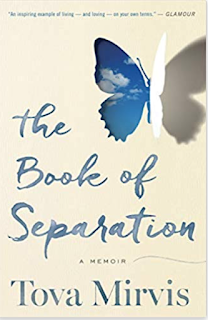
The Book of Separation by Tova Mirvis
When my dear friend Karen gave me Tova Mirvis’ memoir, The Book of Separation, I was quite pleased. I had read Mirvis’ novels, The Ladies Auxiliary and Visible City and thought she wrote with insight and passion. This memoir’s honesty is harrowing as she wrestles with leaving her marriage and her religion to veer from the path that generations of her family had followed. Finding one’s own way is a terrifying proposition for a person who has always lived within the strict religious and social strictures of Modern Jewish Orthodoxy.
Tova Mirvis grew up in an Orthodox home with her parents and two siblings in Memphis, Tennessee. Her youthful memories are warm and wistful when her days filled were filled with love and certainty. She grew up knowing who she was (or thought she was) and what her parents, the community and God expected of her. Every aspect of her life was influenced by the family’s local synagogue and she believed that God was watching her every move. As she grew older and more reflective and thought she might want to be a writer, she begins to question her belief in God and the multiple Talmudic rules regarding food, clothing, friends, transportation and relationships.
Nonetheless, she becomes engaged to her Orthodox husband just twelve weeks after meeting him at Columbia. The mandated rituals related to her marriage illuminate the second-class status of women and anger her. Yet she proceeds, while her husband-to-be never seems to consider deviating from the edicts that govern his life. They have three kids and except for a few small concessions, she obeys the rules. She wears the required wig and prescribed modest clothes, she keeps a Kosher home and observes the relevant rituals for each Holiday. Yet, it was becoming more difficult to adhere to the letter of the law. She and her husband constantly argue. Though Mirvis probably wanted to protect his privacy, the book would have been stronger if she had offered examples of their arguments.
Mirvis’ anger is most apparent when discussing the dictates governing sexual relationships even between married couples. After being told for years that desire is bad, once a woman is married she is considered impure. Sex is regulated by religious rules and women are required to visit the mikvah each month to be cleansed and inspected.
Being a writer made Mirvis’ path harder. She states, “You can’t create freely if you’re always aware of where the borders of permissibility lie.” She understood that her questioning would provoke anger and judgment, “I knew that in a highly codified world, the inner life posed a threat. I knew that these rabbis’ mission was to keep people in side the bounds of the laws. They didn’t believe there were other good or true ways to live, didn’t want their children of their students or their congregants to think that there was a legitimate choice to be made.”
Mirvis tells her readers early in her memoir that Tova means good. She is haunted by the possibility of not being good and therefore not being loved. “This, more than anything was the iron bar across the exit door – love was what tied you and kept you inside. Love, was what you risked losing if you wanted to choose for yourself.”
Mirvis’ ability to write in painstaking detail about the requirements of life on the “inside” is impressive. As angry as she becomes, her descriptions are not cruel and she does not condemn those who remain in the community and adhere to the regulations that chaffed against her consciousness. At the end of the memoir, Mirvis doesn’t leave Judaism, but she leaves the orthodox community. Her parents, her brother and her sister still love her. They have not shunned her. They have allowed her to find her way outside the community as they continue within. As her children age, her memoir will be a gift to them. They will read of her struggle and may even come to understand it. As she says to her son, “ You’re allowed to change, even when it’s painful. You’re allowed to decide who you want to be.”
