Recent Reviews
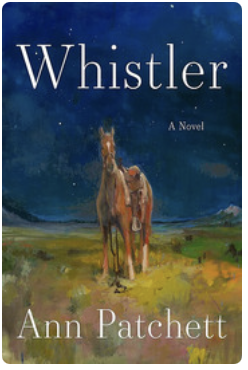
Whistler by Ann Patchett
Ann Patchett’s moving new novel Whistler is a tender meditation on connection, memory, and healing. Though divorce, grief, and trauma run through the story, the novel is uplifting, not bleak. Patchett writes with characteristic insight about childhood experiences, both remembered and buried, that quietly shape the adults we become. As in Commonwealth (2016) and The Dutch House (2019), the aftermath of divorce occupies the emotional center of the novel, and is also depicted with insight, humor, and grace.
A chance encounter at the Metropolitan Museum of Art in New York City reunites 53-year-old Daphne Fuller with her former stepfather, Eddie Triplett. Eddie was married only briefly to Daphne’s mother, and 40 years have passed since he and Daphne last saw one another. Still, his brief presence in her childhood left an indelible mark. Their interests aligned, their banter came easily, and Eddie’s warmth offered comfort to nine-year-old Daphne. She loved him. Together, they had survived a traumatic car accident that deepened their bond: it was Eddie’s kindness and courage in that dire moment that helped keep them alive as they waited to be rescued. Soon after the accident, Daphne’s mother divorced Eddie and contact between them ceased.
When Daphne and Eddie meet again in the novel’s opening chapter, the past returns with startling force. Daphne is overcome with emotion. Daphne says, “And with that I bowed my head and covered my face. I hadn’t known there was something in me to break, but there it was and break it did. I stepped into an open crack in time and fell backwards.”
Later, she realizes, “…somewhere deep inside myself, in a place inaccessible to me since I was nine, I had missed him every day of my life.”
As adults, Daphne and Eddie are given the rare chance to recover what time seemed to have taken from them. They spend long hours together retracing the paths their lives took in the decades apart and eventually speaking openly about the night of the accident. Through Daphne and Eddie, Patchett beautifully shows how certain people remain lodged in the heart and how love can endure beneath the surface of ordinary life. Whistler is a wistful novel illuminating that healing, even if delayed, is possible. 5/5
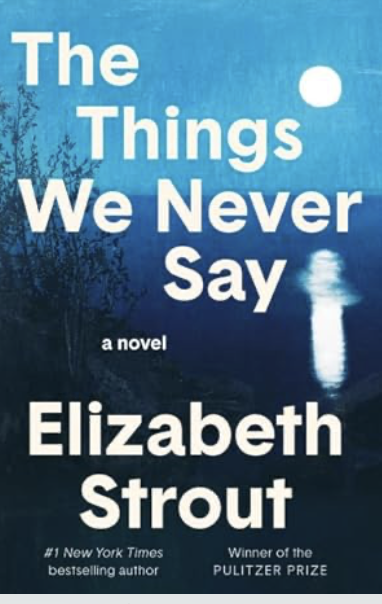
The Things We Never Say by Elizabeth Strout
Elizabeth Strout has written another gem. She has a remarkable ability to deeply probe the psyches of her characters while delivering a perceptive and absorbing read. In this novel, her 11th, she dives even deeper into that well.
Artie Dam, a beloved high school history teacher, is depressed. He feels alone and isolated—not because he lacks people to talk to or spend time with; he doesn’t. He is surrounded by people who love him: his wife of 30 years, his grown son, his fellow teachers, his students, and his friends. Rather, it is an internal angst that plagues him, leaving him with the sense that most thoughts are meant to remain solitary, not shared. The divisive divisions in this country don’t help.
When Artie learns a profound secret about his life, he must decide how to proceed with this knowledge. The revelation forces him to recognize that we don’t truly know ourselves—and sometimes not even the people closest to us. Toward the book’s ending, he thinks he might know why people never say the thoughts closest to their hearts. “Because to say anything real was to say things nobody wanted to know, or if they wanted to know, they would not care in the right way. Or even understand. It’s a private thing to be alive.”
Strout continues to explore the human condition with persistence and curiosity. Though the book is psychologically astute, its ethos is heavy and existential. Author Elizabeth Day’s blurb on the back sums up this novel beautifully: “Strout is a brilliant chronicler of the ambiguity and delicacy of the human condition.” Highly recommend. 5/5

The Correspondent by Virginia Evans
Virginia Evans’s novel The Correspondent radiates warmth, wisdom, insight, and humor. Structured as a collection of letters and emails, the narrative beautifully explores the inner world of a woman’s life while offering her unique perspective on the human experience. The book also celebrates the value and magic of the written word making this novel my favorite of 2025.
Each morning, 73-year-old Sybil Van Antwerp sits down to write letters, a daily ritual she has maintained for much of her life. Her correspondence includes neighbors, colleagues, authors, her brother, her children, her best friend, and one person to whom she writes without ever sending the letters. Expressing her thoughts and emotions through correspondence s becomes her way of connecting with others, while also maintaining distance. Sybil is divorced, a mother of two living children and a retired lawyer. Her personality is marked by stubbornness, sarcasm, and sassiness, yet she also possesses a strong sense of manners and decorum.
Self-sufficiency has long been her pride, but she is gradually losing her sight. Uncomfortable as it is, she finds herself needing help from other people. Ironically, as her vision narrows, her world broadens. This vulnerability seems to make her correspondence more revealing. She seems to be gaining deeper insights about herself and the people in her life. She writes to her daughter, “I know you think of me as your mother only, but please remember, inside, I am also just a girl.”
This period of change leads Sybil to seek forgiveness and to forgive those who have wronged her. She writes with increasing humility and grace. As the narrative unfolds, readers become acquainted with her family and associates, witnessing her steady personal growth. The novel ultimately celebrates the power of writing as a tool for self-discovery.
The Correspondent is an uplifting and perceptive book, offering readers a heartfelt celebration of emotional evolution and the enduring significance of the written word. Highly recommend. 5/5.
