Recent Reviews
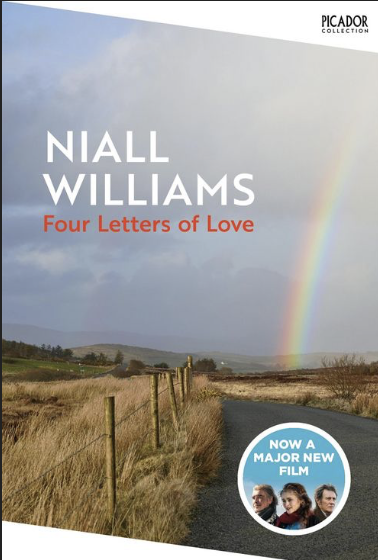
Four Letters of Love by Niall Williams
Four Letters of Love is a story about the mystical, often inexplicable ways people find their beloved. It’s hard to describe the beauty and grace of Niall Williams’ writing. His touch is light, his insights powerful, and each sentence overflows with lyricism. His reverence for the lush landscape of western Ireland and the people who dwell there can be felt in every line.
The book’s back cover states that Isabel Gore and Nicholas Coughlan are destined to be together. And though it’s frustrating that they don’t meet until the last third of the book, Williams seems intent on setting the stage first. In the early chapters, he reveals Isabel and Nicholas’ complicated backstories and the emotional forces that shaped them. These stories include childhood wounds, guilt and the complicated dynamics of each set of parents. Williams dissects and untangles those emotional strands with care and wisdom, adding context to their eventual meeting.
When Nicholas visits the island across the sea from Galway to seek a painting his father made, he falls hard for Isabel, and eventually she for him. Given their prior paths, the probability of their encounter is low, and their eventual meeting seems unlikely. To complicate matters, Isabel is already married. Yet out of the chaos and unpredictability of the world, Niall Williams suggests that sometimes blessings appear. Love’s path is not always straightforward, and Nicholas and Isabel’s connection takes time to take hold. The depth of their bond reveals itself most fully through Nicholas’ love letters.
Here is the short chapter in which he describes meeting Isabel for the first time.
“Some things do not bear telling. I think my father knew this. I think he knew how words can sometimes flatten the deepest emotions or pin them like wild butterflies stunned out of magnificent flight, flimsiest souvenirs of what moved and coloured air like silk. Better to image it. Imagine music playing, imagine light falling through the clouds into the morning street and the scent of the island following us as we walked to find the shop. Imagine there was nothing unlovely in the world, and that we walked as proof of miracles, our feet barely touching the path and smiles playing on our faces as the thousand birds sang in the sky. Imagine goodness floated from us into the city air and cars slowed to unwind windows and breathe the thick perfume that smelled like white candles and fresh linen. Imagine all the aches of the world had secretly mended, and music heralded the news, rising along allegro with notes like joy and laughter pealing as we opened the door. This is how I came to see Isabel Gore for the first time.”
Four Letter of Love is a gorgeous novel. Niall Williams pierces his characters’ hearts, reaches into their souls, and conveys their thoughts and feelings in beautiful, poetic prose. Highly recommend. 5/5
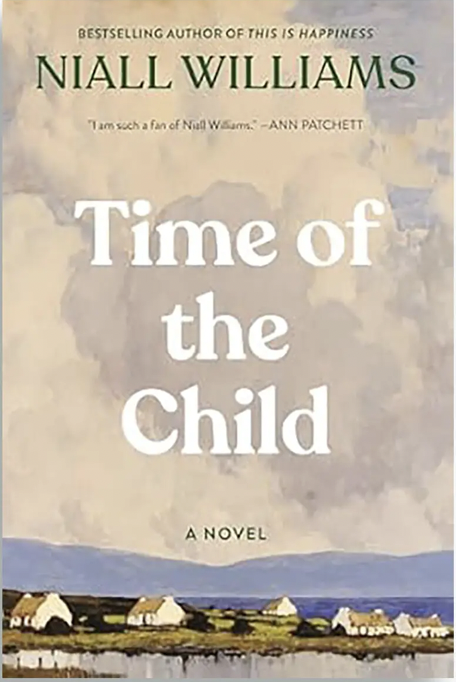
Time of the Child by Niall Williams
Tender and touching, Niall Williams’s Time of the Child is an inspired book for the holiday season. Like his extraordinary novel, This Is Happiness, this tale takes place in the fictitious village of Faha on the western coast of Ireland. Known for his gorgeous prose, Williams does not disappoint. He has written a heartwarming story about Faja’s transformation after an infant is left at the church.
Faha is a poor, rural and isolated community with an eclectic mix of personalities. Everyone knows everyone else’s business. The Catholic church is the beating heart of the village and the moral arbiter of human behavior. The story takes place during the Advent season of 1962. Jack Troy is a widower and village doctor. He lives with his spinster daughter Ronnie, who assists with his medical practice. When an abandoned baby is left in their care, their lives change dramatically. The intense love Jack and Ronnie feel for this infant them with a new sense of purpose. But they know that If the church authorities learn of the child, they will claim her. Jack and Ronnie wrestle with how to handle this situation with its moral and logistical complications.
William’s prose is dense and filled with profound insights into people’s limitations and strengths. Though the novel brims with the characters’ inner thoughts, I wish Williams had included more dialogue. Despite living in the same home, Jack Troy and his daughter Ronnie do not share their thoughts or feelings. It is as if there is a word limit in their home. And thus, they exist in the solitary musings of their own minds. But the miracle of this baby changes their dynamic for the better.
In these troubled times, reading about good but imperfect people is comforting. Williams has lifted up the lives of these villagers into a magical, almost mystical message about living and loving. Williams shows his readers the power of goodness and love in his beautiful novel Time of the Child. 4/5

This is Happiness by Niall Williams
This is Happiness by Niall Williams is a magnificent novel and a perfect book to read during this pandemic. Williams’s narrative transports us to a simpler and more tranquil time. He tenderly captures the lives of people living in the small village of Faha in western Ireland. The story takes place in the 1950s, just as the parish is going to receive electricity. William’s book is one of the most meaningful I’ve read this year. You can feel yourself on the western coast of Ireland looking up at the stars. “Faha was where, when darkness fell, it fell absolutely, and when you went outside the wind sometimes drew apart the clouds and you stood in the revelation of so many stars you could not credit the wonder and felt smaller in body as your soul felt enormous.”
The book is narrated by Noel (Noe) Crowe, an older man, as he recalls the year he lived with his grandparents in Faha. Noe was seventeen then, and he recollects the dramatic months when workers erected poles that would carry electricity to the village. One electric worker named Christy McMahon had lived with Noe and his grandparents while working on the electrification. Christy specifically sought this assignment in Faha. Five decades ago, he had left his bride, Annie Mooney, at the altar on the day they were to be married. Christy felt haunted by his abandonment and hoped Annie would forgive him. He told Noe that he had loved her, but he became afraid his love “would swallow me up.” So at sixty years old, Christy had returned to Faha time to right the mistake he made.
The time Christy and Noe spent had a profound effect on Noe’s understanding of people’s complexity. Christy had told the young Noe, “Some of the things you do when you’re young are unforgivable to you when you’re old.” And Noe concluded from watching Christy wrestle with his choice of fifty years ago that “an older person must accommodate the younger one inside them.”
In lyrical language, Williams describes the presence of music, the ubiquity of rain, and the various religious perspectives of the Faha villagers. He illuminates the power of storytelling to pass the time and dissolve the darkness, especially in the days before electricity. Quirky and earnest characters grace the pages. On one level, the book might be perceived as a tale with sparse action, and yet it is an intricate exploration of universal emotional themes. The book is nostalgic without being maudlin, insightful without being moralistic. This is Happiness is compassionate and profound. It is an ode to the miracle and mystery of being alive. The village of pre-electricity Faha no longer exists, but thanks to William’s beautiful prose and enchanting storytelling skills, this time and place and live on. 5/5
